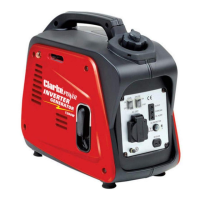
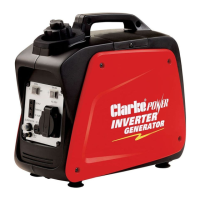
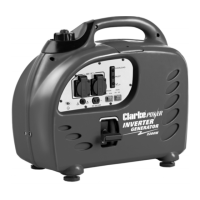
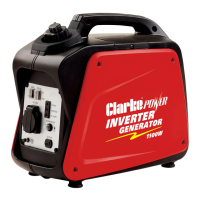
The Clarke 1100W Inverter Generator, Model No: IG1200B, is a portable power solution designed for various applications, from DIY tasks to light trade use, and even as an emergency standby power source. This generator is built to provide reliable electrical output, featuring a compact design with a carrying handle for easy portability.
Function Description:
The IG1200B is an inverter generator, meaning it produces clean, stable power suitable for sensitive electronic equipment. It converts DC power from the engine into AC power, then uses an inverter to convert it back to a stable AC output. This process ensures a consistent voltage and frequency, minimizing the risk of damage to connected devices. The generator is capable of supplying both 230V AC and 12V DC power, making it versatile for a range of electrical needs. It has a rated continuous output of 1000W and a maximum measured output of 1100W.
Usage Features:
- Starting the Engine: To start the generator, users must first ensure all connections are removed from the AC sockets. The air vent knob on the fuel tank cap needs to be turned to the 'open' position, and the fuel valve knob set to 'ON'. The engine ON/OFF switch is then set to 'ON'. For cold starts or if the generator has run out of fuel, the primer bulb should be pumped a minimum of 6 times to introduce fuel into the carburetter. The choke lever is moved to the 'Choke' position. The starting handle is then pulled firmly and sharply until the engine starts. Once started, the starting handle should be released slowly to prevent injury or damage. After the engine warms up, the choke lever is moved to the 'run' position.
- Economy Switch: This feature is designed to minimize fuel consumption and reduce noise levels when no load is applied to the generator. When the economy switch is 'ON', the engine speed varies with the load. When 'OFF', the smart throttle system does not operate. It's important to note that the economy control may not be effective for appliances requiring 'bursts' of power, and should be turned 'OFF' when connecting high-load appliances or using the DC output.
- Connecting Electrical Devices (AC Power): After starting the engine, ensure the appliance is turned off before connecting it to the generator's 230V AC socket. The maximum load for AC appliances should not exceed 1000W. Users are cautioned to ensure appliances are in good working order and to disconnect them if they act abnormally. Devices with inductive loads (e.g., motors) may require more current on startup.
- Connecting Electrical Devices (DC Power): For DC power, the economy control switch must be set to 'OFF'. After starting the generator, ensure the 12V appliance (max 4A) is turned off before connecting it.
- Topping Up Car Batteries (DC Power): The generator can be used to 'top up' car batteries, but not to charge completely flat ones, as this may blow the fuse. The economy control switch should be 'OFF', and the generator started. Battery charging leads are connected to the battery, ensuring the red wire goes to the positive (+) terminal and the black wire to the negative (-) terminal. The leads are then connected to the generator. The battery voltage should be monitored, and the battery disconnected when it reaches 14.4 volts. When disconnecting, the negative lead should always be disconnected first.
- Indicator Lights:
- Output Indicator (Green): Remains on during normal operation.
- Overload Indicator (Red): Lights up if there's an overload or short circuit. If this occurs, all electrical devices should be turned off, the engine stopped, and the total wattage of connected devices reduced to within the generator's rated output. Air inlets and the control unit should be checked for blockages. After checking, the engine can be restarted.
- Oil Alert Indicator (Red): Lights up when the oil level is low, indicating a need to add oil.
- DC Overload Protector: If the DC overload protector activates, users should wait a few minutes and then press the reset button.
- Shutting Down the Generator: For emergency stops, simply set the engine switch to 'OFF'. For a controlled shutdown, all electric devices should be disconnected, the economy control switch set to 'OFF', the fuel valve knob turned to 'OFF' (pointing left), and the air vent knob turned to the 'Close' position. Finally, the engine switch is set to 'OFF'.
Maintenance Features:
Regular maintenance is crucial for the longevity and safe operation of the generator.
- Engine Oil (Every 20 hours of use): The side maintenance panel is removed, and the oil filler cap is turned anti-clockwise and removed. The generator is then tilted to drain the old oil into a suitable container. Fresh SAE30 oil (0.35 litres maximum) is added, ensuring not to overfill or tilt the generator during this process. The oil filler cap and maintenance panel are then replaced. Users are warned about prolonged exposure to used engine oil and advised to wash hands thoroughly after handling. Used oil should be disposed of according to local regulations.
- Air Filter (Every 50 hours of use): The side maintenance panel and air filter cover screw are removed, and the air filter panel slid out. The air filter element is then removed. If the filter is dirty, it should be washed in a solution of warm water and mild detergent, rinsed thoroughly, and allowed to dry completely. Once dry, it should be immersed in clean engine oil, and excess oil squeezed out. Flammable solvents or petrol should never be used to clean the air filter. The filter is then replaced, and the covers secured.
- Spark Plug (Every 50 hours of use): The engine must be allowed to cool before removing the spark plug. The top maintenance panel is removed, and the spark plug cap is taken off. The supplied spark plug box spanner is used to remove the spark plug. Once removed, it should be checked for discoloration, and any carbon build-up removed with a wire brush. The spark plug gap (a) should be checked with a feeler gauge and adjusted to between 0.6 and 0.7 mm if necessary. The overall condition of the spark plug should be checked, and it replaced if damaged. The spark plug is then reinstalled, and the cap and top panel replaced.
- Fuel Tank Filter (Every 100 hours of use or every 6 months): The fuel tank filter, located inside the fuel tank, should be checked periodically for contaminants. The fuel tank cap is removed, and the filter lifted out. The filter is cleaned with solvent. If damaged, it should be replaced. The filter and fuel tank cap are then replaced.


 To Next Page
 General