17
Parts & Service: 020 8988 7400 / E-mail: Parts@clarkeinternational.com or Service@clarkeinternational.com
A good rule of thumb is, the smaller the hole or depth of cut, and the softer the
material to be machined etc, the faster the speed.
Please note that It is not within the scope of this manual to provide a tutorial
on cutting speeds or the methods used to determine spindle speeds (RPM), for
your particular application. It is assumed that the operator is familiar with these
practices.
MAINTENANCE
The amount of maintenance depends on the amount of use the machine
gets. However, it is important to carry out routine maintenance to prevent
premature wear and shortening the life of the machine.
1. Inspect and clean all non painted surfaces. Lubricate using a light
machine oil. Do Not over lubricate. Oil can be applied to the work table
and column etc., using a soft oil soaked cloth.
2. Inspect and clean all moving parts. Lubricate using machine oil. Check for
smooth operation.
3. Inspect the machine for signs of wear or damage. Any faults should be
rectified before continuing.
4. Check all nuts and bolts are tight.
SLIDE ADJUSTMENTS
With use, play may develop in the cross, longitudinal and the post slides. It is
possible to adjust these components in order to eradicate any unnecessary
movement.
Before making any adjustments, clean all friction surfaces. It is necessary to
move the table and cross slide to both extremes to carry out the cleaning
process correctly.
When finished cleaning, re-lubricate using a light machine oil.
Return both the table and cross slide to their central positions.
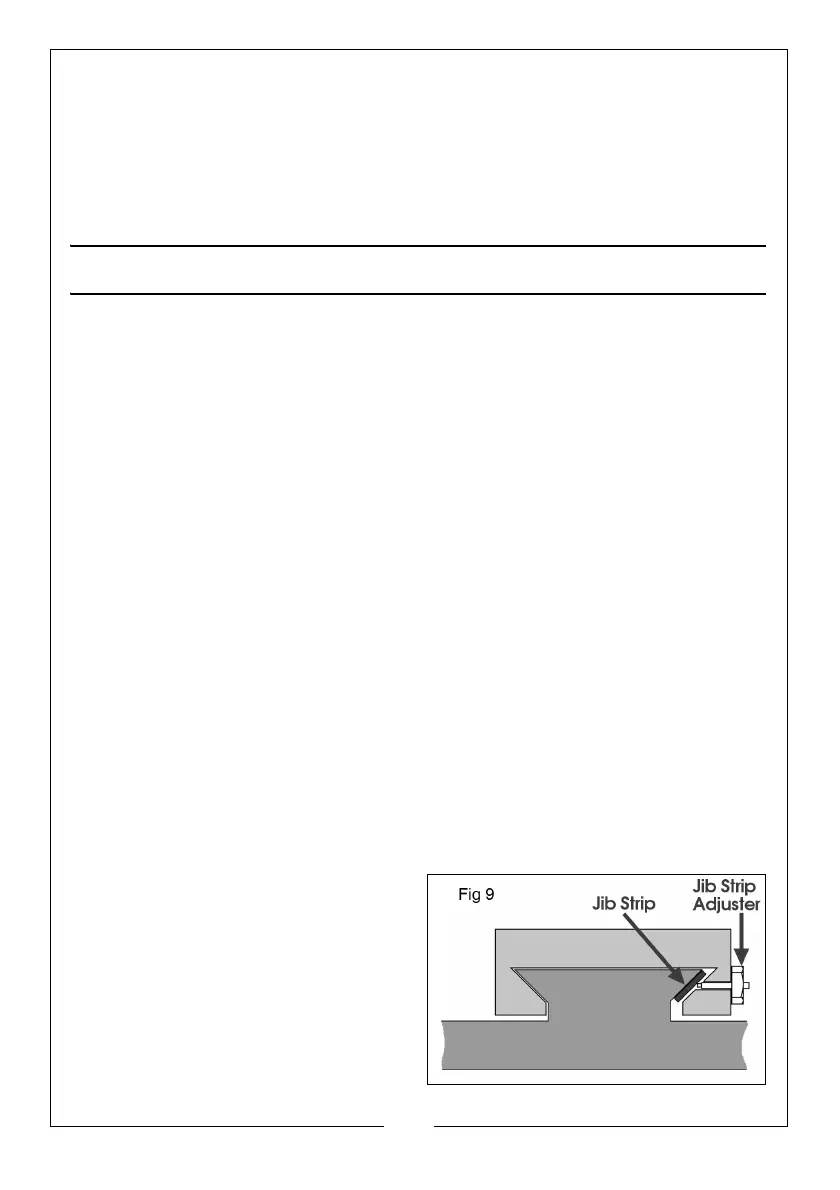
Adjustment is effected by means of
Jib Strips. These are precision
machined steel strips, positioned
between the mating surfaces as
shown in Fig.9. The strips are
adjustable so as to apply pressure on
these surfaces, sufficient for the parts
to slide easily about each other


 To Next Page