23
8 - MAINTENANCE
8.1 Generality
Maintenance must be carried out authorised after-sales
assistance centres or by specialised personnel.
Maintenance allows:
maintaining the unit efficient
reduce deterioration speed to which each equipment is
subject in time
collect information and data to understand the efficiency
state of the unit and prevent possible faults
Frequency of the inspections must be at least six-monthly
However, frequency depends on the type of use.
heavy (continuous or highly intermittent, near to operation
limits, etc.)
critical (essential service).
8.2 Frequency of interventions
8.3 Machine schedule
Foresee a machine schedule to keep trace of the
interventions made on the unit.
In this way, it will be easier to adequately schedule the various
interventions and facilitate any troubleshooting.
On the schedule note:
date
type of intervention made
description of intervention
measurements taken, etc. .
If foreseen a long period of inactivity:
disconnect voltage to avoid electric risks or damages
following lightning
prevent the risk of freezing (empty or glycol the sections of
the system exposed to negative temperatures, keep any
antifreeze heaters powered)
It is advised that start-up after a period of inactivity be carried
out by a qualified technician, in particular after seasonal stops
or for seasonal switch-over.
Upon start-up, follow that indicated in the START-UP section.
Plan in advance the technician intervention to prevent
misunderstandings and be able to use the system when
required
8.4 Stand-by
8.5 DAMPERS
Extruded aluminium with nylon gears.
This type of damper does not require lubrication, but simply
normal cleaning, as there are no parts subject to oxidation.
8.6 FILTERS
The pressure drop values increase in proportion to the storage
of dust.
The filter must be cleaned or replaced at regular intervals,
depending on the concentration of dust in the air.
If the unit is fitted with the differential pressure gauge for the
audible or visual signalling of pressure drops, the operation is
simplified, otherwise it must be performed according to
experience, establishing the maintenance times on a case-by-
case basis.
A series of filter cells should be kept on hand, to avoid
extended unit down time, or worse still operation without filters.
8.7 CELL PRE-FILTERS
Pre-filter cells are installed in the unit on U guides, with sliding
movement.
These are inserted and removed manually, using a hook where
required. The U guides must be clean and the cells inserted
correctly side-by-side, to avoid the problem of air by-pass.
CELLS MADE FROM REGENERABLE SYNTHETIC
MATERIAL
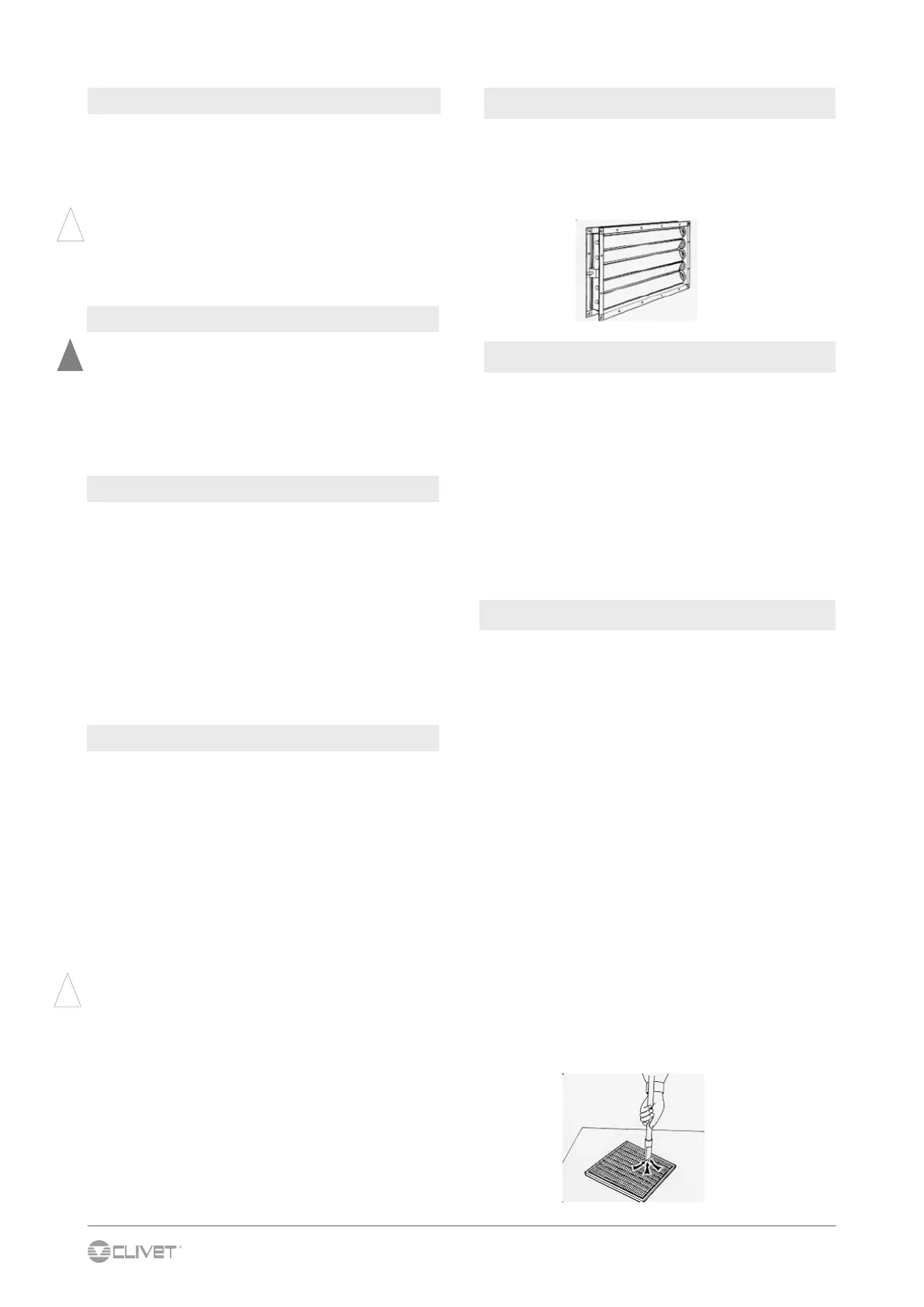
Clean:
by simply shaking;
using a vacuum cleaner, making sure to operate the
vacuum cleaner in the opposite direction to the flow of air
through the filter;
using drinking water, again in the opposite direction to the
air flow;
If no pressure gauge or pressure switch is fitted, the layer of
filtering material or the cells must be replaced according to the
judgement of the maintenance technician.
METAL CELLS
Clean with warm water and detergent, or alternatively by
immersing in caustic soda, and oil with mineral oil.


 To Next Page
 Loading...