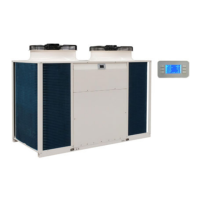
The CLIVET WSAN-XSC3 MF 90.4 - 240.4 is a multifunction heat pump designed for outdoor installation, capable of providing both hot and chilled water simultaneously. This advanced system aims to deliver maximum comfort, high reliability, efficiency, quality, and safety while reducing energy consumption and installation/maintenance costs over its life cycle.
Function Description:
The unit's primary function is to provide cooling and heating for water or a water and glycol mix. It is designed to operate within the technical limits specified in the manual. The system can be configured for either 2-pipe or 4-pipe systems, offering flexibility in application. In 4-pipe configurations, it supports cooling, cooling with partial recovery, cooling with full recovery, heating, and heating with recovery. A desuperheater mode is also available, which, at part load, modulates water flow on the hot side to maintain the target supply temperature, extending exchanger operation time and improving unit efficiency by 5% compared to when desuperheater mode is inactive.
The unit features a comprehensive control system accessible via a service keypad or a connected PC. This allows for monitoring and adjustment of various parameters, including setpoints, demand limits, and climatic text corrections. It supports master-slave configurations for multiple units in a local network, with different operating modes (A, B, C) to manage compressors and optimize refrigeration circuits. Mode A allows each unit to manage its own compressors, while Modes B and C designate a master unit to manage cooling for the entire system, optimizing individual refrigerant circuits and pump operations.
Important Technical Specifications:
The WSAN-XSC3 MF series covers sizes from 90.4 to 240.4.
- Compressor Type: Scroll compressors.
- Refrigerant: R-410A.
- Number of Compressors: 4 per unit for sizes 90.4-120.4, 4-10 for larger sizes.
- Rated Power (C1/C2): Ranges from 45 HP to 120 HP.
- Refrigerant Charge (C1/C2): Varies from 47 kg to 95 kg depending on the unit size.
- Refrigeration Circuits: 2 per unit.
- Internal Exchanger: Plate exchangers for both cold user side and hot user side.
- Exchanger Water Content: Cold user side ranges from 22 L to 62 L; hot user side ranges from 14.4 L to 54.0 L.
- Minimum System Water Content: Ranges from 1667 L to 5320 L, with outdoor air low temperature applications or low/medium requested loads requiring double the indicated value.
- External Section Fans: Axial fans (AX type).
- Number of Fans: 6 to 10 depending on unit size.
- Standard Airflow: Ranges from 30588 l/s to 60489 l/s.
- Water Fittings: 4" or 5" connections for both cold user side and hot user side.
- Standard Power Supply: 400/3~/50 V.
- FLA Total: Ranges from 205.2 A to 497.3 A.
- FLI Total: Ranges from 117.7 kW to 299.2 kW.
- M.I.C. Value (Max. Unit Starting Current): Ranges from 455.6 A to 767.0 A, with soft start accessory reducing it to 317.8 A to 767.0 A.
- Sound Power Level: Ranges from 86 dB(A) to 95 dB(A) for compressor soundproofing (SC) and 86 dB(A) to 90 dB(A) for super-silenced (EN) configurations. Sound pressure level at 1m ranges from 66 dB(A) to 75 dB(A) (SC) and 66 dB(A) to 70 dB(A) (EN).
- Operating Range (Cooling): External air temperature (DB) from -10°C to 46°C, external exchanger outlet water temperature from 5°C to 20°C.
- Operating Range (Heating): External air temperature (DB) from -15°C to 20°C, external exchanger inlet air temperature from 20°C to 55°C.
- Admissible Water Flow-rates: Qmin for cold user side ranges from 7.4 l/s to 16.4 l/s, Qmax from 20.0 l/s to 44.0 l/s. For hot user side, Qmin ranges from 8.5 l/s to 19.8 l/s, Qmax from 22.7 l/s to 51.4 l/s.
- Overload and Control Device Calibrations: High pressure safety pressure switch (open 4050 kPa, closed 3300 kPa), antifreeze protection (3°C open, 5.5°C closed), high pressure safety valve (4500 kPa), low pressure safety valve (2950 kPa), max no. of compressor starts per hour (10), high compressor discharge temperature safety thermostat (140°C).
- Exchanger Operating Range (PED CE): DPr (refrigerant side) 4500 kPa, DPw (water side) 4500 kPa (internal exchanger) and 1000 kPa (recovery exchanger).
Usage Features:
The unit is designed for outdoor installation in fixed positions. Proper positioning is crucial, requiring technical spaces for air intake/exhaust, electrical and water connections, and adherence to local regulations. Anti-vibration devices and flexible joints on hydraulic connections are recommended to limit vibration transmission. The unit should be installed raised from the ground and protected by a suitable fence to prevent unauthorized access. Correct air circulation is mandatory for optimal operation, avoiding obstacles, heat/pollution sources, stratification, and recirculation.
The control system offers various functionalities, including setting up a scheduler for daily events (Off, Eco, On, Recirculating) and enabling/disabling the scheduler. Users can monitor general status, circuit status, source status, and user-side status, including pump commands, inverter commands, and various temperatures and pressures. Remote control options are available via KNX bus, Modbus-RS485, LonWorks, and BACnet IP, allowing for integration into building management systems.
Maintenance Features:
Regular maintenance is essential to maintain unit efficiency and extend its lifespan. Inspections should be performed at least every 6 months, with more frequent checks recommended for continuous or intermittent use. Key maintenance tasks include:
- Corrosion Check: Inspect for presence of corrosion.
- Fixing Checks: Verify panel and fan fixings.
- Coil Cleaning: Clean air coils to ensure maximum thermal exchange, using an air pressure gun or vacuum cleaner.
- Water Filter Cleaning: Check and clean the water filter (1.6 mm mesh pitch) at the unit's water input.
- Water Quality Check: Verify water quality, pH, and glycol weight.
- Exchanger Efficiency Check: Periodically check the temperature difference between supply water and condensation temperature; if it exceeds 8°C-10°C, clean the exchanger using circulation opposite to the usual one, with appropriate acidic products, followed by rinsing.
- Circulating Pumps Check: Inspect for leaks, bearing status (abnormal noise/vibration), and proper closure of terminal protection covers.
- Insulation Check: Verify insulation condition and renew seals if necessary.
- Flow Switch Check: Control operations and remove incrustations from the palette.
- Electrical Checks: Inspect power lead fixing and insulation, earthing cable, electric panel, capacity contactor status, voltage and phase unbalancing, and individual electrical load absorptions.
- Refrigerant Circuit Check: Survey operating parameters and check for leaks.
- Safety Device Tests: Test pressure switches, thermostats, and flow switches.
- Control System Tests: Verify setpoints, climatic compensations, capacity stepping, water/air flow-rate variations, alarm signaling, thermometers, probes, and pressure gauges.
- Compressor Crankcase Heaters Test: Ensure heaters are working, especially before initial start-up or after prolonged inactivity.
- System Discharge: In cases of long non-use or freezing risk, the system can be emptied, or water can be mixed with glycol. Any anti-freeze liquid must be collected and reused as it is a pollutant.
- Component Replacement: Instructions are provided for pump, compressor, and exchanger replacement.
A unit booklet is recommended to record all interventions for easier troubleshooting. Before any maintenance, the unit must be isolated from the electrical supply, locked, and tagged with a safety sign, and residual stresses checked with a multimeter. All electrical operations must be performed by trained personnel in compliance with safety regulations.

 Need help?



 To Next Page
 General