
 Need help?
Do you have a question about the Coastal Amusements Jacks Hi and is the answer not in the manual?
Procedure for receiving the machine, unpacking, and initial placement considerations.
Guidelines for connecting the machine to the mains power supply via a suitable plug and inlet.
Details on the location of the electrical supply connection and the main supply circuit breaker.
Steps to connect power, start the machine, and initiate the first game play.
Instructions for accessing different parts of the machine, including the playfield, cabinets, and top sign.
Explanation of the machine's attract mode and active play mode, including coin acceptance.
Recommended procedure for initial coin loading to set up the playfield appearance.
Guidelines for cleaning and maintaining the machine's surfaces and components for longevity.
Details on mains supply circuit breakers, motor fuses, and power supply unit circuit breakers.
Description of the logic board, its components, and switch settings for game configuration.
Information on the sound board, its DIP switch settings, and loudspeaker specifications.
Explanation of the hopper mechanism, coin counting, and processing, including safety warnings.
Details on the power supply units (PSU) and dichroic lighting transformers, including safety warnings.
Description of the feature interface board's role in driving lamps, reels, and bonus channels.
Instructions for accessing and removing the reel mechanism and its components.
Details on the coin entry sensors, their operation, and lockout conditions.
Explanation of the dual beam opto sensors and their connection to the logic board for coin detection.
Information on electro-mechanical counters for tracking game activity and data port access.
Description of the tilt board, its inputs, alarm activation, and lighting control.
Details on the alarm board, its sounder, and its role in tilt and motor jam alerts.
Explanation of the opto-electronic system for monitoring motor load and preventing jams.
Information on the optional swipe card interface, change board, and its functions.
Information on fluorescent lighting in top signs and coin entry areas, and dichroic spot lamps.
Maintenance instructions for pusher boxes, including lubrication and coin scraper system checks.
General approach to troubleshooting, including initial checks and wiring inspection.
Steps for investigating faults affecting multiple machine sections, focusing on power supply.
A guide to diagnosing and resolving common symptoms like no start, no sound, or light failures.
A list of frequently needed spare parts with corresponding Harry Levy stock numbers.
A high-level overview of the machine's electrical system components and their interconnections.
Diagram illustrating the mains power input wiring and distribution within the machine.
Wiring diagram detailing connections for the tilt board and motor control board.
Wiring diagram showing the connections to and from the main logic board.
Wiring diagram for the feature PCB, including reel unit and playfield lamps.
Wiring diagram for tilt signals, sound board, and motor control board connections.
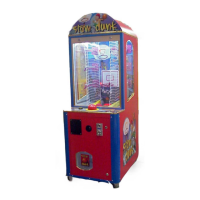
The Jacks Hi is a robust and reliable amusement machine designed for profitable service, featuring a coin-operated game with a pusher box mechanism and reel display. The machine is intended for indoor use and requires a flat, level floor for installation.
The core function of the Jacks Hi machine is to provide an interactive coin-operated game experience. Players insert coins into designated chutes, activating a player section for approximately 20 seconds. During this active play mode, the machine's lighting and pusher box mechanism operate, and the reel mechanism may rotate to create visual interest. The objective of the game involves coins falling over an edge, triggering a hopper that counts them. The machine incorporates a logic board with a micro-controller (PIC) and non-volatile RAM, managing game operations, interfacing electronics, and an RS232 data port for data retrieval.
The machine's electrical system includes circuit breakers for protection, a motor fuse for the motor control circuitry, and power supply units (PSUs) with integrated circuit breakers for low voltage circuits. A feature interface board drives the 'card' lamps on the pin perspex and top sign, controls the reel mechanism, and incorporates 'flag-opto' switches for bonus channels, communicating with the main logic board via a serial link.
The reel mechanism, located behind the pin perspex, displays three illuminated graphics. The motor control system uses an opto-electronic method to monitor motor load and stop the motor in case of a jam or restriction. This system detects interruptions in an infrared beam caused by a hole in the rotating motor shaft, generating pulses that are monitored by the motor control PCB. If the pulse rate decreases below a tolerated threshold, the motor supply is cut off via a solid-state relay.
The machine also features electro-mechanical counters in each player section to record coin-in, feature awarded coins out, and coins over the edge/tickets issued. These readings can also be accessed electronically via the RS232 data port. A tilt board, located in the top sign, incorporates a pendulum tilt device and slam tilt switches on the lower compartment doors. Activation of these inputs triggers an audible alarm and switches off the lighting in the top signs, indicating tampering. An alarm board, situated in the No.1 top sign, drives a sounder for tilt and motor jam alarms.
An optional swipe change facility can be integrated, which includes a change board and interface relay. This system provides a pulsed input, an inhibit relay output, and controls the payout hopper.
 General
| Manufacturer | Coastal Amusements |
|---|---|
| Category | Arcade Game Machines |
| Players | 1 |
| Monitor | LCD |
| Bill Acceptor | Optional |
| Type | Crane |
| Power Requirements | 110V |
| Display | Yes |


 To Next Page