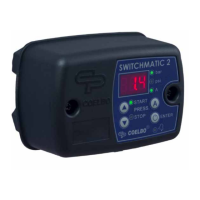
The SWITCHMATIC 2T is an electronic pressure switch with an integrated digital manometer, designed to manage the start and stop of a three-phase pump up to 4kW (5.5 HP). It offers easy adjustment of cut-in and cut-out pressures via its user-friendly control panel. The wiring for this device is analogous to traditional electromechanical switches.
Function Description:
The SWITCHMATIC 2T operates as both a differential pressure switch and a reverse pressure switch. Beyond the basic functionalities of a SWITCHMATIC device, it provides instantaneous readings of the current drawn by the pump. This patented system enables comprehensive control and management of overcurrent, dry-run operation, and fast-cycling.
For more complex setups, the SWITCHMATIC 2T can be synchronized with another SWITCHMATIC 2T unit to manage and protect two pumps operating in a cascade with an alternated starting sequence.
Important Technical Specifications:
- Rated Motor Power: 4.4kW (5.5HP)
- Power Supply: ~3 x 230-400 Vac
- Electric Outlet: ~3 x 230-400 Vac
- Maximum Pressure: 1.2 MPa
- Frequency: 50/60Hz
- Maximum Current: 10 A
- Protection Degree: IP55
- Maximum Water Temperature: 40°C
- Maximum Environment Temperature: 50°C
- Maximum Relative Humidity: 80% (31°C) - 50% (40°C)
- Cut-in Range (Start Pressure): 0.5 ÷ 11.5 bar
- Cut-out Range (Stop Pressure): 1 ÷ 12 bar
- Maximum Differential (Pstop-Pstart): 11.5 bar
- Minimum Differential (Pstop-Pstart): 0.5 bar
- Factory Setting (Start/Stop): 3/4 bar
- Hydraulic Inlet: G1/4" Female - Rotative nut
- Net Weight (without cables): 0.654 kg
Usage Features:
The device offers a wide range of adjustable operating characteristics:
- Adjustable Cut-in and Cut-out Pressures: Easily set via the control panel.
- Integrated Digital Pressure Gauge: Displays pressure in both bar and psi.
- Inner Pressure Transmitter: Provides accurate pressure readings.
- Dry-run Protection: Monitors instantaneous current consumption to detect dry-run conditions.
- Overload Protection: Safeguards the pump from excessive current draw.
- Overvoltage and Undervoltage Protection: Protects the device and pump from electrical fluctuations.
- ART Function (Automatic Reset Test): If the pump stops due to dry-running, the ART function attempts to restart the pump on a scheduled basis to restore water supply. This feature must be activated in step 5 of the ADVANCED MENU (Ar1).
- Fast Cycling Alarm: Activated when the hydropneumatic tank loses too much air, leading to frequent start-stop cycles. This alarm delays the pump's start to prevent damage.
- Manual Start Push-button (ENTER): Allows for manual pump activation.
- Control Panel: Features a 3-digit display, LED indicator lights, and push-buttons for intuitive operation.
- Operation Modes: Supports differential, reverse, and synchronized modes.
- Stand-by Mode: For low power consumption.
- Minimum Period Between Fast Cycles: Configurable to prevent rapid cycling.
- Start and Stop Delay: Adjustable delays for pump operation.
Advanced Settings:
The SWITCHMATIC 2T offers advanced configuration options accessible through the ADVANCED MENU:
- Operation Mode Selection: Choose between conventional pressure switch (normally closed) or reverse (normally open) operation.
- Individual or Master/Slave Mode: For single pump setups or synchronized dual-pump systems.
- Minimum Gap Setting: Adjusts the minimum pressure difference between Pstart 1 and Pstart 2, and Pstop 1 and Pstop 2 in synchronized mode.
- Start and Stop Time Delays: Configurable delays from 0 to 9 seconds.
- ART System Activation: Enable or disable the automatic restore system.
- Minimum Operating Pressure: Set a threshold below which the device determines dry-running operation.
- Dry-running Operation Time Period: Define the duration (5 to 99 seconds) below the minimum operating pressure that triggers a dry-running alarm.
- Overcurrent Protection Percentage: Set the percentage of nominal current above which the overcurrent protection activates.
- Default Values Restoration: Option to restore factory settings.
Warnings and Alarms:
The device provides clear indications for various operational issues:
- Dry-running Alarm (A01): Stops the pump automatically. Can be manually restored or automatically attempted via ART.
- Dry-running by Minimum Pressure (A11): Activated if pressure falls below a set minimum for a defined period. Restores automatically or manually.
- Overload Alarm (A02): Activated when nominal pump current is exceeded. Includes 4 automatic reset attempts.
- Fast Cycling Alarm (A04): Activated after 3 consecutive cycles within a short period. Can stop the pump (rc2) or add a start delay (rc1).
- Damaged Pressure Transmitter (A05): Requires contact with the supplier.
- Overvoltage Alarm (A08): Activated when power supply voltage is exceeded. Includes 4 automatic reset attempts.
- Undervoltage Alarm (A09): Activated when power supply voltage is below the minimum. Includes 4 automatic reset attempts.
Maintenance Features:
- Pressure Sensor Calibration: Allows for recalibration of the pressure sensor if readings are inaccurate. This involves a zero regulation process (disconnecting the device, opening taps, and setting to 0.0) and a full-scale adjustment (starting the pump, adjusting pressure with push-buttons, and validating). Frequent recalibration is not expected and may indicate a need for technical service.
Installation Guidelines:
- Hydraulic Installation: The SWITCHMATIC 2T must be threaded to a G1/4" male fitting at the pump's outlet. Ensure the hydraulic system is properly installed and pressurized before connection.
- Electrical Connection: Must be performed by qualified personnel in compliance with local regulations. Use a differential switch with high sensitivity (I = 30 mA, class A or AC) and a magnetothermic switch adapted to the motor load. Verify power supply is between 230-400V. Use H07RN-F 4G1 or 4G1.5 cables with adequate section. Ensure proper connection of pump (U, V, W) and power supply (L1, L2, L3). Earth conductors connections are compulsory and must be longer than others for safety.
Safety Precautions:
- Risk of damaging pressure assemblies and/or the plant.
- Risk of electric shock.
- Risk for people and/or objects.

 Need help?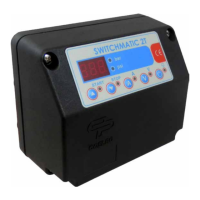

 To Next Page
 General