7
Example: _ 400 mm focal length (tube)__
10mm focal length (eyepiece)
EYEPIECE POWER_
K10 40x
K25 16x
When you are looking at astronomical objects, you are looking through a column of air that
reaches to the edge of space, and that column of air seldom stays still. Similarly, when
viewing over land (terrestrial viewing), you are often looking through heat waves radiating from
the ground, homes, buildings, etc. Your telescope may be able to provide very high
magnifications, but you often end up magnifying all the turbulence between the telescope and
the object you wish to view. The level of magnification required depends on the object
Optimal performance is obtained if the magnification is typically not more than about 30x for
every 10mm of objective lens diameter. Another good rule of thumb is that the usable
magnification of a telescope is about 3x per mm of the aperture (for the AT70, the aperture is
70mm) under good conditions. Thus, magnification of around 210x or less is ideal for a
telescope with a 70mm diameter objective lens (aperture) and is best for observing most
celestial objects. A lower magnification power and a wider field of view are advisable for
observing galaxies and nebulae. The highest magnification power should be used for highly
detailed observations of the moon, Jupiter, Saturn, or any object that is quite bright.
D. ABOUT YOUR REFRACTOR TELESCOPE:
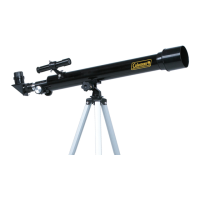
Your telescope has a refractor type optical design. It uses lenses to gather and focus light. The
combination of the front objective lens and eyepiece gathers more light than the human eye is
able to collect on its own, focus it, and present the viewer with a brighter, clearer, and
magnified virtual image. Light enters the open end of the telescope tube. The objective lens
refracts or bends the light. This refraction causes parallel light rays to converge at a focal
point, while those not parallel converge upon a focal plane. This results in a focused image
which is enlarged for viewing through the eyepiece.
The primary front objective lens is a precision ground and polished component that is precisely
positioned at one end of the optical tube, and is pre-aligned for maximum performance at the
factory and should not need any adjustment. Therefore, never tamper with or remove the
lens at this end of the optical tube. Doing so will void your warranty and affect or
damage the performance of your telescope.
TECHNICAL SPECIFICATIONS:
Objective Lens Diameter: 70mm (2.75”) Focal Length: 400mm
Maxumum Magnification: 40x Eyepieces: K10mm, K25mm
Accessories: Erecting Diagonal Prism, 5x24 Finderscope, Astronomy CD, Carrying Case
= 40X magnification power


 To Next Page
 Loading...