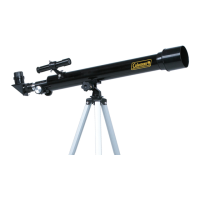
This document is the instruction and owner's manual for the Coleman AT70 Telescope. It provides detailed information on assembly, usage, technical specifications, and maintenance of the telescope.
The Coleman AT70 Telescope is a precision-crafted optical instrument designed for both beginner and advanced stargazers, as well as for terrestrial (land) viewing. Its primary function is to magnify distant objects, allowing users to observe celestial bodies like the moon, planets, galaxies, star clusters, and nebulae, as well as terrestrial landscapes and animals from a distance. The telescope is a refractor type, meaning it uses lenses to gather and focus light, providing a brighter, clearer, and magnified virtual image.
Important Technical Specifications:
- Objective Lens Diameter: 70mm (2.75 inches)
- Focal Length: 400mm
- Maximum Magnification: 40x
- Eyepieces Included: K10mm (providing 40x magnification) and K25mm (providing 16x magnification)
- Optical Design: Refractor type, utilizing a front objective lens and eyepieces to collect and focus light.
- Finderscope: 5x24, used for initial object location due to the main telescope's narrow field of view.
- Accessories: Erecting Diagonal Prism, 5x24 Finderscope, Astronomy CD (Astrowatch Software), and a Padded Carrying Case.
Usage Features:
- Assembly: The manual provides step-by-step instructions for assembling the telescope, including attaching the optical tube to the tripod, inserting the erecting diagonal prism and eyepiece, and mounting the finderscope. Users are cautioned not to overtighten screws during assembly.
- Finderscope Alignment: Before use, the finderscope must be aligned with the main telescope tube to ensure both are pointing at the same object. This is done by selecting a stationary object at least 200-300 feet away during daylight, centering it in the main telescope's view, and then adjusting the finderscope until the object is centered in its crosshairs. Objects in the finderscope appear upside down, which is normal for astronomical telescopes.
- Magnification: The magnification power is determined by dividing the telescope's focal length (400mm) by the eyepiece's focal length. The K10mm eyepiece provides 40x magnification, and the K25mm eyepiece provides 16x magnification. The manual advises that optimal performance is typically achieved with magnification not exceeding 30x for every 10mm of objective lens diameter, or about 3x per mm of aperture (e.g., around 210x for the AT70). Lower magnification is recommended for wider fields of view, especially for galaxies and nebulae, while higher magnification is suitable for bright, detailed objects like the moon, Jupiter, and Saturn.
- Viewing Conditions: It is recommended to use the telescope outdoors or through open windows to avoid distortions from glass reflections or air currents. Allowing the telescope to adjust to the outside temperature (up to 30 minutes for extreme differences) improves performance. Viewing in locations away from city lights is also advised to reduce sky glow interference.
- Starting Observations: Begin viewing sessions with the K25 eyepiece for the widest angle and brightest views.
- Terrestrial Viewing: The Coleman AT70 includes an erecting diagonal prism (4) to correct the inverted image typically seen through standard telescopes, ensuring objects appear in their proper orientation for land observation. The eyepieces must always be used with the erecting diagonal prism for correct orientation.
- Astronomical Observations: The manual suggests starting with prominent objects like the Moon, which is best viewed when less than half full to observe crater and mountain details along the terminator line. For planets, users are advised to consult the included Astrowatch Software CD or astronomy magazines for visibility information. Descriptions of Venus (phases, bright light), Mars (red color, varying brightness), Jupiter (moons, cloud belts), and Saturn (rings, pale yellow color, Cassini division) are provided. It also mentions Uranus and Neptune as rewarding, though less spectacular, targets. The manual encourages exploring galaxies, nebulae, and star clusters beyond the solar system.
- Astrowatch Software CD: The included "TheSkyX First Light Edition" software is an ideal companion, offering an intuitive interface to explore the night sky, identify celestial objects, create observing lists, print finder charts, and view animated tours of astronomical phenomena. It also includes a digital user guide with helpful tips and in-depth descriptions.
Maintenance Features:
- Care of Optics: The optical components will accumulate dirt over time, but significant accumulation is needed to compromise viewing.
- Dust Collection: Keeping dust caps on during storage and transport helps reduce dust collection.
- Condensation: If moisture collects on optical surfaces (e.g., after bringing the telescope indoors), remove dust caps and allow it to evaporate naturally. Point the telescope downward to minimize airborne dust collection. Replace caps once dry.
- Dust Removal: Filtered, compressed air can be used to remove surface dust from lenses and mirrors. Users are warned not to hold the trigger of the compressed air can for extended periods, as propellant may escape and damage optical surfaces.
- Cleaning: Eyepieces and optical surfaces should only be cleaned with special lens paper. Avoid touching optical surfaces.
- Professional Cleaning: If particles cannot be removed after several attempts, professional optical cleaning is recommended.
- General Advice: Minimal optical maintenance is typically required if dust caps are kept on and lenses/mirrors are not handled. Extensive cleaning is usually only necessary every few years.
Safety Warning:
- DO NOT VIEW THE SUN THROUGH A TELESCOPE! SERIOUS INJURY TO THE EYES MAY OCCUR.
- For use by an adult or under the supervision of an adult.
- CHOKING HAZARD: Small parts. Not suitable for children under 3 years.
The manual also includes contact information for customer service regarding inquiries, parts, warranty, or service.

 Need help?

 To Next Page
 General