RICERCA GUASTI
Qualora si riscontrasse un qualsiasi
mal funzionamento dell'impianto ese-
guire quanto segue:
• assicurarsi della presenza della ten-
sione di rete ai trasformatori e verifi-
care che il suo valore non sia supe-
riore o inferiore al 10% del nominale;
• verificare per la parte audio, la pre-
senza della tensione di alimentazione
12V AC ai morsetti 0~ 12~ del portie-
re audio, la tensione fonica 7V DC ai
morsetti 4 (-) F (+), la tensione di 9V
DC (presente alla chiamata) ai mor-
setti 4 (+) C (-);
• verificare per la parte video, la pre-
senza delle tensioni in uscita per la
telecamera e i monitor dopo aver
eseguito una chiamata.
Le tensioni sono segnalate nella cen-
trale art. 4856 rispettivamente da un
led verde e un led rosso.
• verificare che non siano state esegui-
te modifiche all'impianto. In caso con-
trario accertarsi che siano compatibili
con il funzionamento dell'impianto
stesso.
POSSIBILI GUASTI PER
TUTTI I TIPI DI IMPIANTI
PARTE AUDIO
Difetto /
Probabile guasto
e relativo rimedio
• L'audio di un monitor è scadente al
posto esterno /
Il microtelefono inte-
ressato è guasto. Sostituirlo.
• L'audio di tutti i monitor è scadente al
posto esterno /
Il volume esterno del
portiere è regolato ad un livello trop-
po basso. • Il modulo audio-video è
difettoso.
Sostituirlo.
• La ricezione audio di un monitor è
scadente /
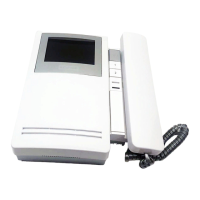
Il microtelefono del moni-
tor interessato è guasto. Sostituirlo.
• Il portiere audio fischia / Diminuire
leggermente il volume esterno del
portiere contrassegnato dal simbolo
dell'altoparlante.
• Il citofono di un monitor non funziona
/
Il conduttore al morsetto S è inter-
rotto. Spostare il conduttore S su un
altro pulsante del modulo di chiama-
ta. • Il microtelefono è guasto.
Sostituirlo.
• L'audio è disturbato da un rumore di
fondo a 50 Hz /
I conduttori dell'im-
pianto sono stati incanalati per un
lungo tratto assieme a conduttori che
alimentano carichi di elevata poten-
za.
TROUBLESHOOTING
Should any problem occur with opera-
tion of the system, follow the instruc-
tions below:
• check the presence of mains voltage
to the transformers and make sure
this is within 10% of the rated volta-
ge;
• for the audio part check the presen-
ce of 12V AC voltage power supply
to terminals 0~ 12~ of the speaker
unit module, 7V DC audio voltage to
terminals 4 (-) F (+), 9V DC voltage
(present when a call is effected) to
terminals 4 (+) C (-);
• check the video part, and the pre-
sence of output voltages for the TV
camera and monitors after making a
call. The voltages are indicated in
central power supply art. 4856 by a
green LED and a red LED respecti-
vely;
• check there have been no modifica-
tions to the system. If any modifica-
tion has been carried out, make sure
this is compatible with the functio-
ning of the system.
POSSIBLE FAULTS
FOR ALL TYPES OF SYSTEM
AUDIO
Fault /
Possible remedy
• Audio of one monitor is poor on the
external unit /
The handset for that
monitor is faulty. Replace it.
• The audio on all monitors is poor on
the external unit /
The external volu-
me of the speaker unit is set at too
low a level. • The speaker unit
module is faulty. Replace it.
• Reception of audio on a monitor is
poor /
The handset for that monitor
is faulty. Replace it.
• The speaker unit whistles / Turn
down the external speaker unit volu-
me marked with the loudspeaker
symbol.
• The handset on the monitor does
not work /
Conductor of terminal S is
interrupted. Move conductors S to
another button of the call module. •
The handset is faulty. Replace it.
• There is a background noise at 50
Hz throughout the system /
The
system cables have been ducted
over a long distance with conductors
supplying high-powered current
loads.
RECHERCHE PANNES
En cas de panne:
• s'assurer que les transformateurs
soient mis sous tension et que celle-
ci ne soit ni supérieure ni inférieure à
10% de la valeur nominale;
• pour la partie audio, vérifier la pré-
sence de la tension 12V CA aux bor-
nes 0~ 12~ du module avec
HP/Micro, de la tension phonique 7V
CC aux bornes 4 (-) F (+), de la ten-
sion 9V CC (à l'appel) aux bornes 4
(+) C (-);
• pour la partie vidéo, vérifier la pré-
sence des tensions à la sortie de la
caméra et des moniteurs après avoir
effectué un appel. Dans l'art. 4856,
les tensions sont respectivement
indiquées par les LEDs rouge et
verte;
• contrôler si aucune modification n'a
été apportée: il faut en effet vérifier si
elle est compatible avec l'installation.
PANNES POSSIBLES POUR
TOUS TYPES D'INSTALLATIONS
PARTIE AUDIO
Défaut / Panne probable et remède
• Mauvaise qualité sonore d’ un moni-
teur vers le poste extérieur /
Le com-
biné de ce moniteur est défectueux.
Remplacez-le.
•
Mauvaise qualité sonore de tous les
moniteurs vers le poste extérieur /
Le
volume du HP-Micro extérieur est trop
bas. • Le HP-Micro extérieur est défec-
tueux. Remplacez le module.
• Mauvaise réception phonique à un
moniteur /
Son combiné est défec-
tueux. Remplacez-le.
• Le HP-Micro siffle / Diminuer legère-
ment le volume du HP-Micro exté-
rieur marqué du symbole d'un haut-
parleur.
• Le combiné d'un des moniteurs ne
fonctionne pas /
Le conducteur à la
borne S est interrompu. Relier le fil S
à un autre bouton du module d'appel.
Le combiné est défectueux.
Remplacez-le.
• Un bruit de fond de 50 Hz se perçoit
dans toute l'installation /
Les câbles de l'installation ont été
canalisés sur longue distance avec
des conducteurs qui fournissent des
charges de courant.
40



 To Next Page
 Loading...