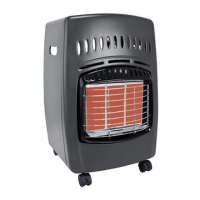
The Comfort Glow Propane Construction Heater, model GCH480, is a direct-fired cabinet construction heater designed for temporary indoor heating in buildings or structures under construction, alteration, or repair. It operates on propane vapor and is equipped with a Piezo Electric/ODS (Oxygen Depletion Sensor) pilot ignition system, ensuring safe operation by shutting down the heater if insufficient fresh air is available. This unvented portable heater draws air (oxygen) from the area in which it is used, necessitating ample combustion and ventilation air. It is crucial to read and understand the user's manual completely before assembling, starting, or servicing the heater, as improper use can lead to serious injury or death from fire, explosion, burn, asphyxiation, carbon monoxide poisoning, and/or electrical shock.
The heater is designed with several usage features to enhance convenience and safety. It includes heat controls for adjusting the desired heat level, offering settings for low, medium, and high output. A handle slot is integrated into the design for easier portability. For stability and mobility, the heater is equipped with four casters, two of which are locking casters located at the front, and two non-locking casters at the back. These locking casters have brakes that can be engaged to keep the heater in place during operation and released for movement. The unit also features a safety guard to protect users from direct contact with the heating elements. The propane cylinder supply system must be arranged to provide for vapor withdrawal from the operating cylinder, and only the regulator and hose assembly provided with the heater should be used. It is essential to keep the propane cylinder in an upright position and protect the cylinder valve and POL fitting from damage.
For safe operation, the heater must be placed on a level and stable surface, maintaining proper clearance from combustible materials: 3 feet (92 cm) from the front, 2 feet (60 cm) from the top, and 1 foot (30 cm) from the sides and rear. It is not suitable for use on finished floors. The heater should not be directed toward any propane or gas container within 20 feet of the front (10 feet in Canada). It is explicitly stated that this heater is not for home or recreational vehicle use and should never be used in spaces that contain volatile or airborne combustibles, such as gasoline, solvents, paint thinners, dust particles, or unknown chemicals. Adequate clearance for accessibility and for combustion and ventilation air supply must be maintained at all times. The heater should never be left unattended while burning or connected to a fuel source.
Maintenance features are critical for the longevity and safe operation of the heater. The appliance should be inspected before each use and at least annually by a professional service person. More frequent cleaning may be required if there is excessive debris. It is imperative to keep control compartments, burners, and circulating air passageways clean, as dust, lint, cobwebs, or debris can affect heater performance. Before cleaning, the gas supply must be turned off at the cylinder, and the gas control knob should be in the "OFF" position.
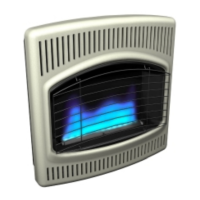
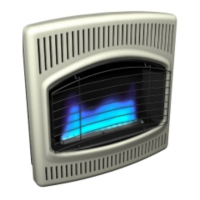
Regular inspection of the pilot and burning patterns is recommended each time the heater is lit. The pilot flame and burner flame patterns should match those illustrated in the manual. Incorrect flame patterns necessitate turning off the heater and contacting a qualified service person. The manual warns against mistaking orange flames with yellow tipping, as dirt or dust particles can cause transient patches of orange flame.
Cleaning the burner and ODS pilot involves using a soft bristle brush, vacuum cleaner, or pressurized air to clean the exterior. A flashlight can be used to inspect the main burner inlet for obstructions, which can be cleared with a straightened metal coat hanger. Vacuuming the primary air openings to the main burners is also important. The manual explicitly warns that failure to keep the primary air openings to the burner(s) clean may result in sooting, property damage, and increased carbon monoxide production. To clean the ODS pilot orifice, pressurized air should be used to blow dust out through the primary air opening on the side of the pilot. The combustion and circulating air passageways should be cleaned with a vacuum cleaner or pressurized air, and the cabinet/casing can be cleaned with a damp cloth.
The lighting instructions detail a step-by-step process, emphasizing safety checks like waiting five minutes to clear any gas and smelling for leaks before proceeding. If gas is smelled, the leak checking section of the manual must be followed. The control knob has specific positions for "OFF," "PILOT," "LOW," "MEDIUM," and "HIGH," and users are instructed on how to depress and turn the knob for ignition and heat adjustment. For the first operation after connecting the gas supply, the control knob should be depressed for at least 30 seconds to allow air to bleed from the gas system. Shutdown instructions involve turning the gas control knob to "OFF" and then turning off the propane tank valve. There is also an option to turn off only the burner while keeping the pilot lit.
Storage guidelines dictate that a propane gas tank should never be stored inside a building or near any gas or oil burning appliance. If the propane tank is not disconnected from the heater, both must be stored outdoors in a well-ventilated area, out of reach of children. If the heater is stored indoors, the tank must be disconnected and stored outdoors in a well-ventilated area, with the plastic tank valve plug tightly installed.
Troubleshooting information is provided to address common issues such as no spark at the ODS pilot, pilot not lighting, pilot lighting but flame going out, burner not lighting, delayed ignition, burner backfiring, yellow flames, burner plaque not glowing, slight smoke/odor during initial operation, whistling noise, clicking noise, gas odor, and heater shutting off on ODS. For each problem, possible causes and corresponding solutions are listed, often recommending cleaning, repositioning parts, replacing components, or contacting a qualified service technician or gas supplier.
The heater is designed and approved as a construction heater under ANSI Z83.7a, CSA 2.14a, and its installation must conform to local codes or, in their absence, with the standard for the Storage and Handling of Liquefied Petroleum Gases ANSI/NFPA 58 and the Natural Gas and Propane Installation Code CSA B149.1. The manufacturer provides a limited warranty covering defects in materials and workmanship for one year from the date of retail sale, with specific conditions and exclusions detailed in the manual.


 To Next Page
 General