EasyManua.ls Logo

Commodore Computers 1581 - Processor Interface and Operations

Default Icon
22 pages
Print Icon
To Next Page IconTo Next Page
To Previous Page IconTo Previous Page
Loading...
1581
SERVICE
MANUAL
Arithmetic/Logic
Unit
(ALU)
The
ALL)
is
a
serial
comparator,
incrementor,
and
decrementor,
and
is
used
for
register
modification
and
comparisons
with
the
disk
recorded
ID
field.
Timing
and
Control
All
computer
and
Floppy
Disk
interface
controls
are
generated
through
this
logic.
The
internal
device
timing
is
generated
from
an
external
crystal
clock.
The
FD1770
has two
different
modes
of
operation
according
to
the
state
of
DDEN.
When
DDEN
=
0,
double
density
(MFM)
is
enabled.
When
DDEN
=
1,
single
density
is
enabled.
AM
Detector
The
address
mark
detector
detects
ID,
data
and
index
address
marks
during
read
and
write
operations.
Data
Separator—
A
digital
data
separator,
consisting
of
a
ring
shift
register
and
data
window
detection
logic,
provides
read
data
and
a
recovery
clock
to
the
AM
detector.
PROCESSOR
INTERFACE
The
interface
to
the
processor
is
accomplished
through
the
eight
Data
Access
Lines
(DAL)
and
associated
control
signals.
The
DAL
are
used
to
transfer
Data,
Status,
and
Control
words_out
of,
orjnto
the
WD1770.
The
DAL
are
three
state
buffersjhat
are
enabled
as
output
drivers
when
Chip
Select
(CS)
and
R/W
=
1
are
active
or
act
as
imput
receivers
when
CS
and
R/W
=
0
are
active.
When
transfer
of
data
with
the
Floppy
Disk
Controller
is
required
by
the
host
processoMhe
device
address
is
decoded
and
CS
is
made
low.
The
address
bits
A1
and
AO,
combined
with
the
signal
R/W,
during
a
Read
operation
or
Write
operation are
interpreted
as
selecting
the
following
registers:
A1
-
AO
0 0
0
1
1
0
1
1
Read
(R/W=
1)
Status
Register
Track
Register
Sector
Register
Data
Register
WRITE
(R/W=
0)
Command
Register
Track
Register
Sector
Register
Data
Register
During
Direct
Memory
Access
(DMA)
types
of
data
transfers
between
the
Data
Register
of
the
WD1770
and
the
pro
cessor,
the
Data
Request
(DRQ)
output
is
used
in
Data
Transfer
control.
This
signal
also
appears
as
status
bit
1
during
Read
and
Write
operations.
On
Disk
Read
operations,
the
Data
Request
is
activated
(set
high)
when
an
assembled
serial
input
byte
is
transferred
in
parallel
to
the
Data
Register.
This
bit
is
cleared
when
the
Data
Register
is
read
by
the
processor.
If
the
Data
Register
is
read
after
one
or
more
characters
are
lost,
by
having
new
data
transferred
into
the
register
prior
to
processor
readout,
the
Lost
Data
bit
is
set
in
the
Status
Register.
The
Read
operation
continues
until
the
end
of
sector
is
reached.
On
Disk
Write
operations,
the
Data
Request
is
activated
when
the
Data
Register
transfers
its
contents
to
the
Data
Shift
Register,
and
requires
a
new
data
byte.
It
is
reset
when
the
Data
Register
is
loaded
with
new
data
by
the
processor.
If
new
data
is
not
loaded
at
the
time
the
next
serial
byte
is
required
by
the
Floppy
Disk,
a
byte
of
zeroes
is
written
on
the
diskette
and
the
Lost
Data
is
set
in
the
Status
Register.
At
the
completion
of
every
command,
an
INTRQ
is
generated.
INTRQ
is
reset
by
either
reading
the
status
register,
or
by
loading
the
command
register
with
a
new
command.
In
addition,
INTRQ
is
generated
if
a
Force
Interrupt
com
mand
condition
is
met.
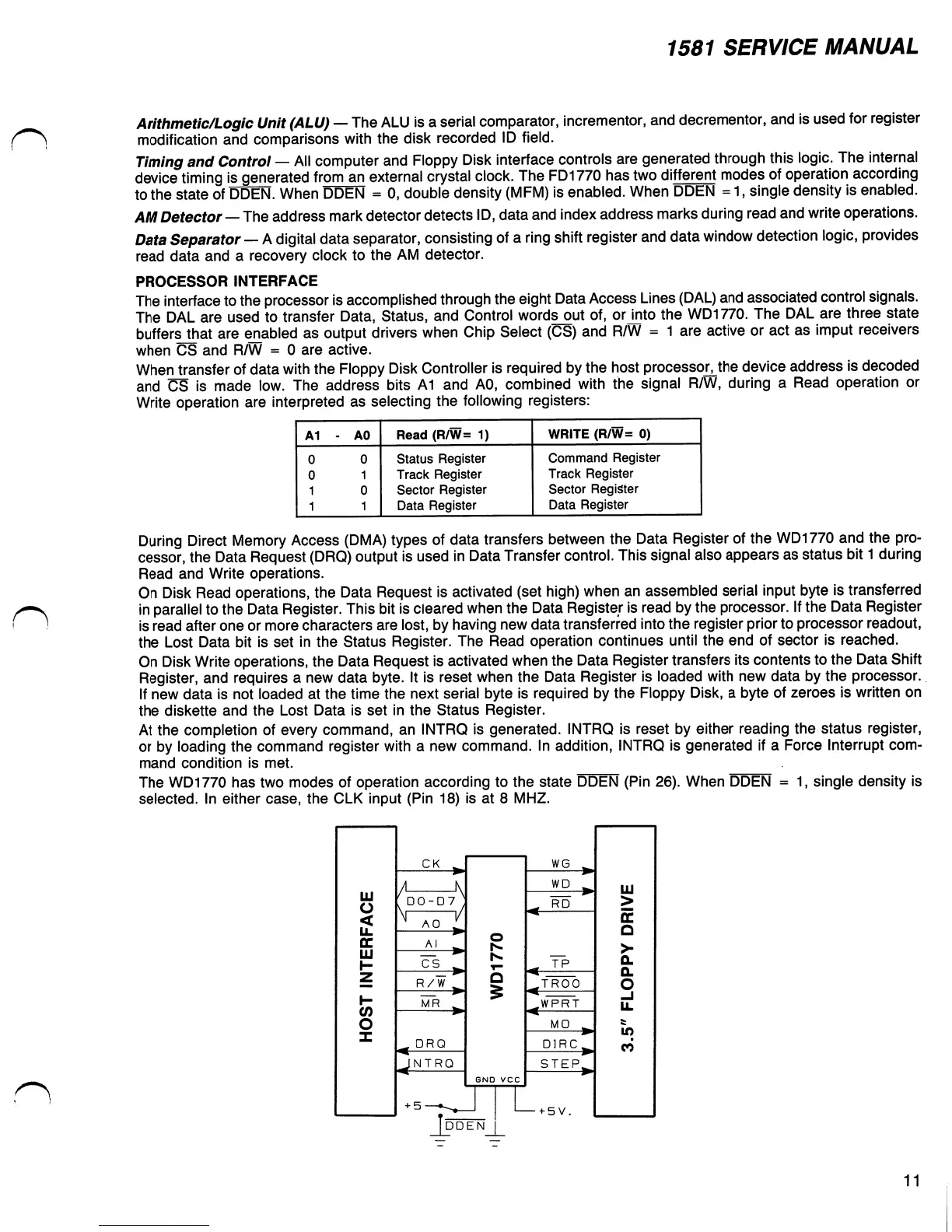
The
WD1770
has two
modes
of
operation
according
to
the
state
DDEN
(Pin
26).
When
DDEN
=
1,
single
density
is
selected.
In
either
case,
the
CLK
input
(Pin
18)
is
at
8
MHZ.
UJ
o
<
Li-
CC
UJ
HOST
CK
CS
R/W
MR
_
;
DRQ
INTRQ
+
5
Jdden
i
GND
VCC
WG
WD
RD
^TROO
WPRT
MO
DIRC
'
+
5
V.
11