;
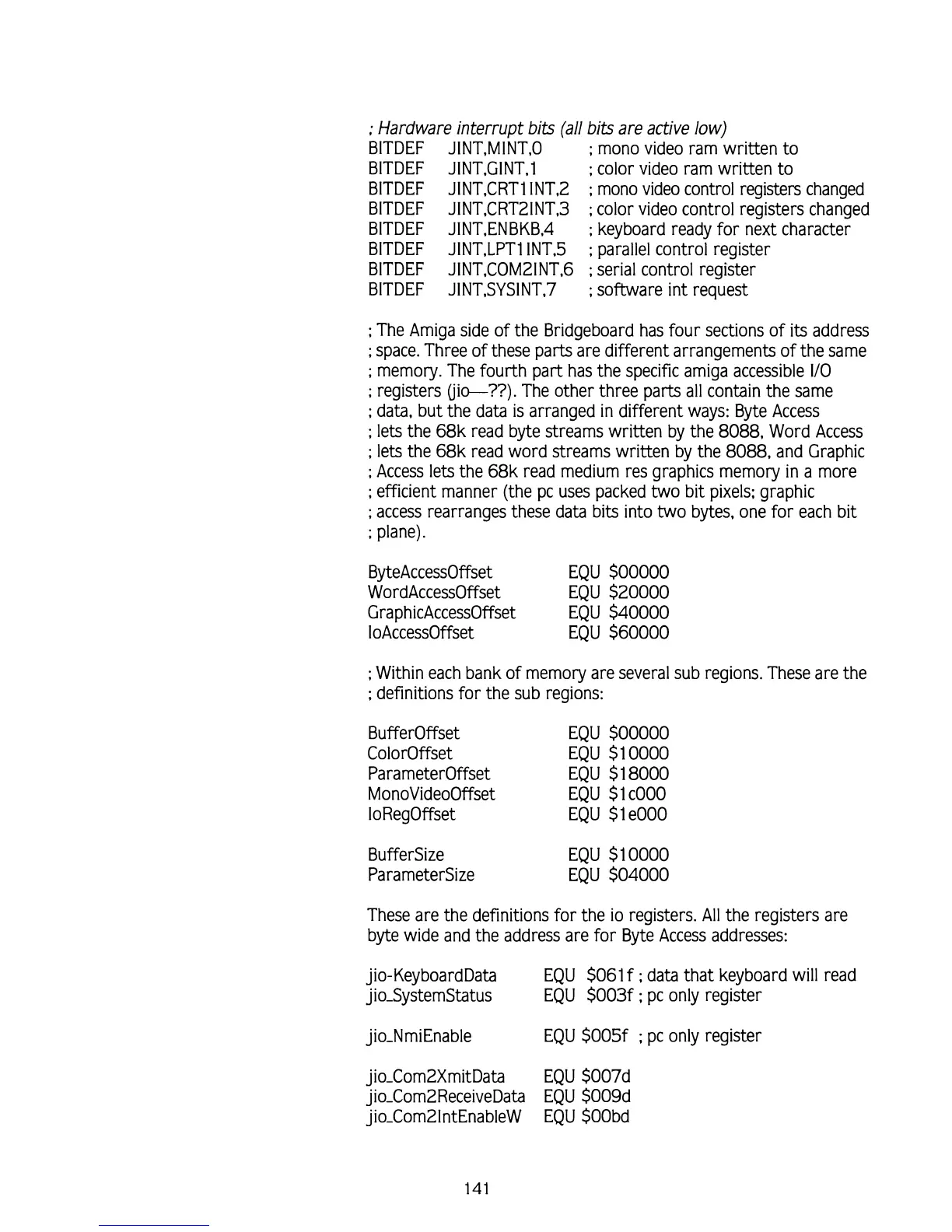
Hardware interrupt bits
(all
bits are active low)
BITDEF JINT,MINT,O
;
mono video ram written to
BITDEF JINT,GINT.l
;
color video ram written to
BITDEF
JINT,CRT1 INT.2
;
mono video control registers changed
BITDEF
JINT.CRT21NT.3
;
color video control registers changed
BITDEF
JINT,ENBKBA
;
keyboard ready for next character
BITDEF
JINT,LPT1 INT,S
;
parallel control register
BITDEF
JINT.COM21NT.6
;
serial control register
BITDEF JINT.SYSINT.7
;
software int request
;
The Amiga side of the Bridgeboard has four sections of
its
address
;
space. Three
of
these parts are different arrangements of the same
;
memory. The fourth part has the specific amiga accessible 110
;
registers (jio-??). The other three parts all contain the same
;
data, but the data is arranged in different ways: Byte Access
;
lets the 68k read byte streams written by the
8088.
Word Access
;
lets the 68k read word streams written by the
8088,
and Graphic
;
Access lets the 68k read medium res graphics memory in a more
;
efficient manner (the pc uses packed two bit pixels; graphic
;
access rearranges these data bits into two bytes, one for each bit
;
plane).
ByteAccessOffset EQU
$00000
WordAccessOffset EQU $20000
GraphicAccessOffset EQU
$40000
loAccessOffset EQU
$60000
;
Within each bank of memory are several sub regions. These are the
;
definitions for the sub regions:
Bufferoffset EQU
$00000
ColorOffset EQU $1
0000
Parameteroffset EQU $1
8000
MonoVideoOffset EQU
$
l c000
IoRegOffset EQU $1 e000
Buffersize EQU $1
0000
Parametersize EQU $04000
These are the definitions for the io registers.
All
the registers are
byte wide and the address are for Byte Access addresses:
jio-KeyboardData EQU $061
f
;
data that keyboard will read
jio-Systemstatus EQU $003f
;
pc only register
jio-NmiEnable EQU $005f
;
pc only register
jio-Com2XmitData EQU $007d
jio-Com2ReceiveData EQU $009d
jio-Com2lntEnableW EQU $OObd








 To Next Page