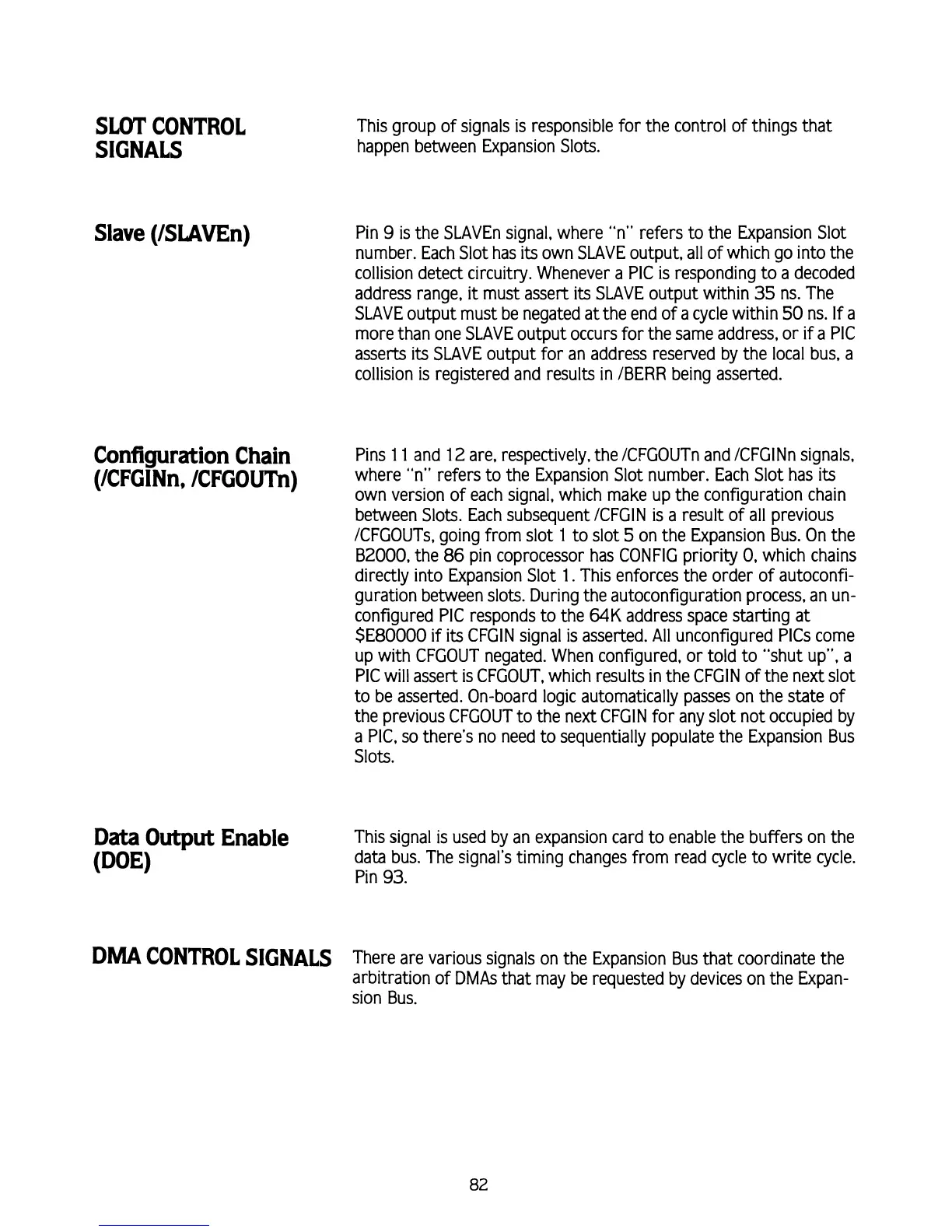
SLOT CONTROL
SIGNALS
Slave
(ISLAVEn)
This group of signals is responsible for the control of things that
happen between Expansion Slots.
Pin
9
is the SLAVEn signal, where "n" refers to the Expansion Slot
number. Each Slot has
its
own SLAVE output, all of which go into the
collision detect circuitry. Whenever a PIC is responding to a decoded
address range,
it
must assert its SLAVE output within
35
ns. The
SLAVE output must be negated at the end of a cycle within
50
ns.
If
a
more than one SLAVE output occurs for the same address, or if a PIC
asserts its SLAVE output for an address reserved by the local bus, a
collision is registered and results in
IBERR being asserted.
Configuration Chain
Pins
1
1
and
12
are, respectively, the ICFGOUTn and ICFGINn signals.
(ICFGINn, ICFGOUTn)
where "n" refers to the Expansion Slot number. Each Slot has
its
own version of each signal, which make up the configuration chain
between Slots. Each subsequent
ICFGIN is a result of all previous
ICFGOUTs, going from slot
1
to slot
5
on the Expansion Bus. On the
B2000, the
86
pin coprocessor has CONFIG priority
0,
which chains
directly into Expansion Slot
1.
This enforces the order of autoconfi-
guration between slots. During the autoconfiguration process, an un-
configured PIC responds to the
64K
address space starting at
SE80000
if
its
CFGlN signal is asserted.
All
unconfigured PlCs come
up with CFGOUT negated. When configured, or told to "shut up", a
PIC will assert is CFGOUT, which results in the CFGlN of the next slot
to be asserted. On-board logic automatically passes on the state of
the previous CFGOUT to the next CFGIN for any slot not occupied by
a
Plc, so there's no need to sequentially populate the Expansion Bus
Slots.
Data Output Enable
This signal is used by an expansion card to enable the buffers on the
(DOE)
data bus. The signal's timing changes from read cycle to write cycle.
Pin
93.
DMA
CONTROL SIGNALS
There are various signals on the Expansion Bus that coordinate the
arbitration of
DMAs
that may be requested by devices on the Expan-
sion Bus.







 To Next Page