EasyManua.ls Logo

Commodore PC - Method 2: Command Line; Debug Command Information

Commodore PC
414 pages
Print Icon
To Next Page IconTo Next Page
To Previous Page IconTo Previous Page
Loading...
Debug
209
Method
2:
Command
Line
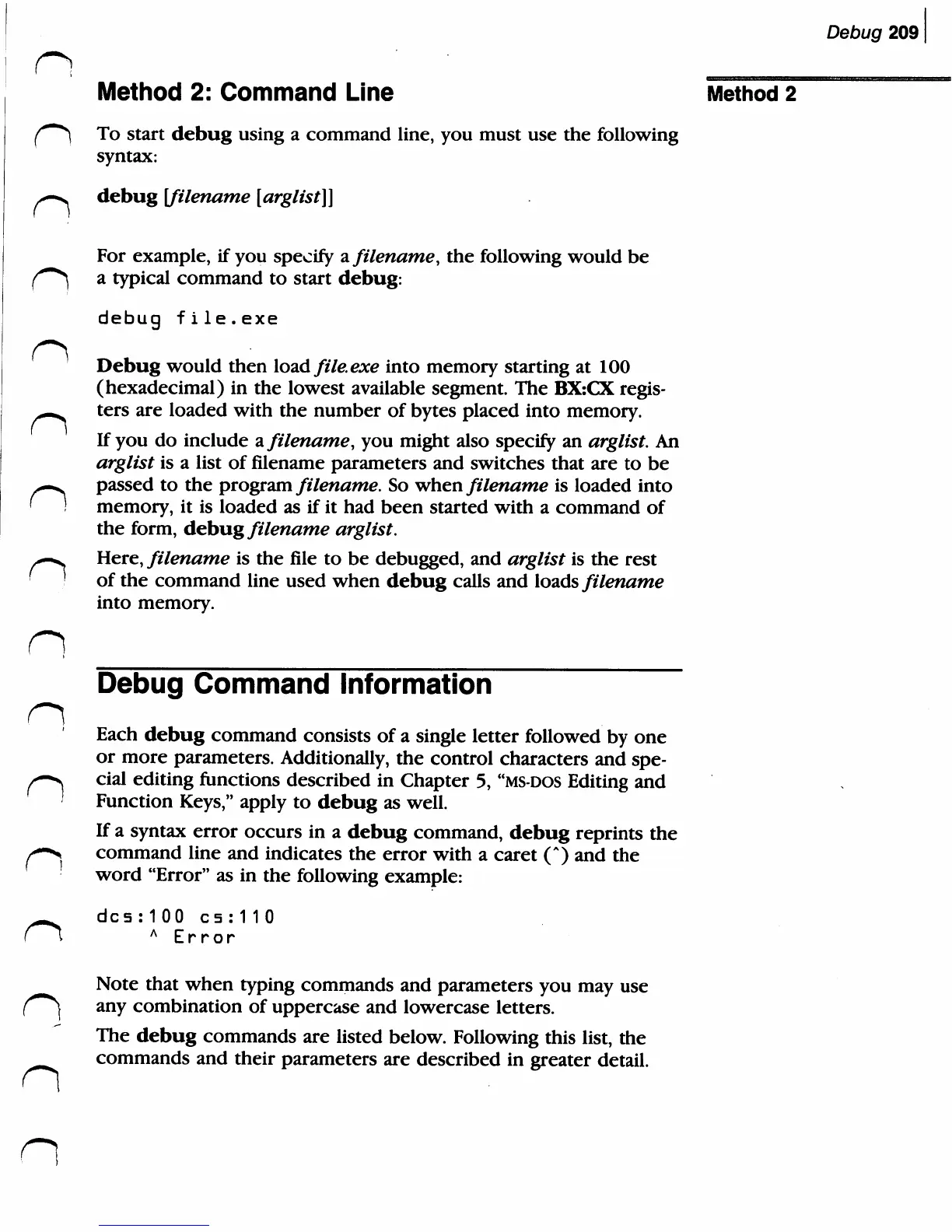
To
start
debug
using
a
command
line,
you
must
use
the
following
syntax:
debug
[filename
[arglist]]
Method
2
n
n
o
n
n
n
n
n
For
example,
if
you
specify
a
filename,
the
following
would
be
a
typical
command
to
start
debug:
debug
file.exe
Debug
would
then
load
file,
exe
into
memory
starting
at
100
(hexadecimal)
in
the
lowest
available
segment.
The
BX:CX
regis
ters
are
loaded
with
the
number
of
bytes
placed
into
memory.
If
you
do
include
a
filename,
you
might
also
specify
an
arglist.
An
arglist
is
a
list
of
filename
parameters
and
switches
that
are
to
be
passed
to
the
program
filename.
So
"when
filename
is
loaded
into
memory,
it
is
loaded
as
if
it
had
been
started
with
a
command
of
the
form,
debug
filename
arglist.
Here,
filename
is
the
file
to
be
debugged,
and
arglist
is
the
rest
of
the
command
line
used
when
debug
calls
and
loads
filename
into
memory.
Debug
Command
Information
Each
debug
command
consists
of
a
single
letter
followed
by
one
or
more
parameters.
Additionally,
the
control
characters
and
spe
cial
editing
functions
described
in
Chapter
5,
"msdos
Editing
and
Function
Keys,"
apply
to
debug
as
well.
If
a
syntax
error
occurs
in
a
debug
command,
debug
reprints
the
command
line
and
indicates
the
error
with
a
caret
(A)
and
the
word
"Error"
as
in
the
following
example:
dcs:100
cs:110
A
Error
Note
that
when
typing
commands
and
parameters
you
may
use
any
combination
of
uppercase
and
lowercase
letters.
The
debug
commands
are
listed
below.
Following
this
list,
the
commands
and
their
parameters
are
described
in
greater
detail.
n

Related product manuals