EasyManua.ls Logo

Commodore Plus 4 - Page 168

Commodore Plus 4
464 pages
Print Icon
To Next Page IconTo Next Page
To Previous Page IconTo Previous Page
Loading...
186
Some
Programming
Techniques
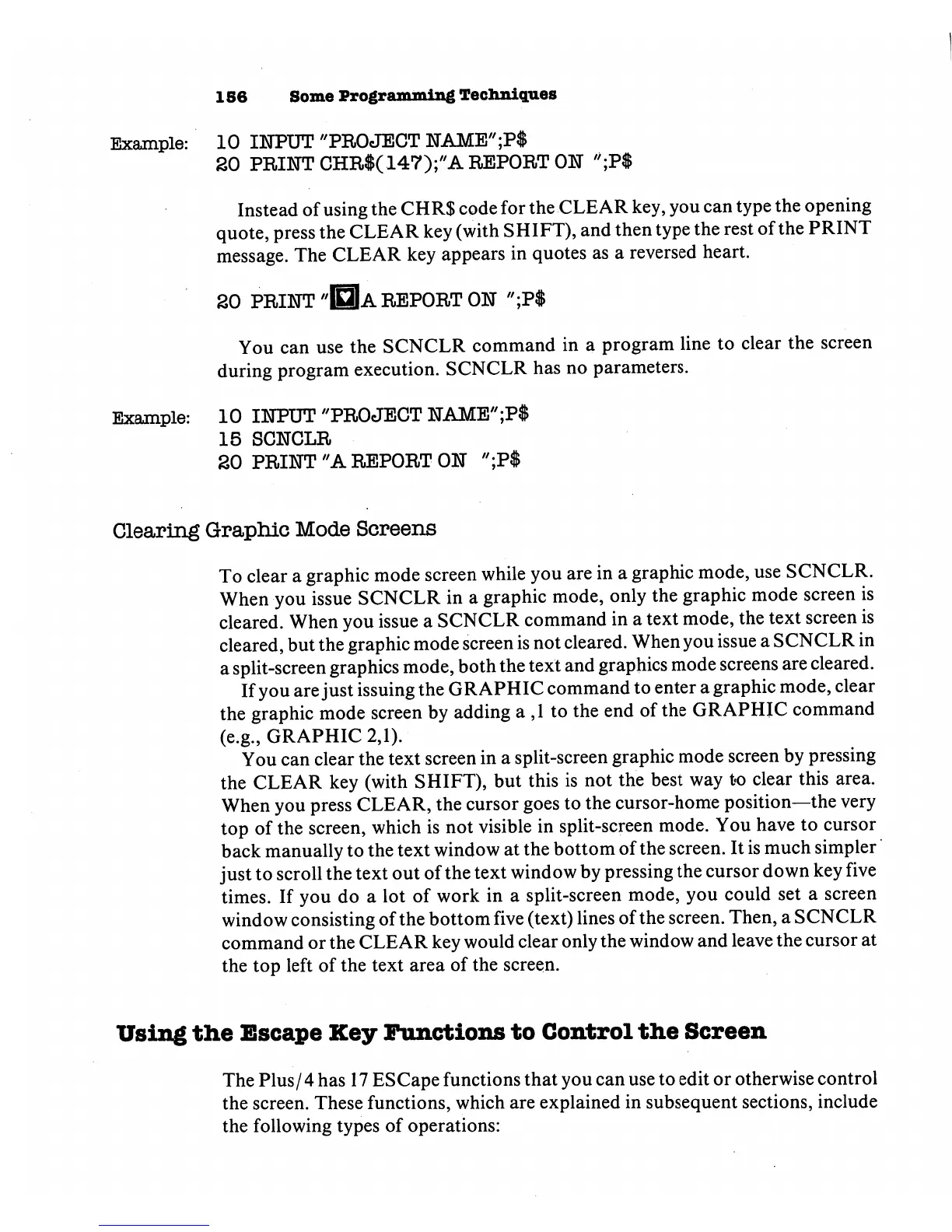
Example:
10
INPUT
"PROJECT
HAME";P$
SO
PRINT
CHR$(147);"A
REPORT
ON
";P$
Instead
of
using
the
CHR$
code
for
the
CLEAR
key,
you
can
type
the
opening
quote,
press
the
CLEAR
key
(with
SHIFT),
and
then
type
the
rest
of
the
PRINT
message.
The
CLEAR
key
appears
in
quotes
as
a
reversed
heart.
20
PRINT
"E2IA
REPORT
ON
";P$
You
can
use
the
SCNCLR
command
in
a
program
line
to
clear
the
screen
during
program
execution.
SCNCLR
has
no
parameters.
Example:
10
INPUT
"PROJECT
NAME";P$
15
SCNCLR
20
PRINT
"A
REPORT
ON
";P$
Clearing
Graphic
Mode
Screens
To
clear
a
graphic
mode
screen
while
you
are
in
a
graphic
mode,
use
SCNCLR.
When
you
issue
SCNCLR
in
a
graphic
mode,
only
the
graphic
mode
screen
is
cleared.
When
you
issue
a
SCNCLR
command
in
a
text
mode,
the
text
screen
is
cleared,
but
the
graphic
mode
screen
is
not
cleared.
When
you
issue
a
SCNCLR
in
a
split-screen
graphics
mode,
both
the
text
and
graphics
mode
screens
are
cleared.
If
you
are
just
issuing
the
GRAPHIC
command
to
enter
a
graphic
mode,
clear
the
graphic
mode
screen
by
adding
a
,1
to
the
end
of
the
GRAPHIC
command
(e.g.,
GRAPHIC
2,1).
You
can
clear
the
text
screen
in
a
split-screen
graphic
mode
screen
by
pressing
the
CLEAR
key
(with
SHIFT),
but
this
is
not
the
best
way
to
clear
this
area.
When
you
press
CLEAR,
the
cursor
goes
to
the
cursor-home
position—the
very
top
of
the
screen,
which
is
not
visible in
split-screen
mode.
You
have
to
cursor
back
manually
to
the
text
window
at
the
bottom
of
the
screen.
It
is
much
simpler
just
to
scroll
the
text
out
of
the
text
window
by
pressing
the
cursor
down
key
five
times.
If
you do
a
lot
of
work
in
a
split-screen
mode,
you
could
set
a
screen
window
consisting
of
the
bottom
five
(text)
lines
of
the
screen.
Then,
a
SCNCLR
command
or
the
CLEAR
key
would
clear
only
the
window
and
leave
the
cursor
at
the
top
left
of
the
text
area
of
the
screen.
Using
the
Escape
Key
Functions
to
Control
the
Screen
The
Plus/4
has
17
ESCape
functions
that
you
can
use
to
edit
or
otherwise
control
the
screen.
These
functions,
which
are
explained
in
subsequent
sections,
include
the
following
types
of
operations:

Other manuals for Commodore Plus 4

Related product manuals