EasyManua.ls Logo

Commodore Plus 4 - Page 48

Commodore Plus 4
234 pages
Print Icon
To Next Page IconTo Next Page
To Previous Page IconTo Previous Page
Loading...
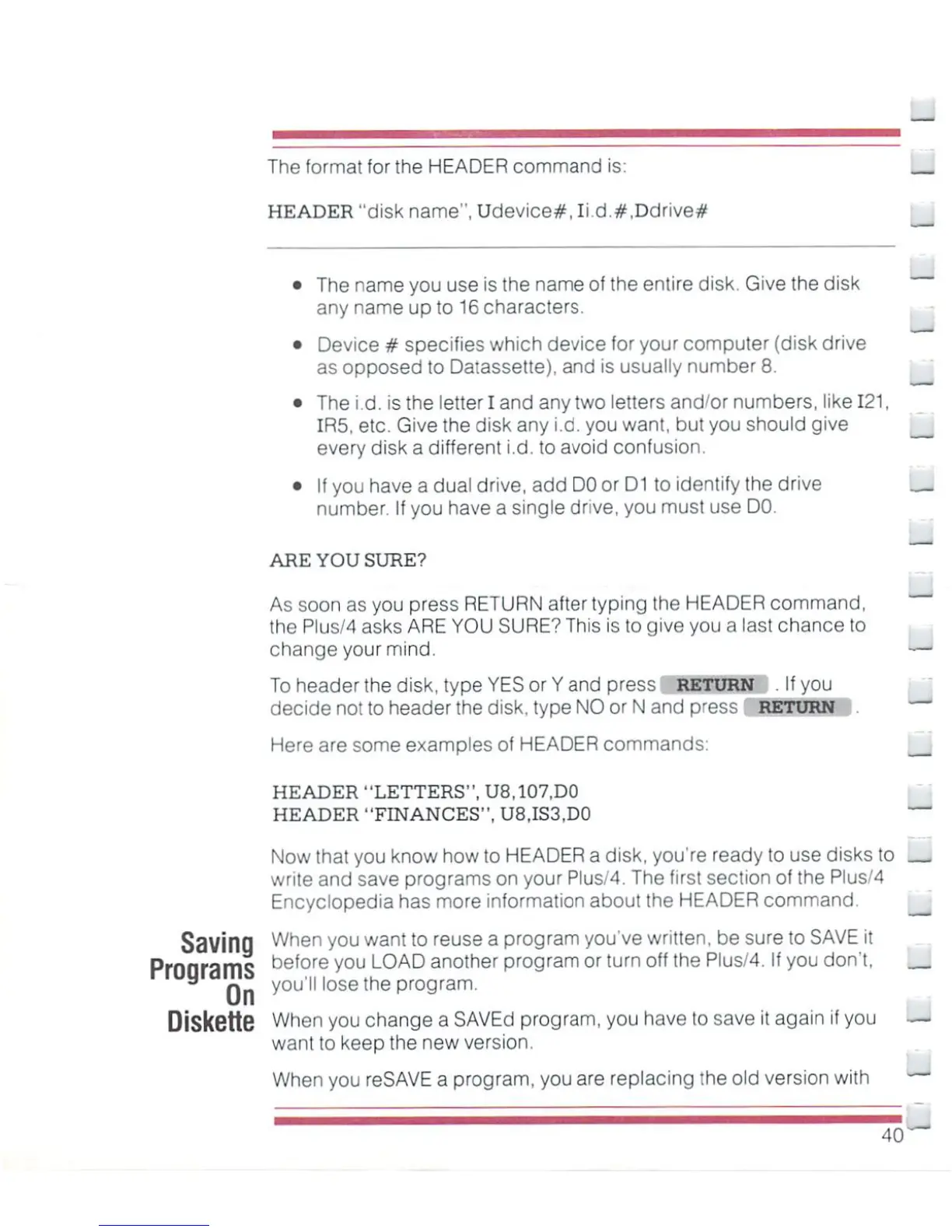
The
format
for
the
HEADER
command
is:
HEADER
"disk
name",
Udevice#,
Ii.d.#.Ddrive#
The
name
you use
is
the
name
of
the
entire
disk.
Give
the disk
any
name
up
to
16
characters.
Device
#
specifies
which
device
for
your
computer
(disk
drive
as
opposed
to
Daiassette),
and
is
usually
number
8.
Thei.d.
is
the
letter
I
and
any
two
letters
and/or
numbers,
like
121,
IR5,
etc.
Give
the disk
any
i.d.
you
want,
but
you
should
give
every
disk
a
different
i.d.
to
avoid
confusion.
If
you
have
a
dual
drive,
add
DO
or
D1
to
identify
the
drive
number.
If
you
have
a
single
drive,
you
must
use
DO.
_
ARE
YOU
SURE?
As
soon
as
you
press
RETURN
after
typing
the
HEADER
command,
the Plus/4
asks
ARE
YOU
SURE?
This
is
to
give
you
a
last
chance
to
change
your
mind.
To
header
the
disk,
type
YES
or
Y
and
press
return
.
If
you
decide
not
to
header
the
disk,
type
NO
or
N
and
press
return
Here
are
some
examples
of
HEADER
commands:
HEADER
"LETTERS",
U8.107.D0
HEADER
"FINANCES",
U8,IS3,D0
Now
that
you
know
how
to
HEADER
a
disk,
you're
ready
to
use
disks
to
.
write
and
save
programs
on
your
Pius/4.
The
first
section
of
the
Plus/4
Encyclopedia has
more
information
about
the
HEADER
command.
When
you want
to
reuse
a
program
you've
written,
be
sure
to
SAVE
it
PrnnramQ
before
you
LOAD
another
program
or
turn
off
the
Plus/4.
If
you
don't,
riuyidina
you'll
lose the
program.
Diskette
When
you
change
a
SAVEd
program,
you
have
to
save
it
again
if
you
want
to
keep
the
new
version.
When
you
reSAVE
a
program,
you
are
replacing
the old
version
with
40^

Other manuals for Commodore Plus 4

Related product manuals