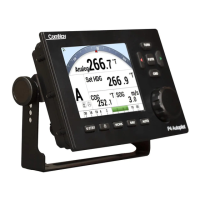
1101/1201 Technical Manual
07/19/02 Page 7 1201 - JULY 19 '02
3.2.2 Disassembly/Re-assembly (2 pcb version)
Disassembly:
Disassembly of the 1101 SPU is a straightforward process. First remove the two Phillips screws
from the rear of the autopilot and pull off the rear cover. Remove the four screws that secure the
chassis to the front cover. Carefully separate the front cover from the chassis. The two main
boards are connected by a 24 pin header as well as a ribbon cable. The Silicone used to hold one
of the boards should be carefully cut free with an exact-o knife. Carefully separate the two
boards, by pulling them apart to disconnect the header pins. If you need to disconnect the ribbon
cable, gently separate the connector on the end of the ribbon cable from the jumper on the
processor board. Use a screwdriver to gently pry the two apart if necessary. DO NOT pull on the
cable itself. The E-PROMS can now be replaced or the unit tested on the ComNav Test Bench.
Re-assembly is the reverse of disassembly. Reapply Silicone to secure the second board to the
chassis.
3.2.3 Signals to and from the Distribution Unit
MOTOR F/B Motor Feedback signals from Remotes to the Distribution Unit.
NAV INPUT Signals from a navigation device in the standard NMEA 0183 format.
RUDDER POSITION Rudder position signal from the Rudder follower.
SPEED CONTROL Proportional signal for rudder control.
SHIELD Outer shield of the cable usually grounded to chassis at one end.
BATTERY (+) Battery power (positive side).
SWT POWER OUT The battery power which can be switched off and on by the processor.
PORT OUT “Open collector” signal that controls the rudder to Port. Ground indicates ON.
STBD OUT “Open collector” signal that controls the rudder to Starboard.
RUDDER POWER +5 volts which is supplied to the Rudder Follower.
BATTERY (-) Battery power (negative side).
RUDDER COMMON Ground signal from the Rudder Follower.
3.2.4 Signals to and from the Control Head
OFF/on When the STANDBY switch in the Control Head is pressed, it drives the OFF/ON
line low, causing the Power circuitry in the SPU to turn the 5 volts line on, turning
the Autopilot on.
SD IN All communications to the autopilot are made through the SPI data line. This
data line sends all relevant data from the Head to the SPU.
DISP CLK Clock for SPI data entering the head. This is an SPI clock and should be running
around 1/32 * E-CLK (62.5 KHz)
KEY Clock Clock for SPI data leaving the head. This is an SPI clock and should be running
at around 1/32 * E-CLK (62.5 KHz)
DISP Data SPI Serial Data into the Head from the SPU.
RKEY Data Transfers SPI Serial Data from the Remotes to the Head.


 To Next Page