STROBOCONN
"PIANO TUNING" MANUAL
---"----
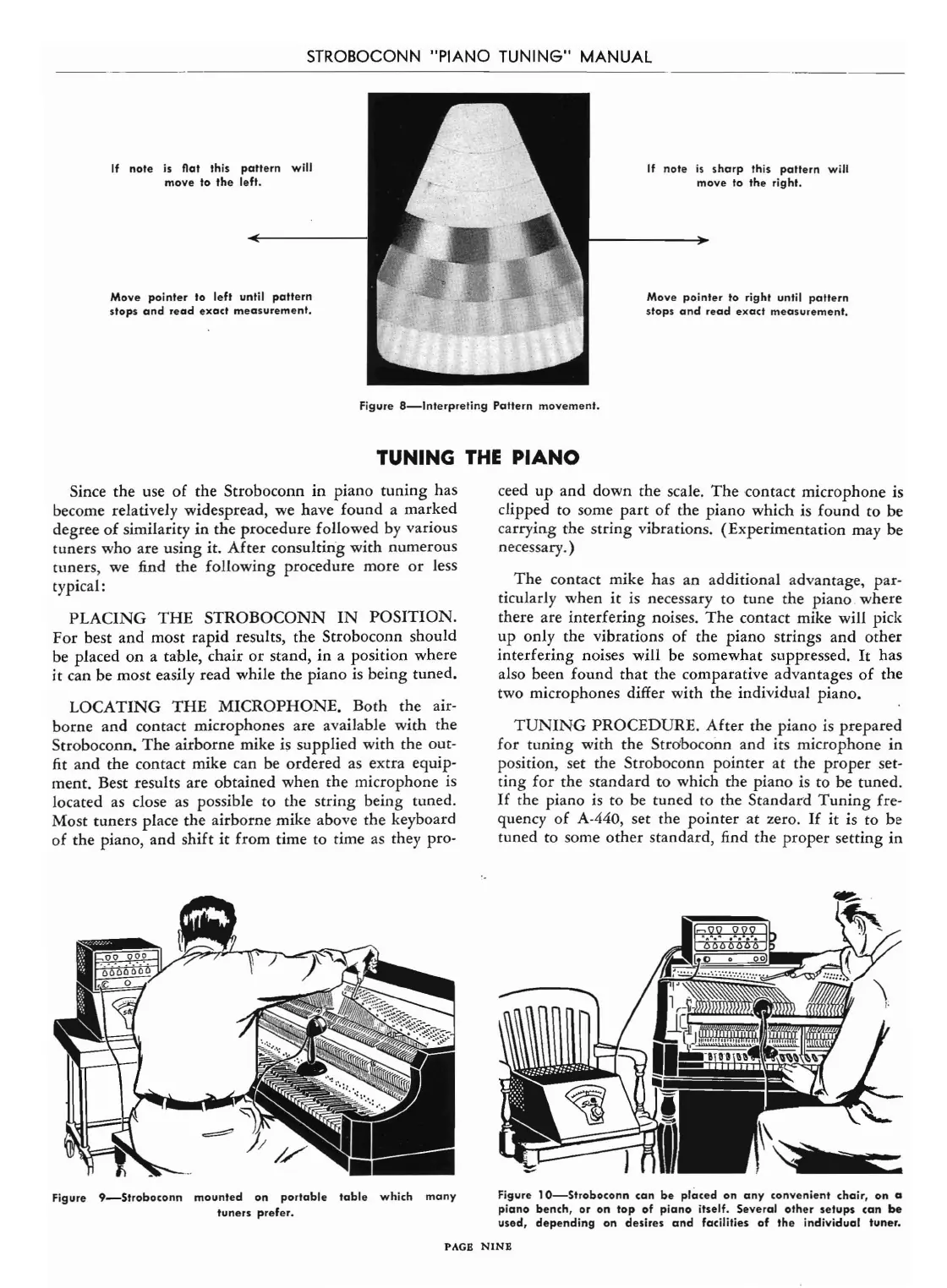
If
note
is
flat this
pallern
will
move
to
the
left.
Move
pointer
to left until
pallern
stops
and
read
exact
measurement.
If
note
is
sharp
this
pallern
will
move
to
the
right.
Move
pointer
to right until
pallern
stops
and
read
exact
measurement.
Figure
8-lnterpreting
Pallern
movement.
TUNING
THE
PIANO
Since the use
of
the Stroboconn
in
piano
tuning
has
become relatively widespread, we have found a marked
degree
of
similarity
in
the procedure followed
by
various
tuners who are using it.
After
consultin"g
with
numerous
wners, we find the following procedure more
or
less
typical:
PLACING
THE
STROBOCONN
IN
POSITION.
For
best and most rapid results, the Stroboconn should
be placed
on
a table, chair
or
stand,
in
a position where
it can be most easily read while the piano is being tuned.
LOCATING
THE
MICROPHONE.
Both the air-
borne and contact microphones are available
with
the
Stroboconn.
The
airborne mike
i~
supplied with the out-
fit
and
the contact mike can be ordered as extra equip-
ment. Best results are obtained when the microphone is
located
as
close
as
possible
to
the string being tuned.
Most tuners place the airborne mike above the keyboard
of
the
piano,
and
shift
it
from time to time as they pro-
ceed
up
and down the scale.
The
contact microphone is
clipped to some
part
of
the piano which is found to be
carrying the
string
vibrations. (Experimentation may be
necessary.)
The
contact mike has an additional advantage, par-
ticularly when
it
is necessary
to
tune the piano where
there are
interfering
noises.
The
contact mike will pick
up
only the vibrations
of
the piano strings
and
other
interfering
noises will be somewhat suppressed.
It
has
also been found
that
the comparative advantages
of
the
two microphones differ with the individual piano.
TUNING
PROCEDURE. After the piano is prepared
for
tuning
with
the Strdboconn and its microphone
in
position, set the Stroboconn
pointer
at
the
proper
set-
ting
for
the standard
to
which the piano is to be tuned.
If
the piano is to be tuned to the Standard
Tuning
fre-
quency
of
A-440, set the
pointer
at zero.
If
it
is to be
tuned to some
other
standard, find the
proper
setting
in
,\\~
Figure
9-Stroboconn
mounted
on
portable
table
which
many
tuners
prefer.
Figure
10-Stroboconn
can
be
placed
on
any
convenient
chair,
on
a
piano
bench,
or
on
top
of
piano
iiself.
Several
other
setups
can
be
used,
depending
on
desires
and
facilities
of
the
individual
tuner.
PAGE
NINE



 To Next Page