STROBOCONN
"PIANO TUNING" MANUAL
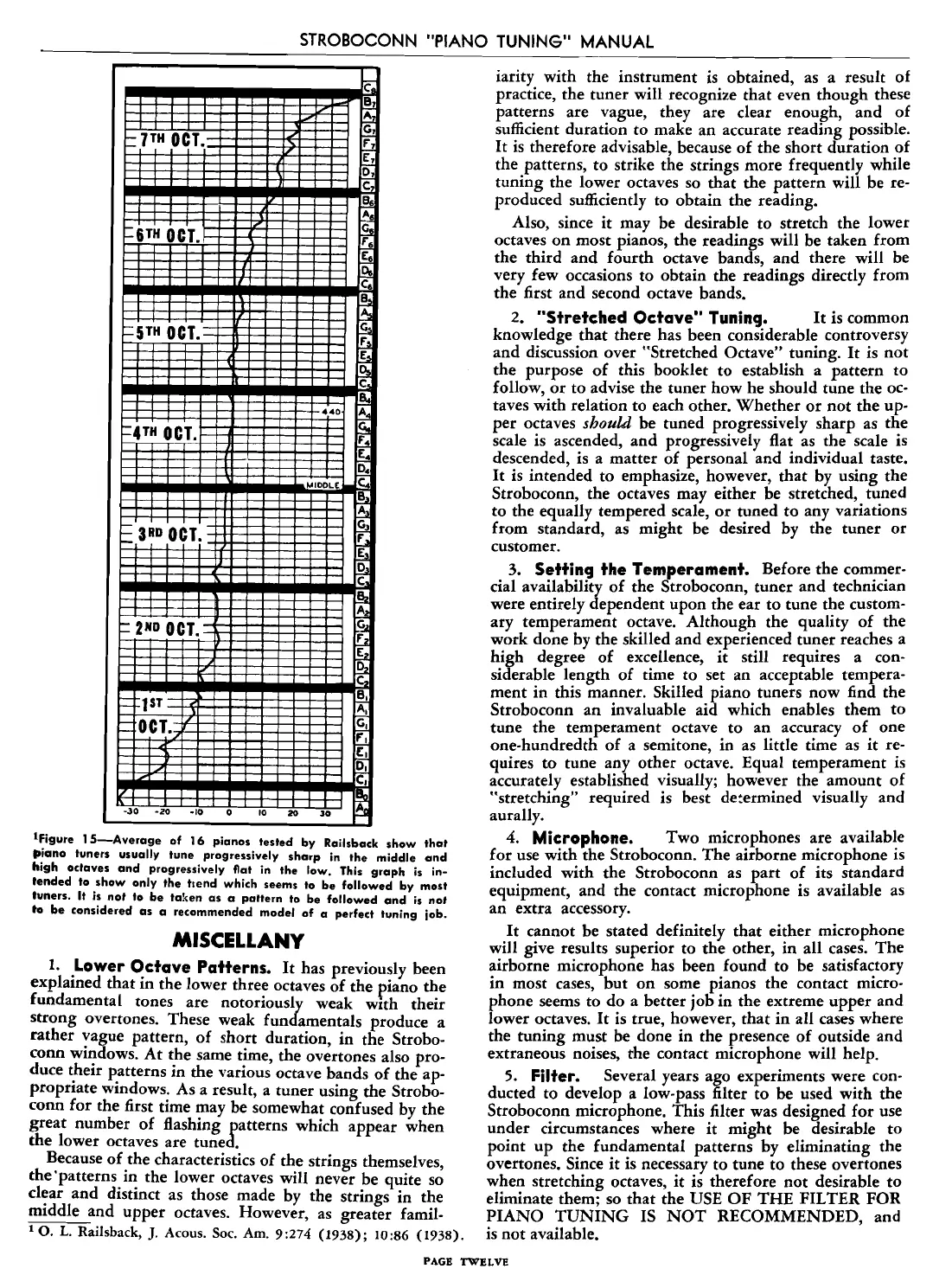
lFigure
IS-Average
of
16
pianos
tested
by
Railsback
show
that
piano
tuners usually
tune
progressively
sharp
in
the
middle
and
high
octaves
and
progressively flat in
the
low. This
graph
is in-
tended
to
show
only
the
!tend
which
seems
to
be
followed
by
most
tuners.
It is
not
to
be
taken
as
a
pattern
to
be
followed
and
is
nol
to
be
considered
as
a
recommended
model
of
a perfect tuning job.
MISCELLANY
1.
.Lower
~C+ave
Patterns.
It
has previously been
explained
that
In
the
lower three octaves
of
the piano
the
fundamental tones are notoriously weak
WIth
their
strong
overtones. These weak fundamentals produce a
rather vague pattern,
of
short
duration,
in
the Strobo-
conn windows.
At
the same time,
the
overtones also pro-
duce their patterns
in
the various octave bands
of
the ap-
propriate
windows. As a result, a tuner using the Strobo-
conn
for
the
first time may be somewhat confused by
the
great
number
of
flashing patterns which appear when
the
lower octaves are tuned.
Because
of
the characteristics
of
the strings themselves,
the'patterns
in the lower octaves will never be quite
so
dear
and
distinct as those made by the strings in the
middle and
upper
octaves. However, as greater famil-
10.
1.
Railsback,
].
Acous. Soc. Am. 9:274
(1938);
10:86
(1938).
r::
7T
H
OCT.
t6TH
OCT.
t::::STH
OCT.
f=4
TH
OCT.
~
3
RD
OCT.
1=
2
N
D
OCT.
;=
1
ST
~
OCT.
-.30
-20
..
'0
o
iarity
with
the instrument
is
obtained, as a result of
practice, the tuner will recognize
that
even
though
these
patterns are vague, they are clear enough, and
of
sufficient duration
to
make
an
accurate reading possible.
It
is
therefore advisable, because
of
the short duration
of
the patterns,
to
strike the strings more frequently while
tuning
the lower octaves so
that
the
pattern
will be re-
produced sufficiently
to
obtain
the
reading.
Also, since
it
may be desirable
to
stretch
the
lower
octaves
on
most pianos,
the
readings will be taken from
the
third
and
fourth
octave bands,
and
there will be
very few occasions
to
obtain the readings directly from
the first and second octave bands.
2.
"Stretched
OC+ave" Tuning.
It
is common
knowledge
that
there has been considerable controversy
and
discussion over "Stretched Octave" tuning.
It
is
not
the
purpose
of
this booklet
to
establish a
pattern
to
follow,
or
to
advise the tuner how he should tune the
oc-
taves with relation
to
each other.
Whether
or
not
the
up-
per
octaves should be
tuned
progressively sharp as
the
scale is ascended,
and
progressively flat as
the
scale is
descended, is a
matter
of
personal and individual taste.
It
is intended
to
emphasize, however,
that
by using the
Stroboconn,
the
octaves may either be stretched, tuned
to
the equally tempered scale,
or
tuned
to
any variations
from standard, as
might
be desired by
the
tuner
or
customer.
3.
Setting
the
Temperament. Before the commer-
cial availability
of
the Stroboconn,
tuner
and technician
were entirely dependent upon the ear
to
tune the custom-
ary temperament octave.
Although
the quality
of
the
work done by
the
skilled
and
experienced
tuner
reaches a
high
degree
of
excellence,
it
still requires a con-
siderable length
of
time
to
set an acceptable tempera-
ment
in this manner. Skilled piano tuners now find the
Stroboconn
an
invaluable aid which enables them
to
tune
the
temperament octave
to
an accuracy
of
one
one-hundredth
of
a semitone, in
as
little time as
it
re-
quires
to
tune any other octave. Equal temperament is
accurately established visually; however the amount
of
"stretching" required is best
de~ermined
visually and
aurally.
4.
Microphone.
Two
microphones are available
for
use
with
the Stroboconn.
The
airborne microphone is
included
with
the Stroboconn
as
part
of
its standard
equipment,
and
the
contact microphone is available as
an
extra accessory.
It
cannot be stated definitely
that
either microphone
will give results superior to
the
other, in all cases.
The
airborne microphone has been found
to
be satisfactory
in
most cases,
but
on
some pianos
the
contact micro-
phone seems
to
do
a better
job
in
the
extreme upper and
lower octaves.
It
is true, however,
that
in
all cases where
the
tuning
must be done
in
the
presence
of
outside and
extraneous noises,
the
contact microphone will help.
5.
Filter. Several years ago experiments were con-
ducted to develop a low-pass filter
to
be used
with
the
Stroboconn microphone. This filter was designed
for
use
under
circumstances where
it
might
be desirable
to
point
up
the fundamental patterns by eliminating the
overtones. Since
it
is necessary
to
tune
to
these overtones
when stretching octaves,
it
is therefore
not
desirable
to
eliminate them; so
that
the
USE
OF
THE
FILTER FOR
PIANO
TUNING
IS
NOT
RECOMMENDED, and
is
not
available.
PAGE
TWELVE



 To Previous Page
 Loading...