STROBOCONN "PIANO TUNING" MANUAL
is
space
provi~eldl
for 7 x
~2,
or
h
84
"'l,~~\~'l\~II'
~rlrl
TdehPar.tsf
from. standabrd
btu
n.i
n
g
d
·
notes, essentla y
covenng
t e
..
~"
.\
'I
I,
Ij
Ij
IS
10
ormation
can e 0 tatne
range
of
the piano keyboard. (See
~w~
~r~~
by
simply
turning
the scale point-
Fig.
6).
(Procedure for tuning
~m~"
~'~~~"""~
er until the
pattern
stops.
Aa,
Alia,
Ba
and
Cs
will be ex-
~~"'
~~
Take,
for
example, an A which
plained later.) has been tuned flatter
than
stand-
The
foregoing explanation
as-
_~
•
~
ard, say
to
435 vibrations
per
sumes
that
the
pointer
on
the tun- _
-==
second instead
of
440.
In
the
"A"
ing
unit
has been left at zero.
::-.
~
window the
pattern
will be seen
With
the scale
pointer
set at zero,
::::.-.
..
_ apparently moving toward the
the Stroboconn is in exact tune _
~
....,::::: left. (Fig.
8.)
Now
by moving
with the equally tempered scale
~%~
~~
the scale
pointer
in
the same dir-
based
on
A-440 vibrations
per
~
...
~
~
...
~
ection, to the left, the
pattern
may
second.
With
the pointer set to
';tI'.4~
~
~
be
brought
to a standstill.
any position other than zero all
~h~
tJ
~
~
The
pointer
will then read
notes are equally changed in hun-
~);!,
,fJ
1'~~\
~,~
"-20"
on
the graduated scale
dredth
parts
of
semitone; and
IIIi
\~",
above the adjusting knob, thus
the Stroboconn is still in
tune
showing directly
how
much the
with
the
equally
tempered
scale Figure
3-Stroboconn
Scanning
Disc
in Stationary 435-vibration tone
is
flat com-
based,
in
this case,
on
an A
of
Position. pared to the standard A
of
440-
some
other
frequency.
(Figure
7 the reading being expressed in
shows
the
vibration frequencies corresponding
to
hundredths
of
a semitone
(cents).
If
the entire piano
different settings
of
the pointer.) has been tuned to equal temperament
(without
stretch)
Now
refer
to
illustration 7. Notice
that
the tuning
on
this lower pitch standard, then all strings would pro-
scale is calibrated
in
hundredths
of
a semitone (referred
~uce
stationary patterns
with
the
pointer
at
"-20."
to hereafter
as
"cents,"
that
is,
l/lOOth
of
a semitone=-l Obviously, any frequency in the range concerned will
cent, etc.).
Four
cents deviation from A-440
is
equal to always be
within
50
hundredths
of
a semitone from
approximately 1 vibration
per
second as indicated by the some note
of
the standard scale.
(Table
1.)
To
learn
diagram.
l
Therefore,
if
it
is desired to tune the piano to
how
much
is
its deviation,
it
is
only necessary to turn the
A-445, move the
pointer
to the
right
to plus 20, 5 (vibra- knob to the
right
or
to the left until the appropriate
tions) X 4 (cents
per
vibration}=20
cents,
or
for A-435
pattern
stands still.
The
only
judgment
lies in deciding
move
the
pointer
to
left
to
minus 20, etc. Figure 7 shows when the
pattern
is
stationary.
No
comparison tone
how
the
pointer
would be moved to tune any
Ere-
is
ever sounded and all counting
of
beats
or
estimation
quency standard. Table
No.
1 shows the deviation of
drift
speed
is
eliminated. Furthermore, deviations
settings for various pitches. can be read directly from a single graduated scale which
Under
many circumstances
it
is
not
sufficient merely serves for all tones.
to
know
that
a tone is sharp,
on
pitch,
or
flat.
It
is
While
the scale on the
Tuning
Unit
is
graduated
only
frequently very
important
to
know
how
much a tone to 50
hundredths
of
a semitone, plus
or
minus, measure-
1
The
publication
"A
Table
Relating Frequency
to
Cents,"
by
ment
of
deviations
of
more
than
50
hundredths
of
a
Young,
is
available from
C.
G.
Conn Ltd. Price $1.00 semitone from a particular note can readily be made
by
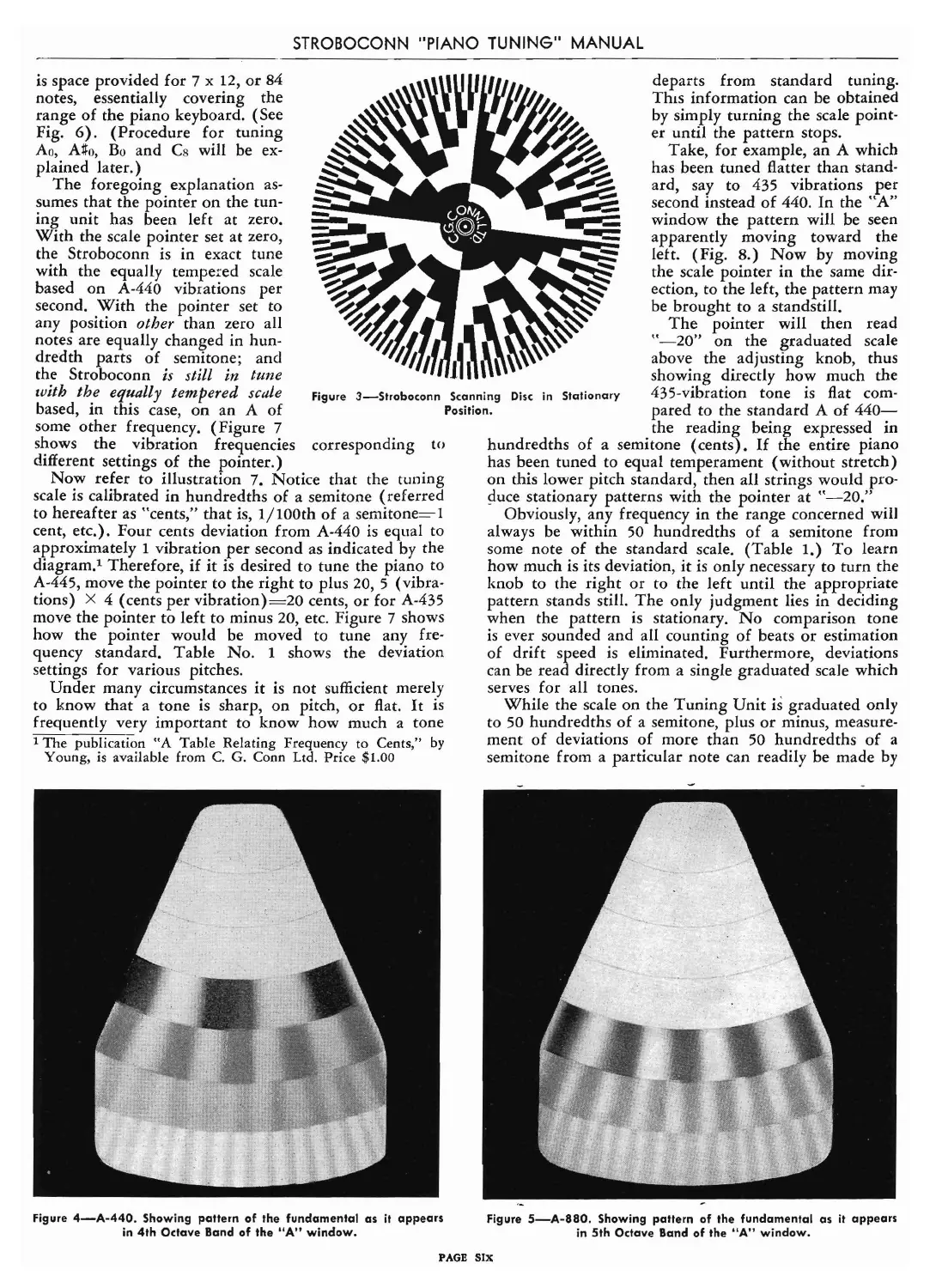
Figure
4-A-440.
Showing
pattern
of
the
fundamental
as
it
appears
in
4th
Octave
Band
of
the
"A"
window.
Figure
5-A-880.
Showing
pattern
of
the
fundamental
as
it
appears
in
5th
Octave Band
of
the
"A"
window.
PAGE
Six


 To Next Page
 Loading...