EasyManua.ls Logo

COOK VCR - User Manual

COOK VCR
8 pages
Print Icon
To Next Page IconTo Next Page
Loading...
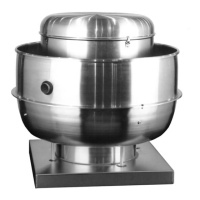
Centrifugal Roof and Wall Exhausters
INSTALLATION, OPERATION, AND MAINTENANCE MANUAL
This publication contains the installation, operation
and maintenance procedures for standard units of the
VCR/VCRD/VCR-HP/VCRD-HP/VCR-XP/VCRD-XP -
Centrifugal Roof and Wall Exhausters. Carefully read
this publication prior to installation or maintenance
procedure.
Loren Cook catalog, VCR, provides additional informa-
tion describing the equipment, fan performance, available
accessories and specification data.
For additional safety information, refer to AMCA publica-
tion 410-96, Safety Practices for Users and Installers of
Industrial and Commercial Fans.
All of the publications listed above can be obtained from
Loren Cook Company by phoning (417)869-6474, exten-
sion 166; by FAX at (417)832-9431; or by e-mail at
info@lorencook.com.
For information and instructions on special equipment,
contact Loren Cook Company at (417)869-6474.
Receiving and Inspection
Immediately upon receipt of a VCR fan, carefully inspect
the fan and accessories for damage and shortage.
• Turn the wheel by hand to ensure it turns freely and
does not bind.
• Record on the Delivery
Receipt any visible sign of
damage.
Handling
Lift the fan by the lifting lugs
provided under top cap. Never lift
by the shaft, motor or housing.
Storage
If the fan is stored for any
length of time prior to installation,
store it in its original shipping
crate and protect it from dust,
debris and the weather.
Installation
If the fan was delivered with the motor unmounted, see
the maintenance sections for belt and pulley installation.
If the fan was purchased as a wall mount unit and a
grease terminator or grease trough was not purchased, a
WARNING
This fan has rotating parts. Safety precautions
should be exercised at all times during installation,
operation, and maintenance.
ALWAYS disconnect power prior to working on fan.
1-1/16 inch diameter drain hole should be inserted on the
bottom side of the unit for drainage.
Fan Installation
a. Ensure the fan discharge is a minimum 40 inches
above the roof surface and a minimum of 10 foot from
any building air intake in order to comply with NFPA 96.
b. Minimum exhaust velocity in the duct should be 1500
FPM in accordance with NFPA 96.
c. If the fan is installed on a surface that is not level, install
the fan in a position that places the drain tube at the
lowest position.
d. Secure the fan to the roof curb at all four corners using
a minimum of four anchor bolts, lag screws or other
suitable fastener.
Personal Safety
Disconnect switches are recommended. Place
the disconnect switch near the fan in order that
the power can be swiftly cut off in case of an
emergency, and in order that maintenance per-
sonnel are provided complete control of the
power source.
VCR
VCR / VCRD
Lifting Lugs
Question and Answer IconNeed help?

Do you have a question about the COOK VCR and is the answer not in the manual?

Summary

Installation, Operation, and Maintenance Manual

Receiving and Inspection

Inspect the fan and accessories for damage and shortage upon receipt.

Handling

Lift the fan using the provided lifting lugs, not the shaft or housing.

Storage

Store the fan in its original shipping crate, protected from dust and weather.

Installation Procedures

Install fan according to specifications, including drain hole placement if needed.

Personal Safety Precautions

Disconnect switches are recommended for emergency power cutoff.

Fan Installation Guidelines

Ensure proper discharge height, duct velocity, level mounting, and secure fastening.

Wiring Installation and Safety

Wiring Installation Requirements

Follow local codes and NEC for wiring, ensure proper wire capacity and connections.

Electrical Safety

Use disconnect switches near the fan for emergency power control.

Fan Wiring Connections

Connect motor via junction box or field compartment; ensure proper sealing.

Final Installation Steps and Torque

Final Installation Steps

Tighten fasteners, check voltage, ensure proper rotation and clearances.

Recommended Torque Specifications

Table of recommended torque values for setscrews and hold-down bolts.

Wiring Diagrams

Single Phase Motor Wiring

Diagrams for single-speed and two-speed single-phase motors.

Three Phase Motor Wiring

Diagrams for three-phase motors, including Y and Delta connections.

VCRD Motor Wiring

Wiring diagrams for VCRD models with Shade Pole, PSC, or 2-Speed PSC motors.

Operation and Pre-Start Checks

Pre-Start Checks

Perform safety lockouts, check fasteners, belts, motor wiring, and wheel rotation.

Start Up Procedure

Turn on fan at low speed, inspect for rotation, vibration, noise, and electrical issues.

Inspection and Maintenance Schedule

Periodic Inspections

Conduct inspections at 30 min, 8 hour, and 24 hour intervals for bolts and belts.

General Maintenance

Establish a schedule for inspecting all parts, including bolts, belts, and bearings.

Grease Terminator Maintenance

Regularly inspect and change the Grease Terminator as needed.

Lubrication Guidelines

Use specified petroleum lubricant for bearings; avoid other grades unless flushed.

Motor and Fan Bearing Service

Motor bearings are sealed; lubricate fan bearings per schedule and conditions.

Shaft Speed Adjustment and Motor Service

Motor Service Information

Contact local representative for defective motors within the warranty period.

Changing Shaft Speed

Adjust variable pitch pulleys to change fan speed, then check belt tension.

Speed Adjustment Procedures

Open pulley for speed reduction; close pulley for speed increase, minding limits.

Pulley and Belt Replacement

Replacing Pulleys and Belts

Steps for removing and replacing pulleys and belts, including cleaning shafts.

Pulley Alignment

Adjust pulley alignment using motor plate and checking gap tolerance.

Belt Tension Adjustment

Adjust belt tension via motor plate; proper tension indicated by belt deflection.

Bearing Replacement and Wheel Adjustment

Bearing Replacement

Procedure for removing old bearings and installing new ones on the shaft.

Wheel Replacement

Instructions for drilling, tapping, and using a puller to remove the wheel.

Wheel-to-Inlet Clearance

Verify and adjust wheel-to-inlet clearance for optimal fan performance.

Troubleshooting Guide

Low Capacity or Pressure Issues

Check rotation, inlet conditions, and wheel alignment for low performance.

Vibration and Noise Problems

Address unbalanced wheels, belt issues, speed, rotation, and bearing lubrication.

Overheated Motor Causes

Investigate wiring, rotation, cooling air, inlet clearance, RPM, and voltage.

Overheated Bearings

Check bearing lubrication and belt tension for overheating issues.

Parts List and Warranty

VCR;VCR-HP;VCR-XP Parts

List of parts for VCR, VCR-HP, and VCR-XP models with part numbers.

VCRD;VCRD-HP;VCRD-XP Parts

List of parts for VCRD, VCRD-HP, and VCRD-XP models with part numbers.

Limited Warranty

Details the one-year warranty for defects in materials and workmanship.

COOK VCR Specifications

General IconGeneral
BrandCOOK
ModelVCR
CategoryKitchen Appliances
LanguageEnglish