Heat
8
8
Compare with the thermometer with Celsius scale, which shows 100 equal
divisions between the marked two points (0 °C to 100 °C).
Materials: 1 thermometer without graduation (4)
1 thermometer -3 °C to 103 °C (5)
1 plastic beaker (9)
1 red peg (12)
1 blue peg (12)
1 immersion heater (13)
1 beaker, heat-resistant (16)
Additionally: 1 thermos flask containing hot water, 1 thermos flask con-
taining ice cold water
1.6 Experiment 6
Taking temperature measurements and reading exercises
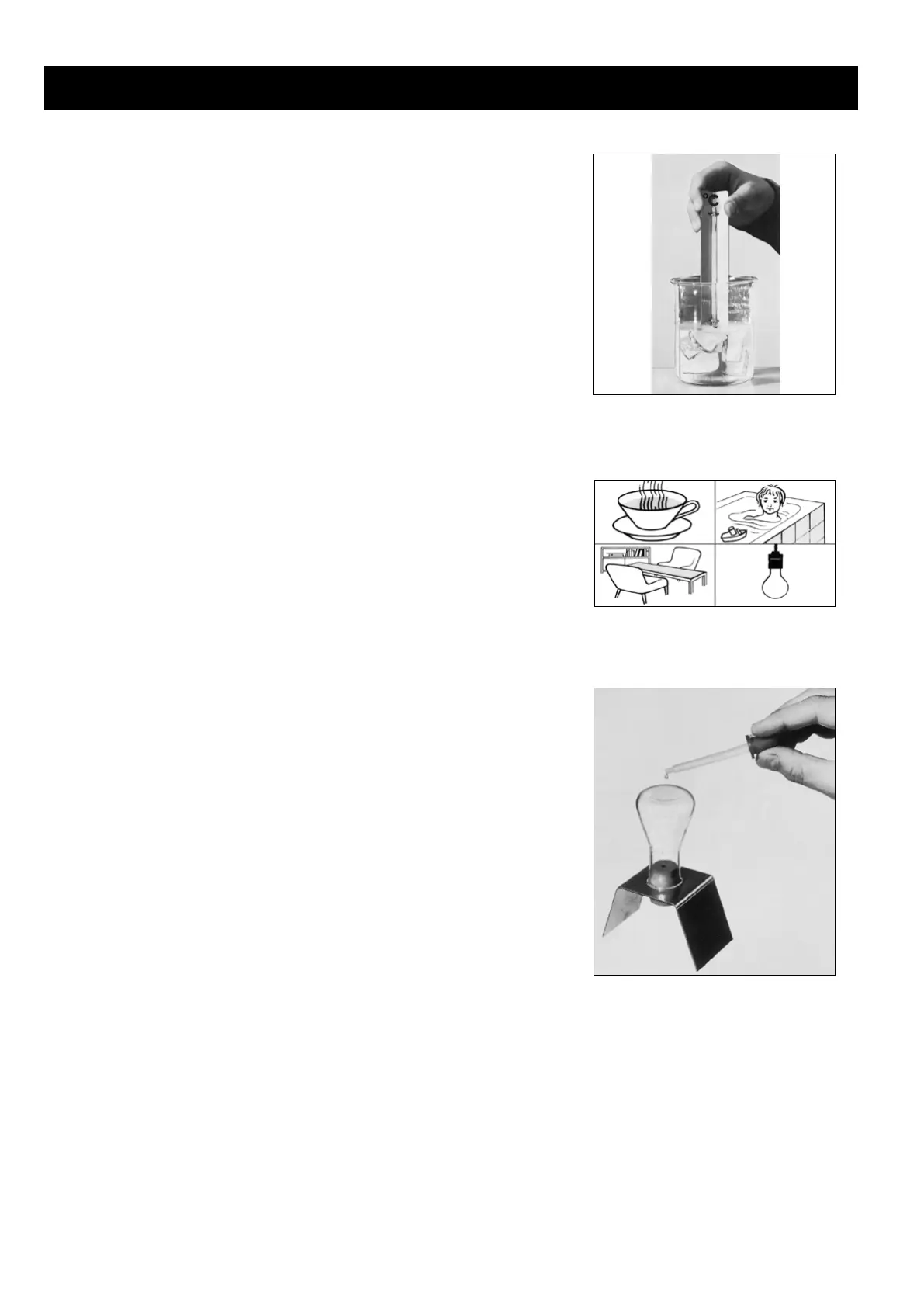
The thermometer can be used to measure different temperatures e.g. class-
room temperature, temperature of cold and warm water, hot tea, tempera-
ture of bulb after light has been switched on for a few minutes etc.
For reading exercises and entries the worksheet at the end of this manual
should be photocopied.
Material: 1 thermometer, -3 °C to +103 °C (5)
1.7 Experiment 7
Converting a liquid into a gas
Close the Erlenmeyer flask with the rubber stopper, invert it and place on the
stand. Place a drop of Eau-de-Cologne or methylated spirits on the middle
of the base of the flask using a dropper.
The drop becomes smaller and smaller until it is no longer visible. The liquid
has vaporized/evaporated. It has turned into a gas.
A gas consists of tiny particles, invisible to the naked eye. However, it is some-
times possible to smell these particles even when the liquid has evaporated
completely, e.g. in the case of Eau-de-Cologne or methylated spirits.
Materials: 1 dropper (2)
1 Erlenmeyer flask (10)
1 rubber stopper (18)
1 bridge-shaped stand (19)
Additionally: Eau-de-Cologne or methylated spirits


 To Next Page