10
109117-1 Rev. A, 10/96
3.1 Basic Theory
pH is the unit of measurement of the acidity or alkalinity of a
solution, and is expressed as the negative logarithm of the
hydrogen ion concentration:
pH = –log[H
+
]
pH 0 is very acidic, pH 14 is very alkaline and pH 7 is neutral.
For routine pH measurements a sensing electrode and a
reference electrode or a combination electrode (both electrodes in
one body) are used along with a meter capable of displaying the
measurements.
The pH sensing electrode has an internal solution with a
constant pH value, and develops a potential when placed in a
solution. This is caused by the activity of the H
+
ions in the
solution. The reference electrode has a defined, stable potential
irrespective of the H
+
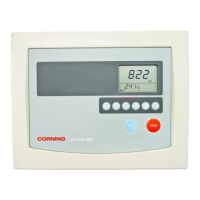
activity in the sample. The Model 430
measures and converts the resulting minute electrode voltages
into a pH reading.
The response of a pH electrode (or its ‘slope’) is defined by the
Nernst equation:
Electrode response = E
0
– 2.3RT . pH
nF
where: E
0
= a constant factor
R = the gas constant
F = the Faraday constant
T = the temperature in Kelvin
n = the ionic charge
The theoretical slope for an electrode is 59.16 mV where the H
+
ionic charge (n) = 1 at 25°C (298K). This means that for a one
unit change in pH the system will sense a change of 59.16 mV.
The measurement of electrode slope is a good indication of
electrode condition.
3



 To Next Page