6
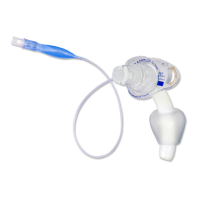
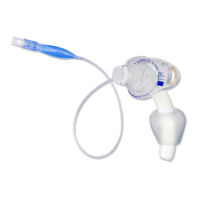
2. With the Shiley Disposable Cannula Cued models (DCT, DFEN) the cu and
ination system should be tested for leakage before inserting the tube. This test can be
performed as follows: Inate the cu with the volume of air indicated in Tables 1 and
2. Then either observe for deation over several minutes or immerse the tube in sterile
saline and observe for air leakage. Deate the cu prior to insertion.
Insertion
CAUTION:
To ease insertion and to guard against cu perforation from sharp edges of
cartilage, the cu should be tapered back. This can be accomplished by rst
inating the cu. Then gently move the cu away from the distal tip of the
outer cannula towards the swivel neck plate as the residual air is removed by
deation. Do not use any sharp instruments such as forceps or hemostats that
would damage the cu when tapering it.
3. Remove the disposable inner cannula and insert the obturator into the outer
cannula. The obturator should be fully seated before the tube is inserted into the
patient. A thin lm of water soluble lubricant can be applied to the outer cannula, cu,
and protruding portion of the obturator to facilitate insertion.
4. After the tracheostomy procedure is performed, insert the tube into the patient’s
trachea. After the tube is properly in place, remove the obturator immediately.
CAUTIONS:
When using a water soluble lubricant verify that the lubricant does not enter
and occlude the tube lumen which may restrict ventilation.
The obturator should be cleaned and then stored in an accessible location near
the patient should it be needed for an unscheduled re-intubation.
WARNINGS:
THE SHILEY DISPOSABLE INNER CANNULA PROVIDED IN THIS PACKAGE CAN
ONLY BE REPLACED BY A SHILEY DISPOSABLE INNER CANNULA (DIC) OF THE
SAME SIZE NUMBER.
A DISPOSABLE INNER CANNULA (DIC) SHOULD BE WITH THE PATIENT AT ALL
TIMES. IN THE EVENT OF RESPIRATORY DISTRESS, THE DISPOSABLE INNER
CANNULA (DIC) MUST BE INSERTED TO MECHANICALLY VENTILATE THE PATIENT.
DURING AND AFTER ATTACHMENT OF RESPIRATORY OR ANESTHESIA
TUBING AND/OR CONNECTORS TO THE DISPOSABLE INNER CANNULA, AVOID
APPLICATION OF EXCESSIVE ROTATIONAL, LINEAR, OR ROCKING FORCES ON
THE TUBING AND/OR CONNECTORS TO PREVENT ACCIDENTAL DISCONNECTION
OF THE DISPOSABLE INNER CANNULA, OR DAMAGE TO THE TRACHEOSTOMY
TUBE.
5. Insert the disposable inner cannula with 15 mm connector and lock into position.
To lock the disposable inner cannula in place, push connector until both snap-locks






 To Next Page