Need help?
Do you have a question about the Craftsman 113.201392 and is the answer not in the manual?
Information on finding the welder's model and serial number.
Important safety warning to read instructions before operating.
Key measures to prevent electrical hazards during welding operations.
Safeguarding eyes and body from welding arc hazards and debris.
Precautions for handling flammable materials near the welding area.
Essential steps for maintaining the welder in safe operating condition.
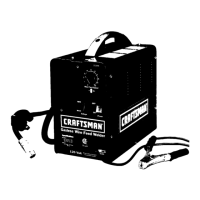
Key safety instructions and identification of welder components.
Details on warranty coverage, service, and customer rights.
Technical details including welding range, voltage, and dimensions.
Guide to unpacking the welder and identifying included parts.
Tools needed and steps for attaching the electrode holder.
Instructions for connecting the work clamp to the welding cable.
Guidelines for safely connecting the welder to a 230-volt power source.
Procedures for connecting electrode and work cables to the welder.
Explanation of the dual range settings and their applications.
Guidance on choosing electrode size and adjusting amperage.
Step-by-step instructions for initiating welding operations.
Solutions for common problems like no operation or weak current.
Maintenance advice for the fan motor and electrical contacts.
Introduction to the guide on welder capabilities and techniques.
Explains the welder's features and how the electrode simplifies welding.
Detailed explanation of how arc welding fuses metal.
Details on protective gear like helmets, gloves, and clothing.
Guidelines for ensuring a safe welding area and selecting tools.
How to practice striking and maintaining a stable welding arc.
Methods for laying weld beads and controlling movement.
Adjusting current, travel speed, and arc length for quality welds.
Visual examples of good and bad welds and their causes.
Techniques for reinforcing or building up surfaces with weld metal.
Explains various joint types like butt, fillet, and lap welds in flat position.
Specific guidance for welding thin sheet metal and preventing burn-through.
How to measure fillet welds and determine their strength.
Practice methods for fillet welds in various joint configurations.
Techniques for performing fillet welds in a horizontal position.
Methods for lap welding and managing metal distortion.
Instructions for vertical-down and vertical-up welding techniques.
Detailed steps for performing vertical-up welds effectively.
Techniques for welding horizontal butt joints.
Guidance on performing welds in the overhead position.
How heat affects metal and causes expansion/contraction.
Steps for welding cast iron, including material preparation.
Methods to prevent cracking during cast iron welding.
Techniques for applying hard surfacing to wear-resistant parts.
Connecting and setting up the twin-carbon arc torch.
Correct flame positioning and applications for the torch.
How to use the arc welder for cutting metal efficiently.
Methods for brazing and soldering using the arc torch.
Using the arc welder for bolt removal and hole creation.
Using the carbon arc for controlled heating of metal.
Using the HF attachment with the welder for TIG welding.
Explains the basic concepts and heat source for TIG welding.
How to feed filler rod during TIG welding operations.
Guide to choosing gases and current for TIG welding different materials.
Common uses for the E-6011 mild steel AC-DC electrode.
Details on E-6011 electrode sizes, amperage, and properties.
Common uses for the E-6013 mild steel AC-DC electrode.
Details on E-6013 electrode sizes, amperage, and properties.
Uses for hard-surfacing electrodes on wear-resistant parts.
Details on hard-facing electrode properties and welding technique.
Common applications for the E-7014 contact electrode.
Details on E-7014 properties and recommended welding methods.
Uses for machinable cast iron electrodes in repairs.
Uses for cutting rods in metal preparation and fabrication.
Visual representation of all replaceable parts for the welder.
Detailed list of part numbers and their corresponding descriptions.
Information on how to obtain service for the welder.
Instructions on providing necessary information for ordering parts.
 General
| Input Voltage | 115V |
|---|---|
| Input Current | 20A |
| Output Current | 90A |
| Type | MIG |
| Wire Size | 0.023 in |

 To Next Page