Need help?
Do you have a question about the Craftsman 196.205680 and is the answer not in the manual?
Details the limited three-year warranty for the welder, covering defects in material or workmanship.
Provides guidelines for safe operation, defining WARNING, CAUTION, and NOTE indicators.
Explains the meaning of hazard symbols like electric shock, fire, and fume hazards found in the manual.
Outlines critical precautions to prevent electric shock, including grounding and avoiding wet conditions.
Details risks associated with arc rays, emphasizing eye and skin protection like welding helmets and shields.
Warns about fire and explosion risks, advising on clearing flammable materials and proper clothing.
Addresses risks from welding fumes, gasses, and vapors, stressing ventilation and respirator use for toxic materials.
Lists relevant industry standards (ANSI, NFPA, OSHA, CSA) for welding safety compliance.
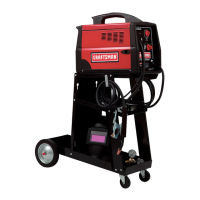
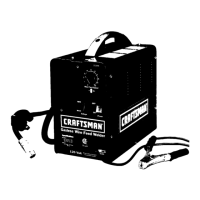
Identifies and explains the function of key parts like the handle, wire speed control, voltage selector, and power switch.
Defines essential welding terminology such as weld puddle, slag, arc, and welding bead for clarity.
Guides on how to unpack the welder, inspect parts, and identify them using the packing list.
Instructions for attaching the welder handle and assembling the provided face shield.
Details on safely connecting the welder to a suitable power source, emphasizing grounding.
Recommendations for selecting and using extension cords to ensure proper welder performance and safety.
Step-by-step guide for loading the welding wire spool into the welder's feed mechanism.
Lists technical specifications and explains the welder's duty cycle rating and its implications for usage.
Explains the function of the welder's power switch and voltage selector for operation.
Advice on positioning the work piece and preparing the joint for effective welding.
Instructions on cleaning and preparing metal surfaces, including beveling for thicker materials.
Details the importance of a secure ground clamp connection for completing the welding circuit.
Introduces MIG welding basics, practice methods, and proper gun handling for effective welds.
Explains the correct angles (Angle A, Angle B) and distance for the welding gun relative to the workpiece.
Provides instructions on how to create a consistent weld bead, emphasizing nozzle contact and arc sputtering.
Describes the elements of gun travel: direction (push/pull) and speed, and their effect on weld quality.
Discusses stringer beads and weave beads, explaining their formation and use.
Details the three basic welding positions: Flat, Horizontal, and Vertical, with guidance for each.
Explains techniques for butt and fillet welds requiring multiple passes for thicker materials.
Introduces spot welding methods like Burn-Through, Punch and Fill, and Lap.
Outlines basic maintenance steps like keeping compartments closed and cleaning the welder.
Emphasizes the importance of maintaining consumables like contact tips and nozzles to prevent gun damage.
Explains the function of the contact tip and how to maintain or replace it for efficient current transfer.
Stresses the importance of cleaning the nozzle to prevent damage to the gun assembly and ensure proper function.
Describes a method to test the welding nozzle for continuity issues that can affect performance.
Provides detailed instructions for replacing the gun liner, including disassembly and reassembly steps.
Introduces the troubleshooting section and the table that helps diagnose and resolve common welder issues.
A comprehensive table listing common problems, their possible causes, and recommended remedies for the welder.
A detailed list of all components for the Model 196.205680 welder, with part numbers and quantities.
A detailed list of components specific to the welding gun assembly, including part numbers.
A schematic illustrating the electrical connections and components within the gasless wire feed welder.
Provides recommended voltage and wire speed settings based on steel thickness for optimal welding results.
 General
| Brand | Craftsman |
|---|---|
| Model | 196.205680 |
| Category | Welding System |
| Language | English |

 To Next Page