The NiftyCASE is a Eurorack modular synthesizer case that also functions as a MIDI-to-CV/Gate converter, allowing users to integrate their Eurorack modules with MIDI keyboards, sequencers, and Digital Audio Workstations (DAWs). It provides a convenient way to control voltage-controlled oscillators (VCOs), envelopes, and other modules using MIDI messages.
Function Description
The primary function of the NiftyCASE is to house and power Eurorack modules while providing MIDI-to-CV/Gate conversion capabilities. It features a built-in USB to MIDI/CV converter, eliminating the need for external interfaces when connecting to a computer. The case offers a variety of input/output (I/O) options to facilitate integration with other audio equipment.
Top I/O:
- CV1 & CV2 Outputs: These outputs transmit variable control voltages (CV) according to the Eurorack 1 volt per octave standard, ranging from 0-10 Volts (a ten-octave span). They are typically used to control the pitch of VCOs. CV1 responds to incoming MIDI notes on MIDI channel 1, and CV2 responds to MIDI notes on MIDI channel 2. Both CV outputs also respond to MIDI channels 3 and 10.
- Gate1 & Gate2 Outputs: These outputs are either on (5V) or off (0V). They are used to turn voices on or off or to trigger envelope modules. Gate1 responds to MIDI notes on MIDI channel 1, and Gate2 responds to MIDI notes on MIDI channel 2. Both gate outputs also respond to MIDI channels 3 and 10.
- Mod (Modulation Wheel) Output: This output transmits a variable control voltage (CV) ranging from 0V to 10V. It responds to MIDI CC#1 (mod wheel) transmitted to NiftyCASE on MIDI channel 1.
- Clock Output: This output transmits a 20ms 5V pulse on every 1/8th of a bar. It responds to incoming MIDI clock signals and is used to synchronize other modules to a master MIDI keyboard or sequencer.
- "to out" Input Jacks: These two 3.5mm mono (TS) audio input jacks are summed (mixed) and sent out of the 1/4" "audio out" jack at the rear of the NiftyCASE.
Rear I/O:
- "Audio out" Output Jack: This 1/4" mono (TS) unbalanced jack outputs the summed audio signals from the "to out" jacks on the top of the NiftyCASE. It connects to a mixer or audio interface.
- MIDI Thru: This DIN5 MIDI port transmits any MIDI information received at the "midi in" port or via MIDI-over-USB, allowing for daisy-chaining of MIDI devices.
- MIDI In: This DIN5 port connects to a MIDI keyboard or sequencer to control the NiftyCASE.
- USB Port: This USB type B port connects to a computer for MIDI-over-USB control. The NiftyCASE can also send MIDI received at its "midi in" port over USB to a computer, functioning as a bi-directional USB-MIDI interface.
- Power In: For connecting the power supply.
MIDI Implementation:
The NiftyCASE handles MIDI messages differently depending on the MIDI channel:
- MIDI Channel 1 (CV1/GATE1 monophonic): Controls CV1 and Gate1.
- MIDI Channel 2 (CV2/GATE2 monophonic): Controls CV2 and Gate2.
- MIDI Channel 3 (CV1/GATE1 + CV2/GATE2 duophonic): The first note outputs on CV1/GATE1, and the second note outputs on CV2/GATE2, enabling control of two voltage-controlled oscillators simultaneously.
- MIDI Channel 10 (Drum Mode): Transforms NiftyCASE into a 5-channel drum trigger machine. The first five top jacks (CV1, Gate1, CV2, Gate2, Mod) behave as gates (0V closed, 5V open) and respond to specific MIDI notes (C1, C#1, D1, D#1, E1) to trigger drum modules, advance sequencers, or other percussive modules.
In monophonic modes (CH1 or CH2), the respective gates open (output 5V) when the first Note On message is received and close (output 0V) when the last key is released. The NiftyCASE also responds to pitch bend CC messages on all three channels, with a range of +/- 1V (one octave up or down). It uses a highest-note priority system on both channels.
Usage Features
Quick Start with a MIDI Keyboard:
- Connect a DIN5 MIDI cable from your MIDI keyboard's output to the NiftyCASE's "midi in" port.
- Connect a 1/4" mono (TS) audio cable from the NiftyCASE's rear "audio out" jack to an audio mixer or sound interface.
- Connect a 3.5mm mono (TS) patch cable from the NiftyCASE's CV1 output to the top tune input jack of your VCO module (e.g., Chipz).
- Connect another 3.5mm mono (TS) patch cable from your VCO module's "out" jack to one of the NiftyCASE's "to out" input jacks.
- Power on both NiftyCASE and your keyboard, ensuring the keyboard's MIDI output channel is set to 1.
- Play your keyboard; the NiftyCASE LED will blink, and the CV1 output voltage will change, updating the VCO's tune/pitch.
Controlling with a Software Sequencer (DAW):
- Connect a USB type B cable between the NiftyCASE's USB port and your computer.
- Connect a 1/4" mono (TS) audio cable from the NiftyCASE's rear "audio out" jack to an audio mixer or sound interface.
- Connect a 3.5mm mono (TS) patch cable from the NiftyCASE's CV1 output to the top tune input jack of your VCO module (e.g., Chipz).
- Connect another 3.5mm mono (TS) patch cable from your VCO module's "out" jack to one of the NiftyCASE's "to out" input jacks.
- Power on NiftyCASE and launch your DAW (e.g., Ableton Live).
- Configure your DAW to send MIDI track information to the NiftyCASE MIDI output (e.g., set "MIDI To" to Cre8audioNiftyCASE and channel to Ch. 1 in Ableton's preferences).
- Sequence your music; the NiftyCASE LED will blink with new notes, and the CV1 output voltage will change, updating the VCO's tune/pitch.
Status LED:
The Status LED indicates power (stays lit when powered and in standby) and incoming MIDI (briefly blinks when MIDI is received). When MIDI clock is received, it blinks on every 1/8th of a bar, serving as a visual metronome.
Maintenance Features
Checking Connections:
Before initial power-up, it's recommended to check all connections to ensure nothing has moved during transit.
- Carefully unscrew and remove any modules and blank panels using the included Allen key.
- Ensure the IDC bus cable is firmly connected to the mainboard.
- Check that the smaller FFC flat cable (between the main board and I/O connector circuit board) is also firmly in place.
- Reseat any loose cables if necessary. A video guide for checking connections is available at https://www.cre8audio.com/checking-connections.
Installing Modules:
- Always turn off the NiftyCASE before adding or removing modules to prevent damage.
- Observe the correct cable orientation: the red line on the cables should always face down.
- Use the supplied tool to remove and replace the M3 (3mm) thread screws.
Troubleshooting:
- USB C connectivity on Mac: Not all USB C hubs and adapters work consistently; Apple-branded ones are recommended.
- High output level on rear "audio out": This is normal as the rear output passes the level from the "to-out" inputs without attenuation. Consider adding a VCA, mixer, or other signal level adjustments before plugging into "to-out" if the level is too high.
- Adding more than 10 modules: An additional flying bus board cable can be added to the NiftyCASE's flying bus.
- Windows computer not detecting NiftyCASE: Look for "Cre8audioNiftyCASE" in the Windows Device Manager. If it appears under "Unknown devices" with an "!" icon, right-click and uninstall it. Unplug and re-plug the USB cable to refresh the driver. No specific drivers are required.
- Older MacBook not detecting NiftyCASE: Some older MacBooks (specifically i7 processor-equipped from around 2012) may require a powered USB hub to operate with NiftyCASE.

 Need help?
 General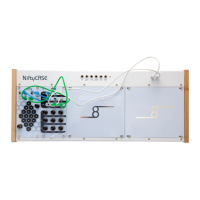

 To Next Page