Need help?
Do you have a question about the Crosley CR6037A and is the answer not in the manual?
Essential guidelines for safe operation, handling, and electrical safety of the turntable.
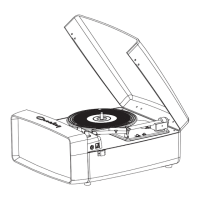
Identifies and labels the key physical parts and features of the turntable unit.
Step-by-step guide on placing records, starting, and stopping playback.
Instructions for connecting external speakers via the auxiliary output jack.
Explanation of how to adjust the turntable's playback speed using the pitch control.
Detailed procedures for safely removing and installing the stylus/needle.
Regulatory information regarding the turntable's compliance with FCC rules for radio frequency energy.
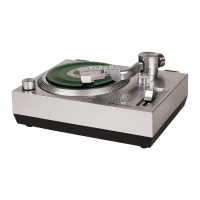
The Crosley CR6037A RSD3 Mini Turntable is a compact and portable record player designed for enjoying your vinyl collection. This instruction manual provides comprehensive guidance on its operation, features, and maintenance, ensuring a smooth and enjoyable user experience.
At its core, the CR6037A functions as a standalone turntable, capable of playing 33 1/3 RPM records. It features a turntable spindle and platter where records are placed. The tonearm, equipped with a headshell and a replaceable needle (Crosley NP5), is responsible for reading the grooves of your vinyl. An On/Off-Volume Knob controls both the power to the unit and the output volume of the integrated speaker. A power indicator light provides visual confirmation when the unit is active. For records with larger center holes, a record adapter is included.
Beyond its primary function of playing records, the CR6037A offers auxiliary output capabilities. A Headphone/Aux Out Jack allows you to connect external active speakers or headphones, enabling you to enjoy your music through a different audio system or privately. This expands the listening possibilities beyond the built-in speaker.
The turntable is designed for portability, indicated by its "Mini Turntable" designation. It can be powered either by a Micro USB Cable or by 4 x AAA Batteries (not included), offering flexibility for use in various locations, whether at home or on the go.
Operating the CR6037A is straightforward, with clear steps outlined in the manual. To begin playing a record, you first place the record on the turntable platter, using the record adapter if necessary for 7-inch singles. The On/Off-Volume Knob is then rotated to power on the unit. Before lowering the tonearm, it's crucial to remove the stylus protector from the stylus assembly to prevent damage to the needle. The manual emphasizes the importance of keeping the stylus guard in place when the turntable is being moved or cleaned.
Once the stylus protector is removed, the tonearm is lifted from its rest. The tonearm rest serves to secure the tonearm when the turntable is not in use, preventing accidental movement and potential damage to the stylus. The tonearm is then carefully moved over the record to the desired starting point. A gentle lowering of the tonearm onto the record initiates playback. When the record finishes playing, the tonearm should be lifted and returned to the tonearm rest, and then pushed into the rest to secure it.
A key usage feature is the Pitch Control. This allows for fine-tuning of the turntable's speed, offering approximately a 10% increase or decrease. By pushing the Pitch Control up, the speed increases, and by pushing it down, the speed decreases. This feature can be useful for correcting slight variations in record playback speed or for creative manipulation of the audio.
The auxiliary output connection enhances the versatility of the CR6037A. By connecting a 3.5mm auxiliary cable between the unit's Headphone/Aux Out Jack and active speakers, users can amplify their music through a larger sound system. This is particularly useful for those who desire a more robust audio experience than the built-in speaker can provide.
Proper maintenance is essential for the longevity and optimal performance of the CR6037A, particularly concerning the needle. The manual provides clear instructions for needle replacement, a common maintenance task for turntables. The process involves three simple steps for removal: gently pulling down the front edge of the needle, pulling it forward, and then pulling it out.
Installing a new needle is equally straightforward. The new needle should be positioned with its tip facing down, and its back aligned with the cartridge. It is then inserted with its front end at a downward angle, and gently lifted upward until it snaps securely into place. This detailed guidance ensures that users can confidently replace the needle themselves, maintaining sound quality and extending the life of their turntable.
The manual also includes general safety instructions that contribute to the overall maintenance and care of the device. These instructions advise against using the product near water, ensuring it is operated with the correct power source, and protecting the power cord from damage. Users are cautioned against overloading wall outlets or extension cords, and against pushing objects into the product's openings. Spilling liquids on the product is also to be avoided. These precautions are crucial for preventing electrical hazards and ensuring the long-term reliability of the turntable.
Furthermore, the manual advises against attempting to service the product oneself, recommending that all servicing be referred to qualified personnel. This prevents potential damage to the unit and ensures that any repairs are carried out safely and correctly. Changes or modifications not expressly approved by the manufacturer could void the user's authority to operate the equipment, underscoring the importance of adhering to the provided guidelines.
Ventilation is another aspect of maintenance addressed in the safety instructions. Slots and openings in the cabinet are provided for ventilation to ensure reliable operation and prevent overheating. Users are instructed not to block or cover these openings, which is vital for maintaining the internal temperature of the device and preventing component failure.
Finally, the manual suggests unplugging the product during lightning storms or when it will be unused for long periods. This protects the device from potential power surges and conserves energy, contributing to its overall maintenance and care.
 General
| Drive Type | Belt Drive |
|---|---|
| Built-in Speakers | Yes |
| USB Output | Yes |
| Cartridge Type | Moving Magnet |
| Power Source | AC Adapter |
| Speeds | 33 1/3, 45 RPM |
| Connectivity | USB, RCA, headphone jack |
| Stylus | Diamond |
| Outputs | RCA |
| Type | Belt Drive Turntable |

 To Next Page