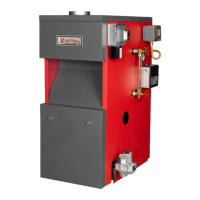
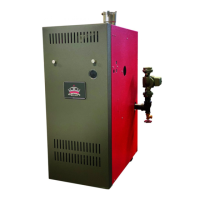
The KSB Series Oil-Fired Steam Boilers are designed for residential and commercial hydronic heating applications. These boilers are a cast iron, oil-fired, low-pressure steam design, suitable for use in closed heating systems. They can be vented by natural draft into a lined masonry or metal chimney, or Type L vent. An adequate supply of air for combustion, ventilation, and dilution of flue gases must be available in the boiler room. These boilers are also designed for use with an indirect domestic water heater.
Function Description:
The KSB Series boilers function by burning fuel oil to heat water, generating steam for heating purposes. The steam is then distributed through a closed heating system to provide warmth. Some models also support an indirect domestic water heater, allowing them to provide hot water for domestic use in addition to space heating. The system includes components like a burner, heat exchanger, pressure gauge, safety relief valve, and various controls to ensure safe and efficient operation.
Important Technical Specifications:
The KSB Series includes several models, each with varying heating capacities and dimensions. Key specifications include:
- Boiler Models: KSB065, KSB075, KSB100, KSB125, KSB150, KSB175, KSB200.
- Burner Input (Gal/Hr): Ranges from 0.55 for KSB065 to 1.90 for KSB200.
- Heating Capacity (MBH): Ranges from 70 for KSB065 to 230 for KSB200.
- Net AHR Rating (Steam MBH): Ranges from 59 for KSB065 to 173 for KSB200.
- AFUE %: All models have an AFUE of 85.1% or 85.3%.
- Dimensions (in.):
- "A" (Width): Ranges from 17-3/8 to 27-3/8.
- "B" (Depth): Ranges from 8-5/16 to 13-5/16.
- "C" (Height): Ranges from 6 to 8.
- Optional Tankless Heater Ratings (GPM):
- KSB065: 2.00 GPM
- KSB075: 2.25 GPM
- KSB100: 2.50 GPM
- KSB125: 2.75 GPM
- KSB150: 3.00 GPM
- KSB175: 3.25 GPM
- KSB200: 3.50 GPM
- Tankless heater ratings are based on 40°F inlet water, 140°F outlet water, and 190°F boiler water. Ratings are also based on 5 minute intermittent draws with 10 minutes between draws.
- Ventilation: Requires adequate air for combustion, ventilation, and dilution of flue gases. Minimum free area for openings into the boiler room is specified based on BTU/hr input.
- Piping: Designed for gravity return systems. Specific piping configurations are detailed for supply, return, and equalizer lines.
- Electrical: Requires 120 Volt connections and a 15A branch circuit with fused disconnect.
Usage Features:
- Oil-Fired Operation: Uses fuel oil for combustion, requiring a reliable fuel oil supply system.
- Steam Heating: Provides steam for hydronic heating systems, suitable for radiators and other steam-compatible heat emitters.
- Indirect Water Heater Compatibility: Many models can be equipped with an indirect water heater to provide domestic hot water, enhancing versatility.
- Natural Draft Venting: Designed for natural draft operation, simplifying installation in homes with existing chimneys or Type L vents.
- Safety Controls: Equipped with various safety devices, including a safety relief valve, pressure limit control, and low water cut-off, to ensure safe operation and prevent overheating or dry firing.
- User Manual Guidance: Comprehensive instructions are provided for installation, operation, maintenance, and troubleshooting, ensuring users can safely and effectively manage their boiler.
Maintenance Features:
- Regular Inspection: Annual inspection by a qualified service technician is recommended to ensure safe and efficient operation. This includes checking the boiler, burner, and controls.
- Boiler Cleaning: Regular cleaning of the boiler, especially the flue passages and combustion chamber, is crucial to maintain efficiency and prevent soot buildup. The frequency depends on the fuel quality and usage.
- Burner Maintenance: The oil burner requires periodic maintenance, including checking the nozzle, electrodes, and fuel pump pressure.
- Vent System Inspection: The vent connector and chimney should be inspected annually for obstructions, corrosion, and proper draft.
- Water Level Management: For steam boilers, maintaining the correct water level is critical. The low water cut-off device should be checked regularly.
- Safety Valve Checks: The safety relief valve should be manually lifted periodically to ensure it is not seized and can operate freely.
- Troubleshooting Guide: The manual includes a detailed troubleshooting section to help diagnose and resolve common issues, such as burner problems, ignition failures, and heating system malfunctions.
- Parts Availability: A comprehensive list of replacement parts is provided, along with part numbers, to facilitate repairs and maintenance.
- Refractory Ceramic Fiber (RCF) Product Safety: The manual includes important product safety information regarding RCFs, which are used in the boiler. It outlines precautions to avoid breathing RCF particulates and dust, recommending personal protective equipment during maintenance or repair activities involving RCFs. This includes wearing a NIOSH-approved respirator, long-sleeved clothing, gloves, and eye protection. It also provides first aid procedures for contact with eyes or skin and for inhalation.
The KSB Series boilers are designed for long-term reliability and efficient performance when properly installed and maintained. Adherence to all instructions and local codes is essential for safe operation.

 Need help?
 General


 To Next Page