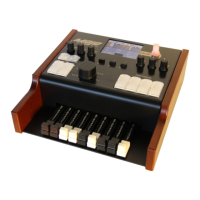
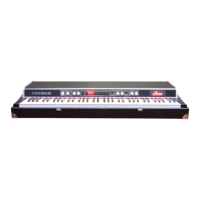
1. THE SOUND OF MOJO
VB3-II virtual tonewheel organ
The sound of Crumar Mojo is based on the same “core” of the virtual
instrument GSi VB3-II. While the virtual instrument runs on regular
computers, Mojo is built on a new dedicated DSP platform,
purposedly designed by Crumar for the new Mojo line. This means
that with Mojo not only you have access to a familiar and intuitive
organ interface controlling one of the most realistic tonewheel organ
simulations, but you also have access to a detailed and extensive parameter set that
lets you customize the organ sound in order to match your preferences any way you
like.
Sound Engine main features:
• Full polyphony (61 upper + 61 lower + 25 pedals = 147 notes)
• 91 modeled tonewheels with accurate phase synchronization
• Adjustable leakage noise and cross modulation between tonewheels
• A total of 22 different tonewheel generators to choose from
• Generator shaping for a total of 154 generator combinations
• Adjustable global tuning from 430 to 450 Hz
• Foldback on 16" deactivatable
• Complex wheels
• Resistor wiring with multiple options
• Realistic “run” motor wow & flutter
• Busbars and 9 key contact simulation
• String Bass with adjustable release time
• Loudness "robbing" effect
• Single triggered percussion with natural capacitor discharge/recharge
• Adjustable Percussion Level & Decay
• Vibrato/Chorus virtual scanner
• Adjustable Vibrato Scanner depth & mix
• Dynamic tube overdrive simulation
• Digital stereo reverb
• Rotary speaker simulation with virtual microphone positioning, tube overdrive,
tube feedback
• Rotors "Front Stop" brake position with adjustable preferred position
• Upper and Lower manuals SPLIT with adjustable split point
• Supports pedal sustain
CRUMAR MOJO CLASSIC & SUITCASE USER'S MANUAL - Page 4/20



 To Next Page