Cryomagnetics Model 4G Operating Instruction Manual
1. Introduction
1.1. Description
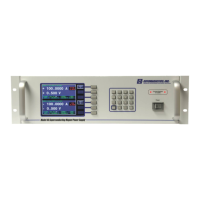
The 4G Superconducting Magnet Power Supply is an advanced instrument designed specifically for
powering superconducting magnets. It is a true four-quadrant power supply, meaning it is capable
of operating with positive current / positive voltage (sourcing power), positive current / negative
voltage (sinking power), negative current / positive voltage (sinking power), and negative current /
negative voltage (sourcing power). The supply allows the user to generate smooth sweeps through
zero current for performing hysteresis loop experiments or other research requiring smooth
magnetic field reversal.
The 4G is available in several configurations using one or two power modules. Power modules are
available as 100A, 150A, and 200A units. This architecture allows the 4G to be configured as a
single 100A, 150A, 200A, or dual 100A unit. Older dual units may be paralleled externally by the
user to provide the full 200A current capability to a single load, but this requires special operational
considerations (see Appendix E). All 4G units are capable of delivering up to ±10 volts of output
voltage. An easy-to-use menu system is provided to allow the operator to set the supply up using
the parameters of his/her particular magnet. Most of the supply operating parameters may be
changed or queried through USB and IEEE-488 interfaces.
Power supplies used for energizing superconducting magnets have unique requirements placed
upon them. The supplies are used to source energy to magnets which can have a wide range of
inductances (mH to kH). In addition, the magnet load can range from a nearly pure resistance to a
nearly pure inductance – and everything in between. This places demands on the supply that are
far beyond what a typical power supply used for bench top electronics would see. The supply will
experience the challenges of sinking energy when a magnet is discharging. At the same time, the
potential exists for either the magnet or power supply to be damaged in the event of a power failure
or magnet quench. The 4G’s advanced circuitry enables it to handle virtually any scenario
encountered in superconducting magnet operation in stride. The design of the 4G makes it a low
noise, highly efficient supply – and one that is proven stable even on the most sensitive
superconducting magnets. Versatile programmability allows the user to specify several different
sweep rates for different current ranges of the magnet – making it possible to sweep a magnet
slower in a particular range if it is more sensitive there, without user intervention


 To Next Page