B
OPERATING PROCEDURES
Read all of SAFETY and this section before attempting any procedure. Pay particular attention to Notices, Cautions, Warnings and Dangers.
23
Owner’s Guide
Fuel
To decrease the risk of severe injury or death from improper fuel handling:
Do not smoke near the fuel tank.
Do not add fuel near open flame or electrical items that can cause a spark.
Always handle gasoline in a well ventilated area.
Always wear eye protection to protect against splashed fuel and fuel vapors.
Inspect the fuel cap, tank and other components for leaks or damage that can cause a hazardous
condition.
Oxygenated or reformulated gasoline, is mixed with alcohols or ethers. Excessive amounts of these blends
can damage the fuel system or cause performance problems. If any operating problems occur, use gasoline
with a lower percentage of alcohol or ether.
Use clean regular grade unleaded fuel. The Ethanol blend fuel up to 10% is permitted.
Do not use gasoline that contains methanol.
High altitude or heavy use/load applications can benefit from higher octane gasoline.
Fuel Tank
The fuel tank is found below the seat on the passenger side of the vehicle. Fill the tank with clean, automotive grade gas-
oline.
Early Production Fuel Tank
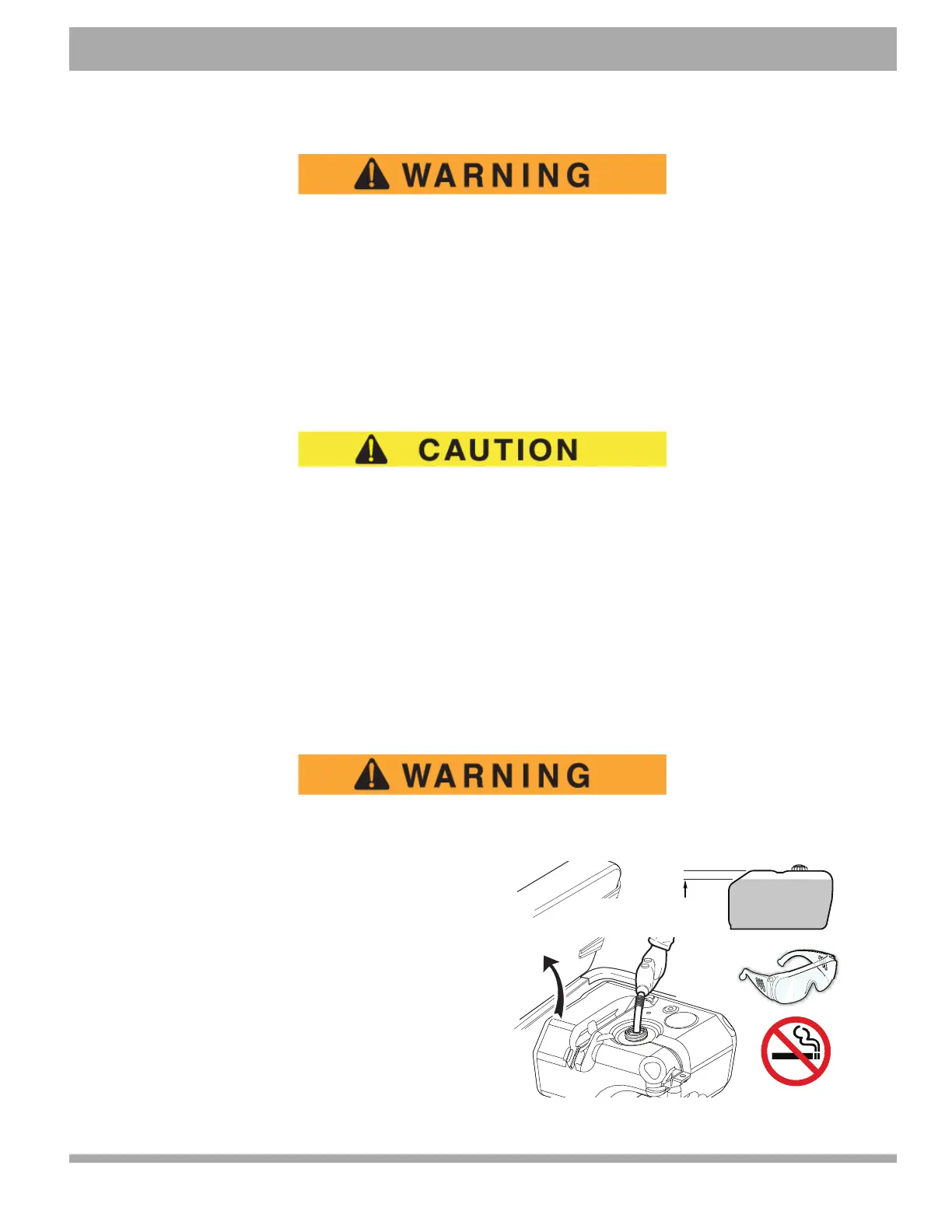
Always allow enough space for the expansion of gasoline. Leave at least 1-inch (2.5 cm) of space
below bottom of filler neck.
Early production fuel tanks can be identified by the loca-
tion of the fuel cap which is located in the middle of the
top of the tank as shown.
Early production fuel tanks require enough space for the
expansion of the gasoline. Leave at least 1-inch (2.5 cm)
of space below the bottom of the filler neck.
FUEL
Leave 1” Min. (2.5 cm)
airspace for ventilation


 To Next Page