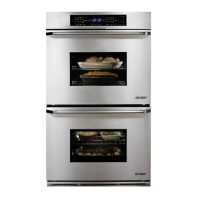
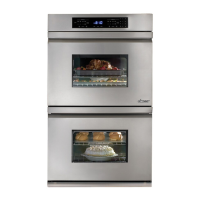
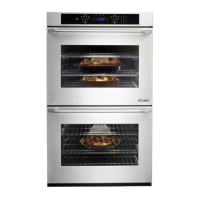
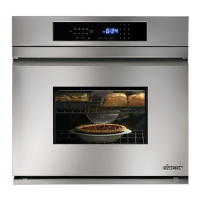
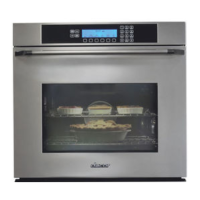
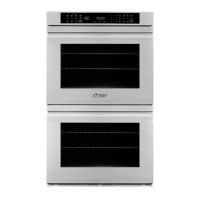
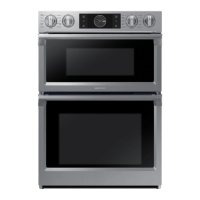
This document is a service guide for Dacor Renaissance Wall Ovens, covering various models including EORS127, EORS130, EORS227, EORS230, EORD227, EORD230, MORS127, MORS130, MORS136, MORS227, MORS230, MORD227, and MORD230. It provides comprehensive information for qualified service technicians to install, troubleshoot, and maintain these appliances, ensuring safe and proper operation. The guide emphasizes the importance of adhering to safety instructions and outlines procedures for diagnosing and resolving common issues.
Function Description
The Dacor Renaissance Wall Oven is designed for domestic cooking tasks, offering various modes such as bake, broil, convection bake, convection broil, pure convection, and self-clean. It features an Electronic Range Control (ERC) system that manages oven functions, temperature, and safety mechanisms. The oven is equipped with multiple heating elements, including bake, broil, and convection elements, along with a convection fan for even heat distribution. A door latch motor ensures the oven door is securely locked, especially during self-cleaning cycles. The control panel, featuring a membrane keypad and numeric keys, allows users to select cooking modes, set temperatures, and manage timers. An oven light illuminates the interior, and a meat probe can be used to monitor internal food temperatures. The appliance is designed to operate on a 240VAC, 60Hz, 50AMP dedicated circuit, with a total connected load of 10.0 KW (41.7 AMP).
Usage Features
The service guide details several usage features through its quick diagnostic tests, which simulate various operational scenarios. Users can turn the oven light on and off, and the membrane keypad provides audible feedback for each key press. The numeric keys allow for precise input, such as setting temperatures or times. The cooling fan activates to dissipate heat, particularly during high-temperature operations like self-cleaning or when the ambient temperature of the control board exceeds safe limits. Cooking modes like convection roast, pure convection, bake, and broil can be initiated with specific temperature settings. The self-clean function automatically locks the oven door for safety. The meat probe feature allows for accurate temperature monitoring during cooking. The oven also supports 12-hour and 24-hour clock modes, and temperature display can be toggled between Celsius and Fahrenheit. A lockout feature is available to prevent unintended use.
Maintenance Features
The service guide is primarily a maintenance document, providing detailed instructions for diagnosing and repairing the oven. It includes important safety instructions that must be followed by qualified service technicians, such as disconnecting electrical power before service and ensuring proper grounding. The guide explains how to locate the appliance data plate to identify the model and serial number, which is crucial for obtaining correct parts and technical assistance.
Troubleshooting Charts: These charts are a core maintenance feature, offering systematic steps to diagnose issues related to voltage and continuity. They cover symptoms like "No clock display," "No elements cycling in ALL modes," "Bake element only is not cycling," "Broil element only is not cycling," "Convection element only is not cycling," "Convection Fan does not run," "Cooling fan does not turn on at designated turn ON temperature," "Latch motor not running during Self Clean," "No oven light only," "No heat in any cooking mode," "Oven sensor failure (U30/31)," and "Latch switch circuit." For each symptom, the charts provide specific voltage test points on the relay board and continuity checks for various components and wiring.
Membrane Continuity Test: This section provides a method to test the membrane touchpad for non-functioning keys by checking continuity across specific test points on the ribbon connector. A reading above 5 Ohms indicates a faulty membrane that needs replacement.
Error Codes: The guide lists EOR-MOR Wall Oven Error Codes (Section 5), which are crucial for diagnosing problems. Each error code (e.g., C01 for Shorted Key Failure, U20/L20 for Cook over temperature, U30/L30 for Open RTD) is accompanied by its condition, max/min bounds, and a software logic description, helping technicians understand the root cause of the error.
Temperature Offset Calibration: Instructions are provided for calibrating the oven's temperature offset. This allows technicians to adjust the oven's temperature readings to ensure accuracy across different cooking modes, addressing potential discrepancies between the set temperature and the actual oven temperature. The process involves entering a calibration mode using specific key combinations and then adjusting the offset for various cooking modes.
Wiring Diagrams: Detailed wiring diagrams (Section 7) are included, showing the electrical connections of all components, including elements, fans, motors, sensors, and control boards. These diagrams are essential for tracing electrical paths, identifying faulty wiring, and ensuring correct reassembly after repairs. Connector and relay functions are also described, providing pin-level details for troubleshooting.
The guide emphasizes that only qualified service technicians should perform service procedures, and it provides contact information for Dacor Technical Assistance. It also includes warnings about not using aluminum foil to line the oven, avoiding steam cleaners, and exercising caution with hot surfaces and the oven door.


 To Next Page
 General