- Diamond blades consist of a steel core provided with segments that contain industrial diamonds.
- Diamond blades ensure lower costs per cutting operation, fewer blade changes and a constant
cutting depth.
- When using diamond blades make sure that it rotates in the direction indicated by the arrow on the
blade.
Diamond blades for different materials
- Diamond blades are ideal for masonry, reinforced concrete and other composite materials.
- Diamond blades are available in several hardness classes.
- Special blades should be used when cutting metal. Ask your dealer for help in choosing the right
product.
Sharpening diamond blades
- Always use a sharp diamond blade.
- Diamond blades can become dull when the wrong feeding pressure is used or when cutting
certain materials such as heavily reinforced concrete.
- Working with a dull diamond blade causes overheating, which can result in the diamond segments
coming loose.
- Sharpen the blade by cutting in a soft material such as sandstone or brick.
Diamond blades and cooling
- During culling the friction in the cut causes the diamond blade to be heated up. If the blade is
allowed to get too hot this can result in loss of blade tensioning or core cracking.
Diamond blades for dry cutting
- Although no water is required for cooling, dry cutting blades must be cooled with air ow around
the blades. For this reason dry cutting blades are recommended only for intermittent cutting. Every
few seconds of cutting the blade should be allowed to run 'free" with no load to allow the air ow
around the blade to dissipate the heat.
Diamond blades for wet cutting
- Wet cutting diamond blades must be used with water to keep the blade core and segments cool
during sawing.
- Wet cutting blades should NOT be used dry.
- Using wet cutting blades without water can cause excessive heat build-up, resulting in poor
performance, severe blade damage and is a safety hazard.
Diamond hlade - side clearance
Water cools the blade and increases its service life while also reducing the formation of dust
Toothed blades, carbide tipped blades and emergency situations
15
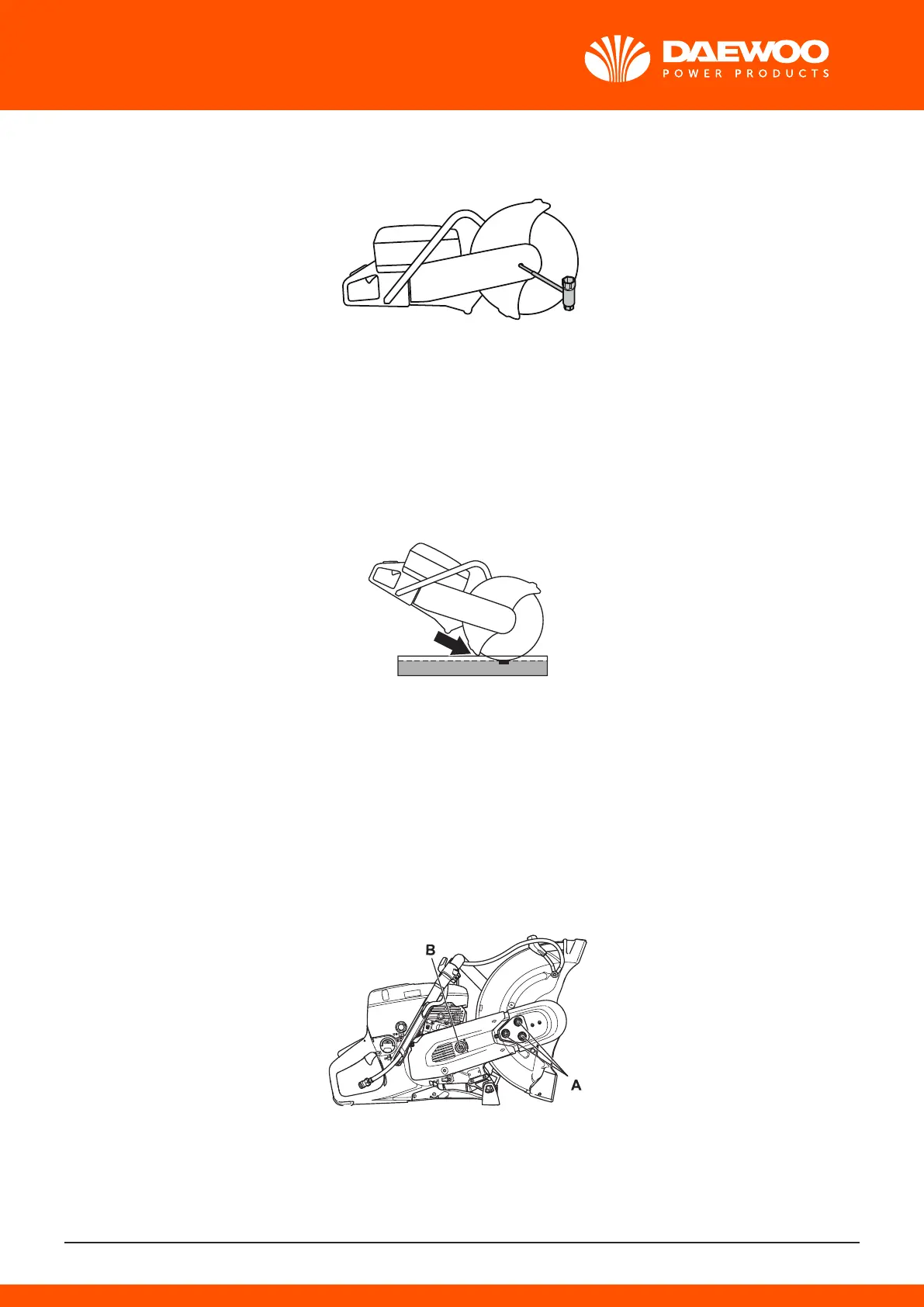
- Lock the shaft. Insert a tool in the hole in the cutting head and rotate the blade until it is locked.
- Tightening torque for the bolt holding the blade is: 25 Nm (215 in.lb).
Blade guard
The guard for the cutting equipment should be adjusted so that the rear section is ush with the
work piece. Spatter and sparks from the material being cut are then collected up by the guard and
led away from the user. The blade guard is friction locked.
- Press the ends of the guard against the work piece or adjust the guard with the adjustment handle.
The guard must always be tted on the machine.
Reversible cutting head
The machine is tted with a reversible cutting head allowing cutting close to a wall or at ground
level, restricted only by the thickness of the blade guard. In the event of a kickback it is harder to
control the machine when cutting with the cutting head reversed. The cutting blade is further away
for the centre of the machine which means the handle and the cutting blade are no longer in align-
ment. It is more difcult to restrain the machine if the blade gets jammed or stuck in its kickback
danger zone. See under the "Kickback" heading in the "Operating" section for additional informa-
tion. Some of the machine's good ergonomic features are jeopardised such as balance. Cutting with
the cutting head reversed should only occur with cuts that are not possible in a standard manner.
- Loosen the three nuts (A) holding the upper belt guard. Turn the belt tensioner (B) to position "O"
to release the tension.
- Remove the upper belt guard.
- Disconnect the water hose nipples and handle from the blade guard (C). Remove the stop (D).


 To Next Page
 Loading...