
 Need help?
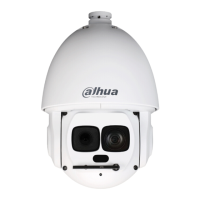
Do you have a question about the Dahua D-SD6AL445XA-HNR and is the answer not in the manual?
This document serves as an installation manual for Network Speed Dome & PTZ Cameras, providing essential information for proper setup, operation, and maintenance. It outlines precautions, installation preparations, and cable requirements to ensure the device functions optimally and safely.
The manual begins with a general foreword, emphasizing the importance of adhering to the instructions for safe and effective use. It includes a "Safety Instructions" section that categorizes signal words like "DANGER," "WARNING," "CAUTION," "TIPS," and "NOTE" to highlight potential hazards and provide helpful information. This structured approach ensures users are aware of critical safety measures and best practices. The "About the Manual" section clarifies that the manual is for reference, and the actual product prevails in case of inconsistencies. It also states that the manufacturer is not liable for losses due to non-compliance with the manual and that designs and software are subject to change without prior notice. Users are advised to contact customer service for the latest information and to upgrade reader software if the PDF cannot be opened. All trademarks and company names are the properties of their respective owners, and users are encouraged to contact customer service for any problems.
The "Important Safeguards and Warnings" section details crucial operating requirements. It stresses the need to handle the device with care during transport and storage, protecting it from falls and heavy vibrations. Users are warned to keep the device away from electromagnetic fields, smoke, vapor, heat, and dust to prevent image quality issues or device damage. Installation near heating sources is prohibited, and users are advised not to disassemble the device to avoid dangers or damage, instead contacting customer service for internal setup or maintenance. The manual also highlights the importance of ensuring no metal or inflammable substances are near the device to prevent fire or short-circuits. Protection against seawater or rain erosion is mentioned, and users are cautioned against aiming the lens at intense light sources to prevent damage. The use of a lightning-proof device is recommended for better protection. A significant part of this section is dedicated to salt spray tolerance levels, advising users not to install the device in environments with higher salt spray levels than it can tolerate. Three levels are defined: devices with higher tolerance can be installed within 1500 m of the sea, medium tolerance devices 1500 m away, and non-tolerant devices 3000 m away. Post-unpacking, if the packing bag is damaged or the desiccant particles are discolored, it will not affect normal use. For devices supporting laser, users are warned not to aim the laser directly at eyes and to maintain a proper distance from flammable materials. Finally, users are advised to contact their local retailer or customer service for any abnormalities and warned against unauthorized modifications or repairs.
"Power Requirements" specifies that all installations and operations must conform to local electrical safety regulations. It instructs users to immediately turn off power and disconnect the cord if water or liquid enters the device, and to contact customer service. The power source must meet Safety Extra Low Voltage (SELV) standards and Limited Power Source requirements (IEC60950-1), with the device label indicating specific power supply needs. Only power adapters from legitimate manufacturers should be used, and connecting multiple cameras to a single adapter is discouraged to prevent overheating or fire. Users must ensure power is off when connecting cables or installing/uninstalling the device. In case of smoke, unusual smells, or noise, power should be immediately disconnected, and customer service contacted.
"Cleaning Requirements" provides instructions for maintaining the device's enclosure. It recommends using a soft cloth, possibly dipped in a mild detergent and wrung out, then drying the enclosure. Harsh chemicals like gasoline or paint thinner are prohibited as they can cause transfiguration or paint flaking. Users are advised to read all manuals before using chemical cloths and avoid prolonged contact between plastic/rubber materials and the enclosure to prevent damage.
"Requirements for Installation and maintenance personnel" lists the necessary qualifications for individuals handling the device. Personnel should have certificates or experience in CCTV installation and maintenance, be certified for working at height, possess basic knowledge of low-voltage wiring and electronic circuit connections, and be able to read and understand the manual. "Requirements for Lifting the Device" emphasizes selecting appropriate tools that can reach the installation height and have high safety performance.
The "1 Installation Preparation" chapter details basic requirements, installation checks, and cable preparations. Basic requirements reiterate adherence to local electrical safety and fire protection regulations, ensuring the application scenario is suitable, and using the device according to its operating environment. Keeping original packing material is advised for potential repairs. Installation checks include verifying sufficient space for the device and its accessories. For PTZ cameras, the installation location must sustain at least four times the device's weight and its accessories; for speed domes, it must sustain eight times the weight. Risky or unstable places are to be avoided, and walls must be thick enough for expansion bolts (to be purchased separately). For speed domes with intelligent tracking, illegal parking capture, or laser, the mounting height must exceed 6 m.
"1.3 Cable Preparation" focuses on selecting appropriate cables. "1.3.1 Video Cable Requirements" specifies 75 ohm, pure copper cored cables with 95% braided copper shielding. It refers to tables for maximum transmission distances for network and HDCVI devices. "1.3.2 RS-485 Cable Requirements" discusses twisted-pair lines (0.56 mm, 24AWG) and how baud rates affect theoretical maximum transmission distance (e.g., 1800 m at 2400bps, 800 m at 9600bps). It notes that thinner cables, intense electromagnetic interference, or too many connected devices reduce this distance. "1.3.3 Selecting Power Cable" explains that cable diameter affects transmission distance and refers to specific sections for 24V AC, 12V DC, 24V DC, 30V DC, and 36V DC power supplies. "1.3.3.2 PoE Power Cable" specifies CAT5E and higher standard network cables for AF, AT, HiPoE, or BT PoE specifications.
The "2 Cables" chapter provides a detailed description and connection guide. "2.1 Cable Description" states that the device comes with a multi-functional combination cable including power, video, audio, RS-485 control, alarm, network, and optical fiber cables. It notes that cable types vary by model and refers to a figure and table for detailed descriptions of each connector (e.g., FC connector, DC power input, 24V AC power input with V+, V-, and grounding, RS-485 with A+ and B-, video output, Ethernet, audio input/output/grounding, alarm output 1/2 and contact switches 1/2 with grounding, and alarm inputs 1-7).
"2.2 Cable Connection" provides step-by-step instructions for specific cable types. "2.2.1 Alarm Cable Connection" guides users to connect alarm input devices to ALARM_IN and ALARM_GND, and alarm output devices to ALARM_OUT and ALARM_COM. It explains that alarm output is a relay switch output and instructs users to configure alarm input/output settings on the device's web interface, setting NO/NC output based on high/low level signals from the alarm input device.
"2.2.2 Thunder-Proof Cable Connection" focuses on protecting the device from lightning, particularly for outdoor installations. It mentions that transient voltage suppressors (TVS) protect against voltage spikes and overvoltage below 6000V, but additional measures are necessary. Key recommendations include keeping signal transmission cables at least 50 m away from high voltage devices, laying outdoor cables under eaves, or underground in hermetic steel tubes with equipotential grounding at both ends. Overhead power cables are prohibited. In areas prone to severe thunderstorms, high-powered lightning protection devices and conductors are required, adhering to regional laws. Equipotential grounding to the electric system is mandatory, meeting anti-jamming requirements and local electrical safety codes. The grounding device must not short-circuit to the neutral line of the high voltage power grid or mix with other wires. When connected to the ground cable, impedance must not exceed 4Ω, and the earth lead's cross-sectional area must not exceed 25 mm². Figures illustrate outdoor lightning protection setups, detailing components like video, communication, and power supply lightning conductors, grounding wire impedance, radius of protection, and steel tubes. "2.2.2.2 Indoor" lightning protection advises using multiple copper cables with a cross-sectional area of at least 25 mm² to connect yellow-green grounding cables/screws to indoor equipotential grounding terminals.
The "3 RS-485 Cable" chapter describes its features and common issues. "3.1 Basic Features" explains that RS-485 industrial buses are half-duplex communication buses with a characteristic impedance of 120Ω and a maximum load of 32 payloads (controllers and controlled devices). "3.2 Common Issues in Use" highlights a common incorrect connection method where terminal resistance is connected to the two devices with the longest cable length, which does not comply with the RS-485 industrial standard. This can lead to signal reflection, reduced anti-interference capability, and device control issues. The manual recommends using RS-485 distributors to avoid these problems and improve transmission quality. "3.3 FAQ on RS-485 Cable" provides a troubleshooting table for common malfunctions. For instance, if the device performs self-check but is out of control, possible reasons include mismatched baud rate/address, misconnected positive/negative electrodes, loose connections, or a broken RS-485 cable. Solutions involve modifying settings, correcting connections, tightening cables, or replacing the cable. If the device can be controlled but operation is not smooth, possible reasons include poor contact, a broken RS-485 cable, excessive distance between host and device, or too many cameras connected in parallel. Solutions include ensuring firm contact, replacing the cable, installing terminal resistance, or installing RS-485 distributors.
"4 Wi-Fi Performance" describes the device's wireless capabilities. It supports 2.4G and 5G frequency bands. For 2.4G, working channels CH1-CH13 are supported (actual channel prevails), and for 5G, the actual working channel prevails. Transmission performance in open places without interference, with the device installed at least 1.5 m above ground, offers an effective communication distance of 100 m. In environments without interference, the signal can pass through a load-bearing wall, with an effective communication distance of 20 m. A note clarifies that actual wall penetration capacity is greatly affected by network layout and the environment.
Chapters "5 Cable Diameter (24V AC) and Transmission Distance," "6 Cable Diameter (12V DC) and Transmission Distance," "7 Cable Diameter (24V DC) and Transmission Distance," "8 Cable Diameter (30V DC) and Transmission Distance," and "9 Cable Diameter (36V DC) and Transmission Distance" provide detailed tables for selecting appropriate cable diameters based on power (in Watts) and transmission distance (in feet/meters). These tables are for reference, with actual conditions prevailing, and assume a maximum voltage loss rate (10% for AC and 10% or 20% for DC, depending on the voltage). The cables are specified as copper with an electrical resistivity of ρ = 0.0175Ω × mm²/m. Each table provides transmission distances for various power levels and cable diameters (0.80 mm, 1.00 mm, 1.25 mm, 2.00 mm). For example, a 20W device powered by 24V AC installed 37m away from the transformer requires a minimum diameter of 0.80mm. Similarly, for a 150W device powered by 30V DC installed 14m away, a 0.80mm diameter cable is needed.
"10 Wire Gauge Reference Sheet" provides a comprehensive table correlating Metric Bare Wire Diameter (mm) with AWG (American Wire Gauge) and SWG (Standard Wire Gauge) values, along with the Bare Wire Cross Section Area (mm²). This sheet is crucial for selecting the correct wire gauge for various applications, ensuring proper electrical conductivity and safety.
"Appendix 1 Cybersecurity Recommendations" offers crucial advice for securing the device in a networked environment. It emphasizes that cybersecurity is vital for all internet-connected devices, including IP video surveillance. The appendix outlines mandatory actions for basic equipment network security, such as using strong passwords (at least 8 characters, including two types of characters, not containing account names or continuous/overlapped characters). It also recommends updating firmware and client software regularly to ensure the latest security patches and fixes, and enabling "auto-check for updates" when connected to a public network. "Nice to have" recommendations include physical protection of equipment (e.g., in a secure computer room with access control), regularly changing passwords, timely setting and updating password reset information (avoiding easily guessed questions), enabling account lock (which is usually enabled by default), changing default HTTP and other service ports to non-standard numbers (1024-65535), enabling HTTPS for secure communication, and enabling whitelist function to restrict access to specified IP addresses. Other recommendations include MAC address binding to reduce ARP spoofing, assigning accounts and privileges reasonably (minimum permissions), disabling unnecessary services (SNMP, SMTP, UPnP) or choosing secure modes (SNMP v3 with strong encryption, TLS for SMTP, SFTP for FTP, WPA2-PSK for AP hotspot), and using encrypted transmission for audio/video data (with a note on potential efficiency loss). Secure auditing practices are advised, such as checking online users and equipment logs for unauthorized access. Finally, constructing a safe network environment is recommended by disabling router port mapping, partitioning and isolating networks using VLAN or network GAP, and establishing 802.1x access authentication to reduce unauthorized access to private networks.
 General
| Camera Type | PTZ |
|---|---|
| Image Sensor | 1/2.8" CMOS |
| RAM | 1 GB |
| ROM | 4 GB |
| Scanning System | Progressive |
| IR On/Off Control | Auto/Manual |
| Focus Control | Auto/Manual |
| Iris Control | Auto/Manual |
| Presets | 300 |
| Video Compression | H.265; H.264; H.264B; H.264H; MJPEG |
| Streaming Capability | 3 Streams |
| Bit Rate Control | CBR/VBR |
| BLC | Yes |
| HLC | Yes |
| WDR | 120 dB |
| Gain Control | Auto/Manual |
| Motion Detection | Yes |
| Region of Interest (ROI) | Yes |
| Image Rotation | 180° |
| Defog | Yes |
| Digital Zoom | 16x |
| Network | RJ-45 (10/100 Base-T) |
| Streaming Method | Unicast/Multicast |
| Max. User Access | 20 Users |
| Electronic Shutter Speed | 1/1 s–1/30, 000 s |
| Minimum Illumination | 0 Lux with IR |
| IR Distance | 150 m |
| Max. Aperture | F1.6 |
| Aperture | F1.6 ~ F4.5 |
| Field of View | H: 67.8°–2.1° |
| Pan/Tilt Range | Pan: 360° endless, Tilt: -15° ~ 90° |
| Manual Control Speed | Pan: 0.1° ~ 200°/s, Tilt: 0.1° ~ 120°/s |
| Protocol | IPv4; IPv6; HTTP; HTTPS; TCP; UDP; ARP; RTP; RTSP; RTCP; SMTP; FTP; DHCP; DNS; DDNS; QoS; UPnP; NTP; ICMP; IGMP; 802.1x; SNMP |
| Intelligence | Face Detection |
| Bit Rate | H.264: 3 kbps–20480 kbps; H.265: 3 kbps–20480 kbps |
| Day/Night | Auto; Color; B/W |
| Noise Reduction | 2D/3D |
| Privacy Masking | Up to 24 areas |
| Audio Compression | G.711a; G.711Mu; AAC; G.726; G.722.1; MPEG2-L2 |
| Audio | 1 channel in; 1 channel out |
| Interoperability | ONVIF Profile S/G/T |
| Edge Storage | MicroSD card slot, up to 256 GB |
| Browser | IE; Chrome; Firefox; Safari |
| Management Software | DSS, DMSS, SmartPSS |
| Certifications | CE, FCC |
| Power Supply | AC24V / PoE+ (IEEE802.3at) |
| Power Consumption | Basic: 13W; Max.: 25W |
| Operating Temperature | –40 °C to +70 °C (–40 °F to +158 °F) |
| Protection Grade | IP67 |
| Gross Weight | 6.5 kg |



 To Next Page