
 Need help?
Do you have a question about the Dahua DHI-ASR1101M and is the answer not in the manual?
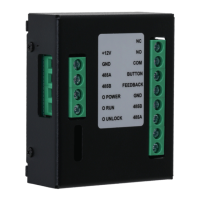
Details the wiring connections for the device, including pin assignments, color codes, and supported communication protocols.
Illustrates how the access control reader integrates with controllers and other devices to form a complete system.
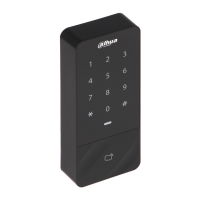
This document outlines the features, installation, and system integration of an Access Control Reader, designed to complement video monitoring and visual talk products in various environments such as commercial buildings, company properties, and smart communities. The reader boasts a simple appearance combined with powerful functionality, making it a versatile component in modern security systems.
The primary function of the Access Control Reader is to provide non-contact access control, acting as a read-only device. It is capable of reading access cards from a distance of 3cm to 5cm, with a rapid response time of less than 0.3 seconds, ensuring quick and efficient entry. The reader supports both Wiegand Protocol and RS485 protocol, with an RS485 baud rate of 9600bps, allowing for flexible integration into existing access control infrastructures.
A key aspect of its functionality is the advanced key management system. This system is designed to significantly lower the risk of data theft and prevent the unauthorized duplication of intelligent cards, thereby enhancing the overall security of the access control system. The reader is equipped with a buzzer and indicator prompts, providing clear audio and visual feedback to users during operation, such as successful card reads or access denials.
For system integrity and reliability, the reader incorporates a watchdog function. This feature continuously monitors the device's operation and automatically resets it if any anomalies or malfunctions are detected, ensuring continuous and stable performance. Furthermore, all connection ports on the device are equipped with over-load protection. This safeguard prevents damage to the reader and connected equipment in case of electrical surges or incorrect wiring, contributing to the longevity and reliability of the system.
The reader is designed for outdoor installation, featuring an IP67 rating, which signifies its resistance to dust and water ingress. This robust construction allows it to operate reliably in various environmental conditions. The device also supports online upgrade capabilities, meaning its firmware can be updated remotely. This feature allows for the implementation of new functionalities, security patches, and performance improvements without the need for physical access to each device, streamlining maintenance and ensuring the system remains up-to-date.
The Access Control Reader is designed for straightforward use and integration. Its non-contact reading capability provides a convenient and hygienic method of access, as users do not need to physically touch the reader with their cards. The quick response time minimizes queues and improves traffic flow, particularly in high-volume areas.
The reader's support for multiple protocols (Wiegand and RS485) offers significant flexibility in system design. This allows it to be easily integrated with a wide range of access control panels and software, making it adaptable to various security setups. The RS485 protocol, with its specified baud rate, ensures reliable data communication over longer distances, which is often necessary in larger installations.
The inclusion of a buzzer and indicator prompts enhances the user experience by providing immediate feedback. A distinct sound or light signal can confirm a successful card read, indicate an access granted status, or alert the user to an issue, such as an invalid card or access denied. This immediate feedback helps users understand the outcome of their access attempt without needing to consult a separate display or wait for a gate to open.
The device's robust design, with an IP67 rating and a wide operating temperature range of -30℃ to +60°C, makes it suitable for deployment in diverse outdoor environments, from cold winters to hot summers. Its ability to withstand high humidity (≤95%) further underscores its resilience in challenging conditions. This durability ensures consistent performance regardless of external factors, reducing the need for frequent repairs or replacements.
The system organization, as depicted in the manual, illustrates how the access control reader integrates with a two-door controller, alarm sensors, an alarm light, a signal output module, a lift control module, and unlock buttons. This comprehensive integration allows for a centralized and coordinated security system, where the reader acts as a crucial input device for granting or denying access, triggering alarms, or controlling other connected security components. For instance, a successful card swipe can not only grant access through a door but also activate a lift or disarm an alarm zone, depending on the system's configuration.
Maintenance of the Access Control Reader is simplified by several design considerations and features. The online upgrade capability is a significant advantage, as it allows for remote firmware updates. This means that security patches, bug fixes, and new features can be deployed across multiple readers without requiring a technician to physically visit each device. This reduces maintenance costs and downtime, ensuring the system remains secure and functional with minimal disruption.
The watchdog function, while primarily a usage feature, also contributes to maintenance by ensuring system stability. By automatically resetting the device in case of a malfunction, it helps prevent prolonged outages and reduces the need for manual intervention to restart the reader. This self-recovery mechanism enhances the overall reliability of the access control system.
Over-load protection on all connection ports is a critical maintenance feature. It safeguards the reader's internal components from electrical damage due to incorrect wiring or power fluctuations. This protection minimizes the risk of hardware failure, extending the lifespan of the device and reducing the frequency of repairs or replacements. It also simplifies troubleshooting, as technicians can be more confident that the reader's internal circuitry is protected.
The device's robust construction, including its IP67 rating and wide operating temperature and humidity ranges, inherently reduces maintenance needs. Its resistance to dust and water means it can withstand harsh environmental conditions without degradation, leading to fewer failures caused by environmental factors. This durability translates into lower long-term maintenance costs and greater operational uptime.
The manual also provides important safeguards and warnings that, when followed, contribute to the device's longevity and reduce the likelihood of maintenance issues. These include instructions on proper installation location (avoiding direct sunlight, high temperatures, lampblack, steam, or dust), ensuring proper ventilation, using the device within its rated input/output range, and not disassembling it without professional instruction. Adhering to these guidelines helps prevent damage and ensures the device operates optimally.
Specific warnings regarding battery usage (if applicable) and power supply further emphasize preventive maintenance. Using the specified power line and ensuring the power supply matches SELV requirements and IEC60950-1 Limited Power Source specifications are crucial for preventing electrical hazards and ensuring stable operation. For I-type structure products, connecting to a power supply plug with GND protection is also highlighted as a safety and maintenance measure.
In summary, the Access Control Reader is designed with a focus on reliability, ease of integration, and simplified maintenance, making it a practical and secure solution for various access control applications.
 General
| Model | DHI-ASR1101M |
|---|---|
| Type | IP Access Controller |
| Processor | Dual-core |
| RAM | 512 MB |
| User Capacity | 100, 000 |
| Card Capacity | 100, 000 |
| Input | 4 inputs |
| Operating Humidity | 10% to 90% (non-condensing) |
| Casing Material | Metal |
| Protection Grade | IP30 |
| Communication | TCP/IP, RS485 |
| Network Interface | 10/100 Mbps Ethernet |
| Operating Voltage | 12V DC |
| Installation | Wall mounting |
| Access Control Interface | RS485, Wiegand |



 To Next Page