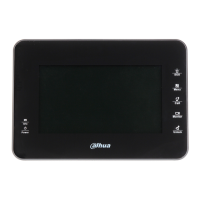
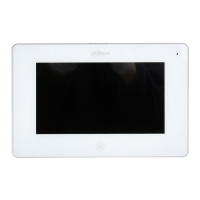
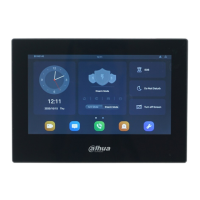
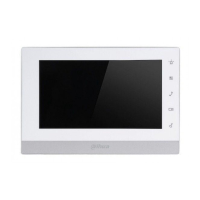
This document serves as a Quick Start Guide for the Digital Indoor Monitor (Model G), also referred to as VTH. It outlines the basic operations, safety instructions, and configuration procedures for the device.
Function Description:
The Digital Indoor Monitor (VTH) is a component of an intercom system, designed to facilitate communication and monitoring within a building or villa setting. It can connect to a Video Door Station (VTO) and other VTHs, allowing for video calls between devices. The VTH can function as a client to a SIP server, or in some configurations, a VTO can act as the SIP server. Key functions include:
- Intercom: Making and receiving video calls from a VTO or other VTHs.
- Monitoring: Viewing live video feeds from connected VTOs.
- Configuration: Setting up network parameters, SIP server details, and VTO/VTH specific information.
- Group Call: When enabled on the SIP server, all extension VTHs receive calls made to a main VTH.
Important Technical Specifications:
The manual describes three models of VTHs:
- Non 2-wire VTH that supports both Wi-Fi and PoE.
- Non 2-wire VTH that only supports PoE.
- 2-wire VTH that supports Wi-Fi.
Rear Panel Components (2-wire model):
- Alarm port: For connecting alarm devices.
- 2-wire port: For 2-wire communication.
- Network port: For network connectivity.
Rear Panel Components (non 2-wire model):
- Alarm port: For connecting alarm devices.
- Power input port: For power supply.
- Network port: For network connectivity.
SIP Server Configuration Parameters:
- IP Addr.: IP address of the VTO acting as the SIP server.
- Port: 5060 (default for VTO as SIP server), 5080 (default for platform as SIP server).
- Username/Password: Leave as default.
- SIP Domain: Leave as default (VDP when VTO works as SIP server).
- SIP Server Username/Password: SIP server web page login credentials.
VTH Configuration Parameters:
- Room No.: Room number for the VTH (e.g., 9901 or 101#0). For multiple VTHs, the main VTH ends with #0, extensions with #1, #2, etc. (up to 9 extensions).
- Master IP: IP address of the master VTO.
- Master Name: Name of the master VTO.
- Master Pwd: Password for the master VTO.
- Version: Device software version.
- SSH: Secure Shell setting (ON/OFF).
VTO Configuration Parameters (on VTH):
- Main VTO Name: Name of the main VTO.
- VTO IP Address: IP address of the main VTO.
- User Name/Password: Login credentials for the main VTO.
- Enable Status: ON/OFF for the main VTO.
- Sub VTO1 Name: Name of the sub VTO.
- VTO IP Address: IP address of the sub VTO.
- User Name/Password: Login credentials for the sub VTO.
- Enable Status: ON/OFF for the sub VTO.
Usage Features:
- Quick Start Guide: Provides a streamlined setup process for first-time users, covering initialization and basic configuration of VTO, VTH, and SIP server.
- Manual Configuration: Allows for detailed adjustment of network parameters (WLAN/LAN), SIP server settings, VTH specific configurations, and VTO additions.
- Password Protection: Requires a strong password for initialization and login, with options for email-based password reset. Passwords must be 8-32 non-blank characters, including at least two types of uppercase, lowercase, numbers, and special characters (excluding ' " ; : &).
- Device Initialization: The VTO requires initialization upon first power-on, involving setting a password and optionally an email for recovery.
- Network Connectivity: Supports both Wi-Fi (WLAN) and wired (LAN) connections. DHCP function can be enabled for automatic IP information acquisition.
- Room Numbering: Room numbers can contain up to 6 digits (numbers or letters) and must be unique from VTO numbers.
- VTO and VTH Management: The SIP server's web page allows adding and managing VTOs and room numbers for VTHs.
- Intercom Functionality Check: After configuration, users can test the VTO calling VTH and VTH monitoring VTO functions.
- SD Card Support: The device supports SD cards for recording and snapshots, indicated by active icons on the monitoring page.
Maintenance Features:
- Firmware Updates: Recommendations to keep device firmware up-to-date for security patches and fixes. An "auto-check for updates" function is suggested for public network connections.
- Client Software Updates: Advised to use the latest version of client software.
- Physical Protection: Suggestions for physical security, such as placing the device in a secure room/cabinet and implementing access control.
- Regular Password Changes: Recommended to change passwords regularly to mitigate guessing or cracking risks.
- Password Reset Information: Device supports password reset, and users are advised to set up and timely update related information (mailbox, security questions).
- Account Lock: Feature enabled by default to lock accounts and source IP addresses after multiple failed login attempts.
- Port Customization: Suggestion to change default HTTP and other service ports to numbers between 1024-65535 to reduce external guessing.
- HTTPS Enablement: Recommendation to enable HTTPS for secure web service communication.
- MAC Address Binding: Advised to bind IP and MAC addresses of the gateway to the device to reduce ARP spoofing risk.
- Privilege Management: Reasonably assign users and minimum permissions based on business needs.
- Service Disablement: Recommend turning off unnecessary services (SNMP, SMTP, UPnP) to reduce risks. If necessary, use secure modes (SNMP v3 with strong encryption, TLS for SMTP, SFTP for FTP, WPA2-PSK for AP hotspot).
- Encrypted Transmission: For sensitive audio/video data, enabling encrypted transmission is recommended, though it may cause some loss in transmission efficiency.
- Secure Auditing:
- Check online users: Regularly verify authorized logins.
- Check device log: Review logs for IP addresses and key operations.
- Network Log: Enable network log function to synchronize critical logs to a network log server for long-term tracing, due to limited on-device storage.
- Safe Network Environment:
- Disable router port mapping for intranet device protection.
- Partition and isolate networks using VLAN, network GAP, etc., if no communication is required between sub-networks.
- Establish 802.1x access authentication.
- Enable IP/MAC address filtering to limit host access.

 Need help?
 General

 To Next Page