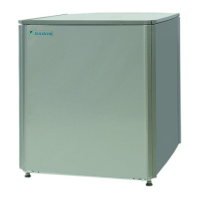
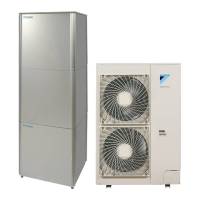
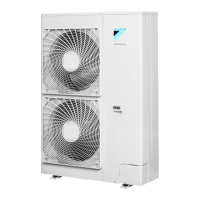
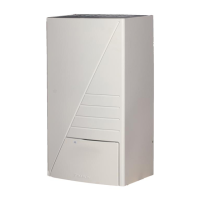
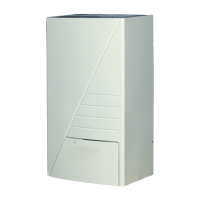
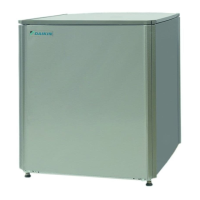
This document serves as an operation manual for the Daikin EKHBRD011ABV1, EKHBRD014ABV1, EKHBRD016ABV1, EKHBRD011ABY1, EKHBRD014ABY1, and EKHBRD016ABY1 indoor units, which are part of an air-to-water heat pump system, including various options. It provides comprehensive instructions for starting up, operating, maintaining, and troubleshooting the unit.
The unit is designed for floor-standing indoor installation and is primarily used for heating applications. It can be integrated with space heating radiators and an optional domestic hot water tank. A remote controller with room thermostat functionality is supplied as standard for system control.
Function Description
The Daikin indoor unit functions as the internal component of an air-to-water heat pump system, specifically designed for heating. It manages both space heating and domestic water heating, offering various operational modes to optimize comfort and energy efficiency.
Space Heating Operation:
Space heating can be controlled in two primary ways:
- Room Temperature Control: Heating is activated based on a desired room temperature set point, which can be adjusted manually or via a schedule timer. This mode prioritizes maintaining the set room temperature.
- Leaving Water Temperature Control: Heating is activated based on a desired leaving water temperature set point. This can also be set manually, through a schedule timer, or automatically via weather-dependent operation.
Weather-Dependent Set Point Operation: When active, the leaving water temperature is automatically adjusted based on the outdoor temperature. Colder outdoor temperatures result in warmer water, and vice versa. This feature helps reduce power consumption compared to a fixed leaving water temperature. Users can apply a shift value (up to ±5°C) to fine-tune the target water temperature.
Automatic Setback Function: This feature allows for lowering the room temperature during specific periods, such as at night, to match varying temperature demands throughout the day and night. It can be combined with weather-dependent set point operation and is an automatic daily scheduled function.
Domestic Water Heating Operation:
The unit supports several modes for domestic water heating, provided a domestic hot water tank option is installed:
- Automatic Storage: Hot water is produced based on a daily fixed pattern, typically heating water during the night when space heating demands are lower, until a storage temperature set point is reached. This stored hot water can then fulfill daily requirements.
- Manual Storage: This is a one-time operation that immediately heats water in the domestic hot water tank to the storage temperature set point. It's useful for immediate hot water needs.
- Reheat Operation: This mode prevents the domestic hot water from cooling below a certain minimum temperature. The unit will heat water when the minimum reheat value is reached, continuing until the reheat maximum temperature is achieved.
- Disinfection Operation: This mode periodically heats the domestic hot water tank to a specific high temperature to disinfect it. The temperature set point, retention time, day, and hour for this operation are configurable.
Emergency Operation: In emergency mode, heating is exclusively performed by the heater kit, bypassing the heat pump operation. This mode is activated via a field setting and ensures heating continues even if the heat pump is not operational.
Quiet Mode Operation: This mode reduces the compressor speed, thereby lowering the noise produced by the indoor unit. While it may take longer to reach the desired temperature set point, it's beneficial for noise-sensitive environments. There are multiple levels of quiet mode operation that can be configured.
Simultaneous Demand of Space Heating and Domestic Water Heating: The unit cannot perform both space heating and domestic water heating simultaneously. If both are requested, the unit prioritizes heating the domestic hot water tank to its reheat maximum temperature first, during which space heating is temporarily suspended.
Usage Features
The remote controller is the primary interface for operating the EKHBRD unit. It offers comprehensive control over all heating applications and options.
Quick Start-up: The manual provides a step-by-step guide for quickly initiating both space heating and domestic water heating operations, allowing users to start the system before delving into detailed instructions.
Setting the Clock: Users can set the current time and day of the week, which is essential for the schedule timer functionality. The clock needs manual adjustment for daylight saving changes and may reset after a power failure exceeding one hour.
Schedule Timer Operation: The unit features a flexible schedule timer that allows users to program up to five actions per day for space heating, domestic water heating, and quiet mode. These actions are executed automatically.
- Space Heating Schedule: Can be programmed based on temperature set points (room or leaving water temperature) or ON/OFF instructions.
- Domestic Water Heating Schedule: Allows programming of ON/OFF times for domestic water heating, with the water heated to a storage set point defined in field settings.
- Quiet Mode Schedule: Enables scheduling of quiet mode activation and deactivation.
Temperature Read-out Mode: Users can view actual temperatures on the remote controller display, including leaving water temperature, entering water temperature, indoor temperature, outdoor temperature, and hot water supply tank temperature.
Programming and Consulting the Schedule Timer: The manual details the procedure for programming and reviewing scheduled actions. Users can add, remove, or alter programmed actions. It also explains how to copy programmed actions from one day to the next.
Operating the Remote Alarm Option: An optional EKRP1HBA digital I/O PCB can be connected to the indoor unit to remotely monitor the system. It provides three voltage-free outputs: THERMO ON/OFF (for space heating operation), ALARM OUTPUT (for error conditions), and DOMESTIC HOT WATER MODE ON/OFF (for domestic water heating operation).
Operating the Optional Remote Controller: If an optional remote controller is installed alongside the main controller, the main controller (master) retains full access to all settings, while the second controller (slave) has restricted access to schedule and parameter settings.
Field Settings: These settings define parameters for the unit's operation, including weather-dependent operation, setback functions, and disinfection. They are accessible and programmable through the user interface on the indoor unit. Each setting has a unique 3-digit code.
Maintenance Features
Regular maintenance is crucial for ensuring optimal availability and performance of the unit. While most maintenance should be performed by a professional Daikin technician, some activities can be carried out by the operator.
Operator Maintenance:
- Remote Controller Cleaning: The remote controller should be kept clean using a soft, damp cloth.
- Water Pressure Check: The water pressure indicated on the manometer should be checked to ensure it is above 1 bar.
- The supply cord, if damaged, must be replaced by the manufacturer or a qualified person to avoid hazards.
- During long periods of inactivity (e.g., summer for heating-only applications), it is critical NOT to switch off the main power supply to the unit. Switching off the power supply stops the automatic repetitive movement of the pump, which can lead to the pump getting jammed.
Refrigerant Information: The product contains fluorinated greenhouse gases (R134a, GWP value: 1300). Periodical inspections for refrigerant leaks may be required based on European or local legislation. Users should contact their local dealer for more information.
Troubleshooting: The manual provides guidelines to help users solve common problems. If a problem cannot be resolved, users are advised to consult their installer. Examples include issues with the remote controller display, error codes, incorrect schedule timer execution, and capacity shortages.
Disposal Requirements: Dismantling of the unit and treatment of its refrigerant, oil, and other parts must be done in accordance with relevant local and national legislation by a qualified installer. The unit should be treated at a specialized facility for re-use, recycling, and recovery to prevent potential negative environmental and health consequences.


 To Next Page

 General