EasyManua.ls Logo

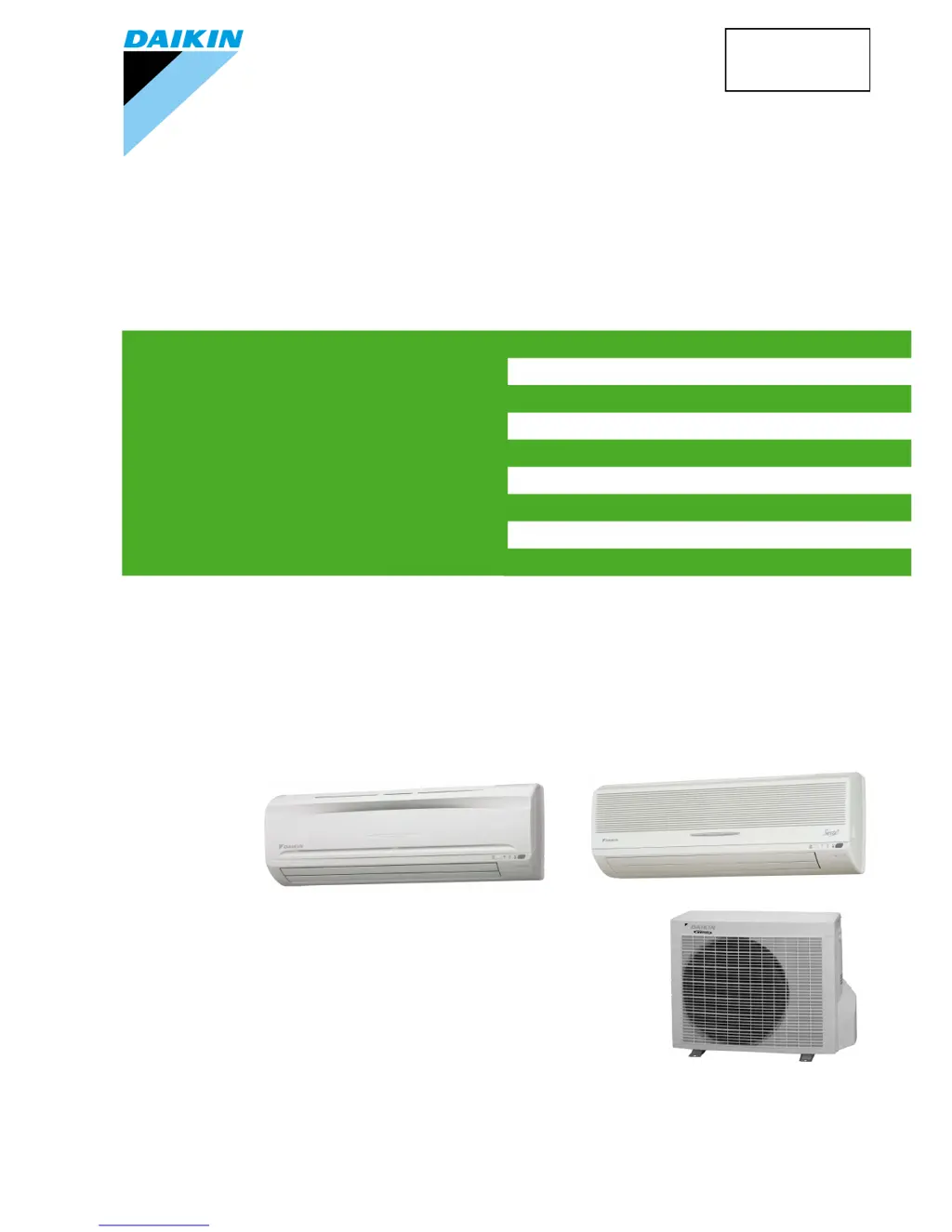
Daikin RK35BVMB - User Manual

Daikin RK35BVMB
201 pages
Print Icon
To Next Page IconTo Next Page
Loading...
SiBE04-302
Inverter Pair
Wall Mounted Type
B Series
[Applied Models]
z
zz
zInverter Pair : Cooling Only
z
zz
zInverter Pair : Heat Pump
Service
Manual

Table of Contents

Other manuals for Daikin RK35BVMB

Questions and Answers

  • R
    raymond06Aug 20, 2025
    Why Daikin RK35BVMB Air Conditioner is not turning on? (OPERATION lamp is off)
    • V
      Vincent HartmanAug 20, 2025
      If your Daikin Air Conditioner isn't turning on and the OPERATION lamp is off, check the following: * Ensure the breaker hasn't been turned OFF or a fuse hasn't blown. * Verify that there isn't a power failure. * Confirm that batteries are correctly installed in the remote controller. * Check if the timer setting is correct.
  • H
    honeillAug 22, 2025
    What to do if Daikin RK35BVMB operation stops suddenly? (OPERATION lamp is on)
    • G
      gwendolynwilliamsAug 22, 2025
      If your Daikin Air Conditioner stops suddenly and the OPERATION lamp is on, it might be due to a sudden large voltage fluctuation. For system protection, the air conditioner automatically resumes operation in about 3 minutes.
  • M
    Matthew BrooksAug 25, 2025
    Why Daikin Air Conditioner operation does not start soon?
    • L
      Lori WoodAug 25, 2025
      If your Daikin Air Conditioner doesn't start immediately after pressing the ON/OFF button soon after stopping or reselecting the mode, wait for about 3 minutes.
  • J
    Joanne ColeAug 26, 2025
    Why Daikin Air Conditioner outdoor unit emits water or steam?
    • V
      Virginia DayAug 26, 2025
      The outdoor unit of your Daikin Air Conditioner may emit water or steam. This can occur in HEAT mode when frost on the outdoor unit melts during defrost operation. In COOL or DRY mode, moisture in the air can condense on the cool surface of the outdoor unit piping and drip.
  • M
    Melanie NewtonAug 27, 2025
    Why is my Daikin RK35BVMB cooling effect poor?
    • D
      davischristopherAug 27, 2025
      If the cooling or heating effect of your Daikin air conditioner is poor, consider the following: * Ensure the air filters are clean. * Check for any obstructions blocking the air inlet or outlet of the indoor and outdoor units. * Verify that the temperature setting is appropriate. * Confirm that all windows and doors are closed. * Make sure the airflow rate and direction are set correctly.
  • D
    Donna TurnerAug 29, 2025
    How to improve cooling (heating) effect of Daikin Air Conditioner?
    • C
      Christopher CombsAug 29, 2025
      If you're experiencing poor cooling or heating with your Daikin Air Conditioner, consider these points: * Ensure the air filters are clean. * Make sure nothing is blocking the air inlet or outlet of the indoor and outdoor units. * Verify that the temperature setting is appropriate. * Confirm that windows and doors are closed. * Check if the airflow rate and direction are set correctly. * Check if the unit is set to the INTELLIGENT EYE mode.
  • R
    robertsdeborahAug 31, 2025
    Why my Daikin RK35BVMB smells bad?
    • E
      eric63Aug 31, 2025
      If your Daikin Air Conditioner's indoor unit is emitting an odor, it's likely due to smells from the room, furniture, or cigarettes being absorbed into the unit and discharged with the airflow. If this occurs, it is recommended to have the indoor unit cleaned by a technician.
  • H
    howardcharlesSep 2, 2025
    Why Daikin RK35BVMB hot air does not flow out soon after the start of heating operation?
    • K
      Kenneth King PhDSep 2, 2025
      If hot air doesn't flow out immediately after starting the heating operation on your Daikin Air Conditioner, allow 1 to 4 minutes for the system to warm up. The system is designed to discharge air only after reaching a certain temperature.
  • R
    ruizandrewSep 4, 2025
    Why Daikin RK35BVMB Air Conditioner heating operation stops suddenly and a flowing sound is heard?
    • C
      charles68Sep 4, 2025
      If the heating operation on your Daikin Air Conditioner stops suddenly and you hear a flowing sound, the system is likely removing frost from the outdoor unit. Wait for about 3 to 8 minutes.
  • T
    Tara LeeSep 6, 2025
    Why does Daikin RK35BVMB release mists from the indoor unit?
    • J
      jose01Sep 6, 2025
      Mists may come out of the indoor unit of your Daikin Air Conditioner when the air in the room is cooled into mist by the cold airflow during cooling operation.

Summary

Part 1 List of Function

Functions

Overview of available functions for different models.

Cooling Only

Lists functions applicable to cooling-only models.

Heat Pump

Lists functions applicable to heat pump models.

Part 2 Specifications

Specifications

Technical details and operating parameters of the units.

Cooling Only

Technical specifications for cooling-only units.

Heat Pump

Technical specifications for heat pump units.

Part 3 Printed Circuit Board Connector Wiring Diagram

Printed Circuit Board Connector Wiring Diagram

Diagrams showing PCB connectors and their assignments.

Indoor Unit

PCB connector layout and function for indoor units.

Outdoor Unit

PCB connector layout and function for outdoor units.

Part 4 Function and Control

Main Functions

Detailed explanation of core operational functions.

Frequency Principle

How compressor frequency controls capacity and performance.

Power-Airflow Dual Flaps, Wide Angle Louvers and Auto-Swing

Describes airflow control features like flaps and louvers.

Fan Speed Control for Indoor Units

How fan speed is adjusted based on operating conditions.

Programme Dry Function

Explains humidity control while maintaining room temperature.

Automatic Operation

Describes automatic mode switching between cooling and heating.

Night Set Mode

Mode for energy saving during sleep by adjusting temperature.

Intelligent Eye

Function using a motion sensor for energy saving.

Home Leave Operation

Function to record and recall preferred operating settings for convenience.

Inverter Powerful Operation

Maximizes cooling/heating output by increasing fan and compressor speed.

Other Functions

Covers miscellaneous functions like Hot Start.

Function of Main Structural Parts

Explanation of key components and their roles.

Main Structural Parts

Illustrates the basic refrigeration cycle components.

Function of Thermistor

Explains the role of various thermistors in system control.

Control Specification

Details the logic and parameters for unit operation control.

Mode Hierarchy

Outlines the priority of different operating modes.

Frequency Control

Details how compressor frequency is determined and adjusted.

Controls at Mode Changing; Start-up

Describes operations during mode changes and unit startup.

Discharge Pipe Control

Explains control logic based on discharge pipe temperature.

Input Current Control

Details setting frequency limits based on input current.

Freeze-up Protection Control

Explains how freezing of the indoor heat exchanger is prevented.

Heating Peak-cut Control

Describes controls to limit heating output during peak demand.

Fan Control

Details fan control logic based on various operating conditions.

Moisture Protection Function 1 (Securing of Differential Pressure and Blown Air Temperature)

Protects compressor by limiting output frequency based on temperature.

Moisture Protection Function 2

Compressor stop logic based on outdoor temperature conditions.

Defrost Control

Explains the defrosting cycle for heat pump models.

Electronic Expansion Valve Control

Details control strategies for the electronic expansion valve.

Malfunctions

Lists and explains various detected malfunctions and their codes.

Forced Operation Mode

Describes the forced cooling mode used for service.

Additional Function

Covers supplementary functions like Voltage Detection.

Part 5 System Configuration

System Configuration

Guidance on proper unit operation and user explanation.

Instruction (In case of FTK(X)S 25;35 BVMB)

Important instructions for safe installation and operation.

Safety Precautions

Essential safety guidelines for installation and unit handling.

Names of Parts

Identification of key components in the indoor and outdoor units.

Preparation before Operation

Steps for setting up the remote controller and initial unit preparation.

AUTO·DRY·COOL·HEAT·FAN Operation

Explains how to select and change the unit's operating modes.

Adjusting the Air Flow Direction

Instructions for adjusting horizontal and vertical louvers for airflow.

POWERFUL Operation

How to activate and use the powerful mode for maximum output.

OUTDOOR UNIT SILENT Operation

Lowers outdoor unit noise level for quiet operation, especially at night.

HOME LEAVE Operation

Function to record and recall preferred operating settings for convenience.

INTELLIGENT EYE Operation

Explains the motion sensor function for energy saving.

TIMER Operation

How to set timers for automatic ON/OFF operation of the unit.

Care and Cleaning

Procedures for cleaning the indoor unit, outdoor unit, and filters.

Trouble Shooting

Guide to identifying and resolving common operational problems.

Part 6 Service Diagnosis

Caution for Diagnosis

Important warnings and guidelines before performing diagnostic checks.

Problem Symptoms and Measures

Lists common operational issues and their corresponding checks and measures.

Service Check Function

Describes how to access diagnostic error codes via the remote controller.

Troubleshooting

Comprehensive guide to diagnosing and resolving unit malfunctions.

Error Codes and Description

Table of error codes, their meanings, and reference pages.

Indoor Unit PCB Abnormality

Troubleshooting steps for faults related to the indoor unit's PCB.

Freeze-up Protection Control or High Pressure Control

Explains conditions leading to freeze-up or high-pressure faults.

Fan Motor (AC Motor) or Related Abnormality

Troubleshooting steps for issues with the fan motor or related components.

Thermistor or Related Abnormality (Indoor Unit)

Troubleshooting steps for indoor thermistor faults or abnormalities.

Signal Transmission Error (between Indoor and Outdoor Units)

Diagnosing communication errors between the indoor and outdoor units.

OL Activation (Compressor Overload)

Troubleshooting steps for compressor overload conditions.

Compressor Lock

Troubleshooting steps for compressor lock faults.

Input Over Current Detection

Diagnosing faults related to excessive input current detection.

Four Way Valve Abnormality

Troubleshooting steps for four-way valve malfunctions.

Discharge Pipe Temperature Control

Explains control logic and troubleshooting for discharge pipe temperature.

Position Sensor Abnormality

Troubleshooting for compressor startup failure related to position sensor.

CT or Related Abnormality

Diagnosing faults related to the Current Transformer (CT) sensor.

Thermistor or Related Abnormality (Outdoor Unit)

Troubleshooting steps for outdoor unit thermistor faults.

Electrical Box Temperature Rise

Diagnosing issues related to temperature rise in the electrical box.

Radiation Fin Temperature Rise

Troubleshooting for faults related to radiation fin temperature.

Output Over Current Detection

Diagnosing faults related to output over-current detection.

Insufficient Gas

Explains detection and troubleshooting for insufficient refrigerant gas.

Over-voltage Detection

Troubleshooting steps for over-voltage conditions.

High Pressure Control in Cooling

Diagnosing issues related to high pressure in cooling mode.

Check

Procedures for checking specific components and systems.

How to Check

General guidance on performing component checks.

Electronic Expansion Valve Check

Procedure to check the electronic expansion valve's function.

Part 7 Removal Procedure

Indoor Unit

Procedures for disassembling the indoor unit components.

Removal of Air Filter

Step-by-step guide to remove and replace the air filter.

Removal of Front Grille

Procedure to remove and reattach the front grille assembly.

Removal of Horizontal Blade and Vertical Blade

Instructions for removing internal air direction blades.

Removal of Switch Box, PC Board and Swing Motor

Steps to access and remove internal electronic components.

Removal of Heat Exchanger

Detailed procedure for removing the indoor unit's heat exchanger.

Install of Drain Plug

Instructions for installing the drain plug correctly during assembly.

Removal of Fan Rotor and Fan Motor

Steps to remove the indoor unit's fan motor and rotor.

Outdoor Unit

Procedures for disassembling the outdoor unit components.

Removal of External Casing

Steps to remove the outer panels and covers of the outdoor unit.

Removal of Bell mouth and Left Side Plate

Procedure to remove the bell mouth and side panel of the fan assembly.

Removal of PCB and Electrical Box

Steps to access and remove the outdoor unit's main PCB and electrical box.

Removal of Propeller Fan and Fan Motor

Procedure to remove the outdoor unit's fan motor and propeller.

Removal of Compressor Noise Absorption Pad

Steps to remove the noise absorption pad for the compressor.

Removal of Partition Plate and Reactor

Instructions for removing internal partition plates and reactors.

Removal of Four Way Valve and Motor Valve

Detailed procedure for removing the four-way valve and its motor.

Removal of Compressor

Steps for safely removing the main compressor unit.

Part 8 Others

Others

Additional information and settings not covered elsewhere.

Jumper Settings

Configuration options for jumpers and addresses for dual units.

When Two Units are Installed in One Room

Setting addresses for multiple indoor units in one room.

Jumper Setting

Details the functions of PCB jumpers JC and JB.

Adjusting the Angle of the Intelligent Eye Sensor

How to adjust the sensor angle for optimal detection range.

Explanation

General explanations and notes on unit operation.

Test Run from the Remote Controller

Guide to performing trial operation using the remote controller.

Part 9 Appendix

Piping Diagrams

Diagrams illustrating refrigerant piping configurations.

Indoor Units

Diagram showing refrigerant piping for indoor units.

Outdoor Units

Diagrams showing refrigerant piping for outdoor units.

Wiring Diagrams

Diagrams showing electrical connections and layouts.

Indoor Units

Wiring diagrams for indoor unit PCBs and components.

Outdoor Units

Wiring diagrams for outdoor unit PCBs and components.

Daikin RK35BVMB Specifications

General IconGeneral
Cooling Capacity3.5 kW
Heating Capacity4.0 kW
RefrigerantR32
Power Supply220-240 V, 50 Hz
Indoor Unit Weight9 kg
Outdoor Unit Weight32 kg

Related product manuals