Need help?
Do you have a question about the Danfoss RA 2000 and is the answer not in the manual?
Table detailing RA2000 sensor types, code numbers, temperature ranges, and application notes.
Specifications for RA-FN valve bodies including connections, kv-values, and pressure ratings.
Specifications for RA-G valve bodies including connections, kv-values, and pressure ratings.
Correlation between scale settings and room temperatures for different RA2000 sensors.
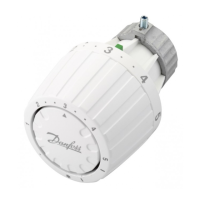
Detailed breakdown of the RA2000 thermostatic sensor's components and operation.
Sizing charts for selecting RA-FN valves based on flow rate and pressure drop.
Sizing charts for selecting RA-G valves based on flow rate and pressure drop.
An example calculation demonstrating how to use capacity charts and formulas for valve selection.
Detailed dimension tables for various RA-FN and RA-G valve body types and connections.
This document describes the Danfoss RA 2000 series of radiator thermostats, including RA-FN and RA-G valve bodies, designed for commercial and industrial heating systems.
The RA 2000 radiator thermostats provide sophisticated proportional control of room temperature. The actuator unit senses the ambient temperature, compares it to the required temperature set by the user, and adjusts the valve setting accordingly. This proportional control ensures smaller temperature swings compared to conventional on/off thermostats, maintaining a more stable room temperature. The system operates based on a bellows and saturated vapor charge, where pressure in the bellows, calibrated to temperature, balances against a regulating spring. A rise in ambient temperature increases vapor pressure, moving the valve cone towards the "closed" position, while a drop in temperature causes the bellows to contract, moving the valve cone towards the "open" position. The vapor charge condenses at the coldest part of the sensor, ensuring the thermostat responds to room temperature changes rather than water temperature. However, to prevent the sensor from registering a higher temperature due to heat from the valve body and pipework, horizontal mounting is recommended for built-in sensors. Remote sensors are available for situations where the built-in sensor might be affected by curtains, surface pipes, or when vertical mounting is necessary due to obstructions. Remote temperature adjusters are ideal for inaccessible valves, mounted at 1.5m above the floor.

 To Next Page
 General