
 Need help?
Do you have a question about the Danfoss VLT 28 and is the answer not in the manual?
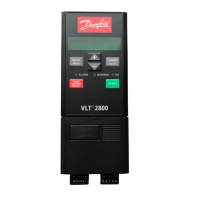
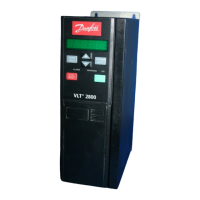
The Danfoss VLT® 2800 Series is an adjustable frequency drive designed for various motor control applications. This device requires careful installation and operation to ensure safety and optimal performance.
The VLT® 2800 Series controls the speed and operation of connected motors by adjusting the frequency of the electrical current. It can manage multiple motors in parallel, provided their combined current consumption does not exceed the drive's maximum rated output current. When operating multiple motors, the drive maintains the ratio between their rated RPM values, even if the motors have different RPM ratings. However, using the electronic thermal relay (ETR) for individual motor protection is not possible in parallel motor systems; separate protection must be provided for each motor.
The drive offers both "Hand" and "Auto" operational modes. In "Auto" mode, the drive receives external references via control terminals (analog or digital signals) or serial communication. In "Hand" mode, the speed can be controlled locally through the keypad. Certain control signals remain active in "Hand" mode, including Hand Start, Off Stop, Auto Start, Reset, Coasting Stop Inverse, Quick Stop Inverse, Stop Inverse, Reversing, DC Braking Inverse, Setup Select LSB/MSB, Thermistor, Precise Stop Inverse/Start, and Jog.
The control panel features a six-digit LED display that continuously shows operating data, supplemented by LEDs for ON, WARNING, and ALARM indications. Parameters can be changed via the control panel, unless the function is locked.
The VLT® 2800 Series requires careful installation. High voltage is present whenever the drive is connected to electrical current, necessitating a 4-minute wait after disconnecting AC power before servicing to allow for electrical discharge. The [STOP/RESET] key on the control panel does not disconnect the equipment from the AC line and should not be used as a safety switch. Proper grounding is essential for user protection against supply voltage and motor overload. Ground leakage currents can exceed 3.5 mA.
For motor overload protection, parameter 128 (Motor thermal protection) should be set to "ETR trip" or "ETR warning." In North America, ETR functions provide Class 20 overload protection according to NEC requirements. Terminal plugs for the motor and AC line supply should not be removed while the drive is connected to the AC line. DC bus terminals are also high voltage inputs that must be disconnected before servicing.
The motor can start via digital commands, bus commands, references, or a local start command whenever power is applied. Servicing should never occur with power applied. The motor may also start while parameters are being changed, so the [STOP/RESET] key should be pressed before modifying data. Unintended starts can also occur due to electronic faults or temporary overloads/faults clearing in the AC line or motor connection.
The drive is air-cooled, requiring a minimum of 4 inches (100 mm) of open space above and below the unit for proper cooling. Ambient and 24-hour average temperatures must not exceed specified limits. If ambient temperatures are between 45°C and 55°C, derating of the drive is necessary. All VLT 2800 units can be installed side-by-side, as they do not require side ventilation. However, with the IP 21 solution, a minimum of 4 inches of air is required on each side, prohibiting side-by-side mounting. In the USA and other countries, a NEMA 1 terminal cover is required if the drive is not installed within another enclosure.
Control wires must be shielded/armored and connected to the drive chassis with a clamp. The shield should also connect to the chassis of the controlling device. For long wires or analog signals, a 100 µF capacitor may be needed between the shield and chassis to prevent 50/60 Hz ground loops.
The drive has a high leakage current and must be properly grounded. Grounding cables should be as short as possible and connected with the greatest possible surface area to ensure low impedance. For multiple drives in a cabinet, the metal backplate should serve as a joint ground reference plate.
A high voltage test can be performed by short-circuiting terminals U, V, W, L1, L2, and L3, and applying a maximum of 2160 V DC for 1 second between this short-circuit and terminal 95.
Only shielded/armored motor and control cables should be used, with the screen connected to ground at both ends. Twisted shield ends (pigtails) should be avoided as they ruin shielding effectiveness at high frequencies. Cable clamps should be used instead. Good electrical contact from the installation plate through the screws to the metal cabinet is crucial. Starwashers and galvanically conductive installation plates should be used. Unshielded/unarmored motor cables should not be used in installation cabinets.
Control cables and serial communication cables must be attached with cable clamps at both ends. Twisted shield ends (pigtails) increase shield impedance at higher frequencies and should be avoided. If ground potential differences exist between the VLT and PLC, an equalizing cable (minimum 6 AWG/16 mm²) placed next to the control cable can resolve electrical noise. For very long control cables, 50/60 Hz ground loops can be resolved by attaching one end of the shield to ground via a 100 nF capacitor.
External fuses must be fitted in the AC line supply for all unit types. Specific fuse types (Bussmann KTN-R or Ferraz Shawmut ATMR for 200-240 Volts, Bussmann KTS-R for 380-480 Volts) are required for UL/cUL applications. Drives with RFI filters cannot be connected to grounded DELTA or IT mains/AC line systems. For 380-460 Volt units with RFI-filters, the voltage between phase and ground must not exceed 300 Volts.
All types of three-phase asynchronous standard motors can be connected to the drive. An LC filter is recommended for motors without phase insulation paper. Motor rotation direction can be changed by switching any two phases at the drive output or motor terminals.
The electronic thermal relay in UL approved variable frequency drives provides UL approval for single motor protection when parameter 128 (Motor thermal protection) is set to "ETR Trip" and parameter 105 (Motor current) is set to the rated motor current.
Voltages up to 850 VDC can occur on brake terminals 81 and 82. The connection cable to the brake resistor must be shielded/armored, with the shield connected to both the drive's ground and the brake resistor using cable clamps.
Load sharing allows connecting several frequency converters' DC intermediate circuits, requiring extra fuses and AC coils. Parameter 400 (Brake function) must be set to "Load sharing [5]." Use 6.3 mm Faston Plugs for DC (Load Sharing).
For lifting/lowering applications, an electromagnetic brake can be controlled via a relay output or digital output (terminal 46). The output must remain closed (voltage-free) when the drive cannot support the motor. Mechanical brake control should be selected in parameter 323 or 341. The brake is released when the output frequency exceeds the brake cut-out value (parameter 138). If the drive is in alarm or overvoltage, the mechanical brake engages immediately.
All control terminals are located underneath the protective plate on the front of the adjustable frequency drive. The plate is removed by sliding it downwards.
To program the drive, first enter motor nameplate data (parameters 102-106) into the Quick menu. The motor must be stopped to change parameter data.
AMT measures stator resistance without the motor turning, optimizing drive adjustment to the motor. It is recommended to perform AMT on a cold motor. Repeated AMT runs can cause motor heating, but this is generally not critical. To perform AMT, access parameter 107 (Automatic motor tuning) in the Quick menu, select "Optimization on (AMT START) [2]," and press [START]. After AMT is complete, press [STOP/RESET] to save motor data.
Warnings or alarms appear as numerical codes (Err. xx) on the LED display. Warnings persist until the fault is corrected, while alarms flash until the [STOP/RESET] key is pressed. For Trip locked faults, the AC line supply must be cut off, the fault corrected, and then the AC line reconnected, followed by pressing [STOP/RESET] to reset the drive.
To manually reset the drive to factory default settings, disconnect AC line voltage. Hold down the [QUICK MENU], [+], and [CHANGE DATA] keys while reconnecting AC line voltage. Release the keys once the drive is powered on.
If the drive operates at temperatures above 45°C, a derating of the rated output current is necessary. The service life of the unit will be reduced without applicable derating if operated in this range.
The drive is designed for specific cable lengths (75m unscreened/unarmored or 25m screened/armored). If a larger cross-section cable is used, the output current should be reduced by 5% for each step increase in cable cross-section to account for increased capacitance and ground leakage current.
The drive automatically adjusts the switching frequency between minimum and maximum values (parameter 411) based on internal temperature, load, ambient temperature, supply voltage, and cable length, preventing thermal overload. When using an LC filter, the minimum switch frequency is 4.5 kHz.
 General
| Frequency | 50/60 Hz |
|---|---|
| Enclosure Rating | IP20 |
| Input Voltage | 200-240 VAC |
| Supply Voltage | 200-240 VAC ±10% (1-phase) |
| Output Voltage | 0 to Input Voltage |
| Communication | RS-485 |
| Protection Features | Overvoltage, Undervoltage, Short Circuit, Ground Fault |
| Operating Temperature | -10°C to +40°C |
| Humidity | Max. 95% RH, non-condensing |
| Storage Temperature | -25°C to +70°C |


 To Next Page