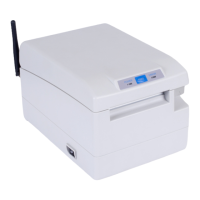
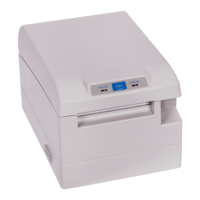
Fiscal Printer DATECS FP-2000 Version 3.10
SPrice Singular price. A floating-point number – decimal places depend on the count set
using command 83 (53h).
Total Accumulated sum for this article.
Sold Accumulated quantity - a floating-point number with 3 decimal places.
Available Available quantity of this article.
Name The name of the item. Up to 36 symbols.
If the item cannot be found, one ‘F’ byte is returned.
- ‘F’ Returning the data on the first found programmed item.
Syntax: <F>[<PLU>]
If the parameter PLU is present, then the first programmed article with number greater than or equal to PLU is
returned. If missing, PLU=1 is assumed. The returned data is similar to the subcommand ‘R’.
- ‘L’ Returning the data on the programmed item with the greatest number.
Syntax: <L>[<PLU>]
If the parameter PLU is present, then the first programmed article with number lower than or equal to PLU is
returned. If missing, PLU=999999999 is assumed. The returned data is similar to the subcommand ‘R’.
- ‘N’ Returning the data on the next found programmed item. Depending of the starting subcommand (‘F’
or ‘L’), the articles are enumerated in ascending or descending order.
Syntax: <N>
The returned data is similar to the subcommand ‘R’.
The last three commands are used to receive a list of programmed items. The subcommand ’F’ or ‘L’ is followed
by ‘N’ until the response ‘F’ comes. This means that the process of reading has ended with the last available item.
- ‘f’ Returning the data on the first sold item.
Syntax: <f>[<PLU>]
If the parameter PLU is present, then the first sold article with number greater than or equal to PLU is returned. If
missing, PLU=1 is assumed. The returned data is similar to the subcommand ‘R’.
- ‘l’ Returning the data on the sold item with the greatest number.
Syntax: <l>[<PLU>]
If the parameter PLU is present, then the first sold article with number lower than or equal to PLU is returned. If
missing, PLU=999999999 is assumed. The returned data is similar to the subcommand ‘R’.
- ‘n’ Returning the data on the next found sold item. Depending of the starting subcommand (‘f’ or ‘l’), the
articles are enumerated in ascending or descending order.
Syntax: <n>
The returned data is similar to the subcommand ‘R’.
The last three commands are used to receive a list of sold items. The subcommand ’f’ or ‘l’ is followed by ‘n’ until
the response ‘F’ comes. This means that the process of reading has ended with the last available item.
- ‘X’ Returning the data on the first free item.
Syntax: <X>[<PLU>]
Returns: PLU
If the parameter PLU is present, then the first free (not programmed) article with number greater than or equal to
PLU is returned. If missing, PLU=1 is assumed.
- ‘x’ Returning the data on the last free item.
Syntax: <x>[<PLU>]
Returns: PLU
If the parameter PLU is present, then the first free (not programmed) article with number lower than or equal to
PLU is returned. If missing, PLU=999999999 is assumed.
6DH (109) PRINTING A DUPLICATE RECEIPT
Data field: <Count>
Response: None
Count Number of duplicate receipts (only a value of 1 or 2 is accepted!).
The command initiates the printing of a copy of the last closed receipt containing registered sales. Immediately
after the tax registration number the inscription “DUPLICATE” is printed out in bold letters.
The printer will refuse to print a second copy of a receipt.


 To Next Page
 Loading...