37
Tempest Operation Manual
Envelopes
A Note About Envelope Shape
Like most synthesizers, Tempest’s envelopes are not linear, but curved. Without
going into too much detail (or math), the curve is based on a logarithmic func
-
tion. But that curve—and, therefore, the envelope’s shape—can be altered with
modulation.
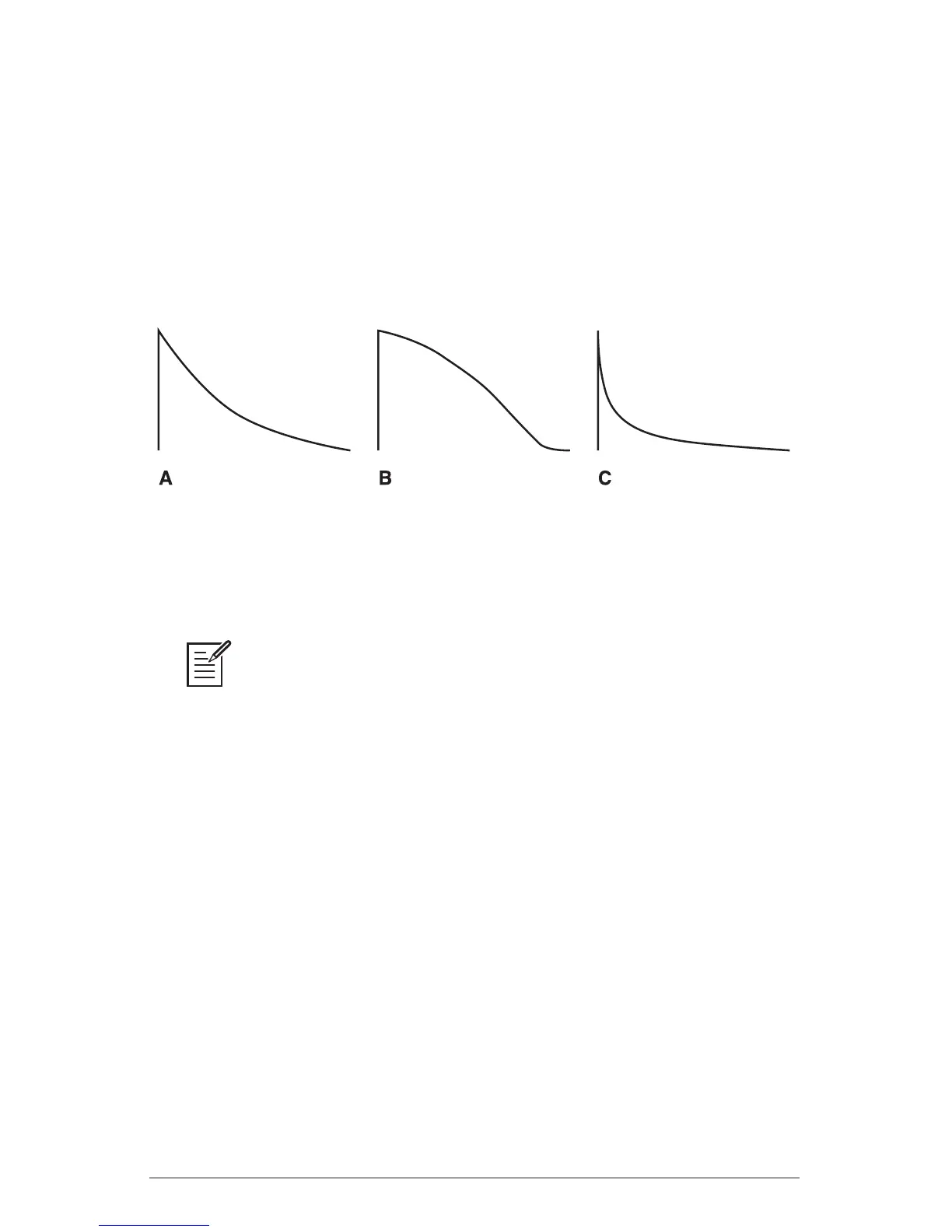
For example, gure A below shows the “normal” decay of a simple AD envelope
where attack is set to 0.
Using one of Tempest’s Mod Paths (see page 40), an envelope can be used to
modulate itself. Figure B shows what happens when the envelope in gure A is
used as the modulation source and the mod destination is that same envelope’s
decay, with a mod amount of -60; gure C is with a mod amount of 60.
Modulating an envelope segment also changes its length (time). In the previ-
ous examples, gure B’s decay time was decreased and gure C’s decay time was
increased.
LFO 1 & 2
Tempest has two low frequency oscillators (LFOs). The LFOs can be free-
running or synced to the beat.
LFO2:
Off, On—
Chooses the LFO to edit. When off, the panel controls affect
LFO 1; when on, LFO 2.
Rate:
0...162—
Sets the LFO frequency. Speed ranges from slow (30 seconds)
to very fast—at 90 (8 Hz, C-2) and above the speed steps in semitones, up to 162
(523 Hz, C4 or an octave above middle C).
Amount:
0...127—
Sets the amount of LFO routed to the destination.



 To Next Page