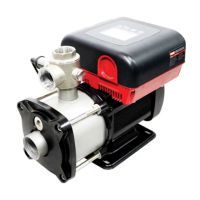
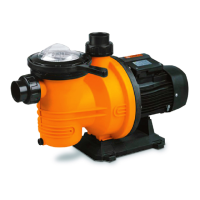
The Dayliff DB/DBH range of horizontal multistage centrifugal pumps are designed for continuous duty in various water transfer applications, particularly for pumping slightly corrosive liquids. These pumps are characterized by their compact physical dimensions, an axial suction port, and a radial discharge, and are designed for base plate mounting.
Function Description
The pumps are primarily used for transferring thin, clean, non-aggressive, and non-explosive liquids. The DB series is suitable for liquids with solid particles, while the DBH series is designed for liquids without solid particles or fibers, and can handle slightly aggressive liquids. The multistage design allows for higher pressure capabilities compared to single-stage pumps, making them suitable for applications requiring significant head. The monoblock design, combining both pump and motor, contributes to quiet and smooth operation.
Important Technical Specifications
Pump Construction:
- DB Series: Suction chamber and pump head are made of grey cast iron. The impeller and impeller housing are constructed from stainless steel.
- DBH Series: Pump body, suction, and discharge ports, as well as all other parts in contact with the pumped liquid, are made from AISI 316 stainless steel, offering enhanced corrosion resistance.
- Mechanical Seal: Made from silicon carbide, designed for easy replacement.
Motor Specifications:
- Type: Totally enclosed, fan-cooled single-phase squirrel-cage motor.
- Protection: Built-in thermal overload protection, suitable for continuous duty.
- Connection: Can be connected to a power outlet fuse or MCB (protection must be provided).
- Enclosure Class:
- DB2/4 & DBH: IP54
- DB 8/12: IP44
- Insulation Class: F
- Voltage:
- Single-phase: 1x220-240V
- Three-phase: 3x380-415V (for DB8-50, DB12-50 models)
- Speed: 2900rpm
Operating Conditions:
- Pumped Liquid:
- DB: Thin, clean, non-aggressive, non-explosive liquids with solid particles.
- DBH: Thin, clean, slightly aggressive, non-explosive liquids without solid particles or fibers.
- Liquid Temperature: 0°C - 110°C
- Max. Ambient Temperature: +40°C
- Max. Suction Lift: According to NPSH curve plus a safety margin of 1 meter.
- Max. Operating Pressure:
- 10 Bar up to 40°C
- 6 Bar up to 90°C
Pump Data (Examples):
- DB 2-30: Power 480W, Current 2.3A, DNB 1", DNA 1", Weight 12kg.
- DB 4-60: Power 1450W, Current 6.2A, DNB 1¼", DNA 1¼", Weight 15kg.
- DB 8-50: Power 1710W, Current 3.4A, DNB 1¼", DNA 1¼", Weight 29kg.
- DB 12-50: Power 2700W, Current 4.8A, DNB 1½", DNA 1½", Weight 27kg.
- DBH 2-40: Power 0.37kW, Current 4A, DNB 1", DNA 1", Weight 10kg.
- DBH 8-30: Power 1.5kW, Current 12A, DNB 1½", DNA 1½", Weight 22kg.
Usage Features
Installation:
- Location: Must be sited in a dry, well-ventilated, and weatherproof location, with an ambient temperature not exceeding 40°C.
- Mounting: Should be located on a solid, flat surface, ensuring the shaft is in a horizontal position.
- Suction Pipe:
- The diameter of the suction pipe must be at least the size of the pump suction inlet.
- If the suction depth exceeds 4 meters, a one-size larger diameter pipe should be used.
- For optimal performance, suction height should be minimized.
- In negative suction scenarios (pump above water level), the suction pipe must be slightly angled upwards towards the pump inlet to prevent air locks.
- The suction pipe must be immersed in water by at least 0.5m to prevent vortex formation, and a good quality foot valve must be fitted.
- All suction pipe connections must be completely airtight for proper pump operation.
- Delivery Pipe:
- The diameter of the delivery pipe should be chosen to suit the required flow rate and pressure, but must not be smaller than the pump outlet size.
- It is advisable to fit a non-return valve and an isolating valve on the delivery outlet.
- This is essential if the delivery pressure exceeds 20 meters.
- Piping Support: Pipes must be fitted using suitable brackets to prevent transmitting stress to the pump body. Care should be taken not to overtighten pipes during fitting to avoid damage.
Electrical Connections:
- Responsibility: The installer is responsible for making electrical connections in compliance with local regulations. A professional electrician must carry out these connections.
- Isolation and Protection: All installations must include an isolator for mains power cutoff and coarse current protection (fuse or MCB rated at 2-3 times the full load current specified on the pump plate).
- Power Supply: Ensure the power supply rating matches the specifications on the pump rating plate.
- Earthing: Electrical connections must follow details in the pump junction box cover, and effective earthing must be provided according to local regulations.
- Motor Protection:
- Single-phase motors have built-in thermal overload protection in the motor windings.
- Three-phase motors require installation with a remote starter.
Priming:
- Requirement: The pump must be primed before operation to prevent serious damage from running dry.
- Procedure: Completely fill the pump housing with clean water through the priming plug before switching it on.
- Re-priming: The pump should be primed whenever it has not been used for a long period or if air has entered the system.
Maintenance Features
Routine Maintenance (Precautions):
- Safety First: Never perform any work on the pump without first disconnecting it from the mains supply.
- Foot Valve: Regularly check that the foot valve is clean and unrestricted.
- Storage: If the pump is to be unused for extended periods, it is advisable to completely empty it, rinse with clean water, and store it in a dry place.
- Shaft Release: If the shaft does not run freely, release it using a screwdriver inserted into the special slot at the rear of the pump shaft. If this is insufficient, remove the pump body by unscrewing the mounting bolts and thoroughly clean it to remove any encrustation.
Troubleshooting Guide:
- Motor Won't Start:
- Possible Cause: No Power. Solution: Check connections and power supply.
- Possible Cause: Impeller stuck. Solution: Refer to the maintenance section for instructions.
- Motor Turns Without Pumping:
- Possible Cause: Delivery head exceeds pump capacity. Solution: Reduce delivery head or specify a different pump.
- Possible Cause: Clogged foot valve. Solution: Clean foot valve.
- Possible Cause: Excessive suction height. Solution: Move pump closer to water level.
- Possible Cause: Air in suction. Solution: Check if suction pipe is airtight, ensure foot valve is immersed by at least 50cm, or prime the pump.
- Flow Rate Insufficient:
- Possible Cause: Suction height at limit. Solution: Reduce suction height.
- Possible Cause: Foot valve partially clogged. Solution: Clean foot valve and, if necessary, the entire intake pipe.
- Possible Cause: Impeller blocked. Solution: Disassemble pump and carefully clean pump body and impeller.
- Tripped Motor Overload:
- Possible Cause: Overheated motor. Solution: Check voltage and ventilation.
- Possible Cause: Impeller stuck. Solution: Release impeller (refer to maintenance section).
Warranty:
- General Liability: Davis & Shirtliff's liability for defects is limited to replacement or repair (at their discretion) of defects arising from faulty design, materials, or workmanship within a specified period. The warranty period begins immediately after delivery to the customer and ceases at its termination. The assessment of the warranty period is based on the date the Company is informed of the failure.
- Exclusions: The warranty applies solely to the equipment supplied and excludes claims for consequential damages, fair wear and tear, careless handling, lack of maintenance, faulty installation, incompetence of the user, Acts of God, or any other cause beyond the Company's control. Any repair or attempted repair by unauthorized parties invalidates all warranties.
- Standard Warranty Terms:
- Up to one year: Item will be replaced or repaired at no charge.
- Over one year, less than two years: Item will be replaced or repaired at 50% of the Davis & Shirtliff market price.
- Process: For equipment supplied or installed by others, the defective unit must be promptly returned free to a Davis & Shirtliff office and collected after repair. Site repair is not included, and any site attendance costs will be payable at standard chargeout rates.
- Proof of Purchase: Proof of purchase, including the invoice, is required for any warranty claim.

 Need help?
 General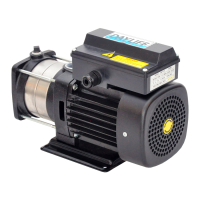

 To Next Page