EasyManua.ls Logo

Daytona DS400SB - User Manual

Daytona DS400SB
12 pages
Print Icon
To Next Page IconTo Next Page
Loading...
Visit our website at: http://www.harborfreight.com
Email our technical support at: productsupport@harborfreight.com
64782
Owners Manual & Safety Instructions
Save This Manual Keep this manual for the safety warnings and precautions, assembly,
operating, inspection, maintenance and cleaning procedures. Write the product’s serial number in the
back of the manual near the assembly diagram (or month and year of purchase if product has no number).
Keep this manual and the receipt in a safe and dry place for future reference. 22i
When unpacking, make sure that the product is intact
and undamaged. If any parts are missing or broken,
please call 1-888-866-5797 as soon as possible.
Copyright
©
2022 by Harbor Freight Tools
®
. All rights reserved.
No portion of this manual or any artwork contained herein may be reproduced in
any shape or form without the express written consent of Harbor Freight Tools.
Diagrams within this manual may not be drawn proportionally. Due to continuing
improvements, actual product may differ slightly from the product described herein.
Tools required for assembly and service may not be included.
Read this material before using this product.
Failure to do so can result in serious injury.
SAVE THIS MANUAL.
Question and Answer IconNeed help?

Do you have a question about the Daytona DS400SB and is the answer not in the manual?

Summary

Owners Manual & Safety Instructions

Initial Safety Warning

Highlights critical safety advice before using the product.

Important Safety Information

General Safety Precautions

Comprehensive list of safety rules and guidelines for operation.

Product Specifications

Set Up Procedures

Bleeding Trapped Air

Procedure to remove air from the hydraulic system for optimal performance.

Operating the Floor Jack

Lifting a Vehicle Safely

Step-by-step instructions for safely lifting a vehicle.

Lowering a Vehicle Safely

Step-by-step instructions for safely lowering a vehicle.

Maintenance and Servicing

Troubleshooting Common Issues

Problem Diagnosis and Solutions

Table detailing common symptoms and their probable solutions.

Overview

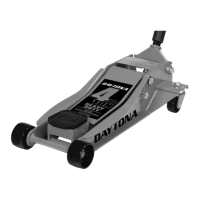
This document is an owner's manual and safety instructions for the Daytona 4-Ton Floor Jack, model DS400SB. It provides comprehensive information on the jack's function, technical specifications, usage, and maintenance.

Function Description

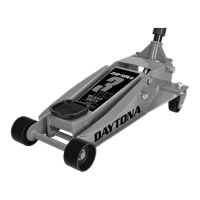
The Daytona 4-Ton Floor Jack is a hydraulic lifting device designed to raise vehicles for maintenance and repair. It features a heavy-duty construction capable of supporting significant loads. The jack operates by pumping a handle, which actuates a hydraulic system to lift a saddle, thereby raising the vehicle. A release valve allows for controlled lowering of the load. The manual emphasizes the importance of using appropriate jack stands to support the vehicle once it is lifted, as the floor jack is not intended to support a load for extended periods or for working underneath.

Important Technical Specifications

  • Weight Capacity: 4 Tons (8,000 lb.)
  • Maximum Height: 20.25 inches
  • Minimum Height: 4.25 inches
  • Handle Length: 49 inches
  • Hydraulic Oil: Non-detergent 22 weight hydraulic jack oil
  • Weight (Jack): 102 lb.

Usage Features

The manual outlines several key usage features and safety precautions:

  • Operation: The jack is operated by inserting the handle into the handle socket. Turning the handle counterclockwise opens the release valve to lower the jack, while turning it clockwise closes the valve for lifting. Pumping the handle raises the saddle.
  • Safety First: Users are instructed to read and understand all safety warnings before operation. Critical safety measures include not exceeding the rated capacity, using the jack only on hard, level surfaces, and immediately supporting the lifted vehicle with appropriate jack stands.
  • Vehicle Preparation: Before lifting, the vehicle must be parked on a flat, level, solid surface, with the engine off, transmission in "PARK" (automatic) or lowest gear (manual), and the emergency brake applied. Tires not being lifted should be chocked.
  • Lifting Points: The jack's saddle must be positioned under the vehicle manufacturer's recommended lifting points. The manual explicitly warns against using any objects (like blocks of wood) between the saddle pad and the lifting point, as this can reduce stability and cause the vehicle to slip.
  • Controlled Lowering: Loads must be lowered slowly by turning the handle counterclockwise (never more than 1/2 full turn).
  • Handle Socket Clip: The handle socket may be held down by a clip under tension for shipping. Users are advised to wear ANSI-approved safety goggles when removing this clip carefully.
  • No Alterations: The product should not be altered, and only manufacturer-supplied attachments/adapters should be used.
  • No Movement Under Load: The vehicle should not be moved or dollied while on the jack, and no work should be performed on, under, or around a load supported only by the jack.

Maintenance Features

Regular maintenance is crucial for the safe and effective operation of the Daytona 4-Ton Floor Jack:
  • Pre-Use Inspection: Before each use, a thorough inspection is required. This includes checking for leaking hydraulic fluid, loose hardware, misalignment or binding of moving parts, cracked, bent, or broken parts, and any other condition that might affect safe operation. Any issues found must be corrected before using the jack.
  • Bleeding Trapped Air: If the jack's motion seems spongy or the saddle does not lift completely, air may be trapped in the hydraulic system. The manual provides detailed steps for bleeding the air, which involves removing the fill plug, opening the release valve, and pumping the handle multiple times.
  • Hydraulic Oil Level Check and Refill: The hydraulic oil level should be checked periodically. If low, non-detergent 22 weight hydraulic jack oil should be added until the oil level reaches the top of the piston inside the cylinder.
  • Hydraulic Oil Change: The hydraulic oil should be changed at least once every three years. This involves draining the old oil, refilling with new oil, and then bleeding the system.
  • Lubrication: Weekly lubrication is recommended. This involves injecting general-purpose lithium grease into the grease fittings and lightly lubricating the linkages and pivot points. Improper or inadequate lubrication voids the warranty.
  • Storage: After use, the jack should be wiped dry with a clean cloth and stored in a safe, dry location out of reach of children and unauthorized people. Storing the jack in a humid area or exposing it to corrosive vapor voids the warranty.
  • Troubleshooting: The manual includes a troubleshooting guide for common issues such as the jack not lifting at capacity, the saddle lowering under load, spongy pump stroke, handle moving up when the jack is under load, and oil leaks. Solutions often involve checking the release valve, bleeding air, checking/filling oil, or flushing valves. Users are warned not to use a damaged or malfunctioning jack and to seek qualified technician assistance if problems persist.

Daytona DS400SB Specifications

General IconGeneral
BrandDaytona
ModelDS400SB
CategoryJacks
LanguageEnglish

Related product manuals