EasyManua.ls Logo

dbx 160X - Page 9

dbx 160X
41 pages
Print Icon
To Next Page IconTo Next Page
To Previous Page IconTo Previous Page
Loading...
OUTPUT
LEVEL
(dB)
Operating
notes
_
Basic
Operation
Using
the
THRESHOLD
control
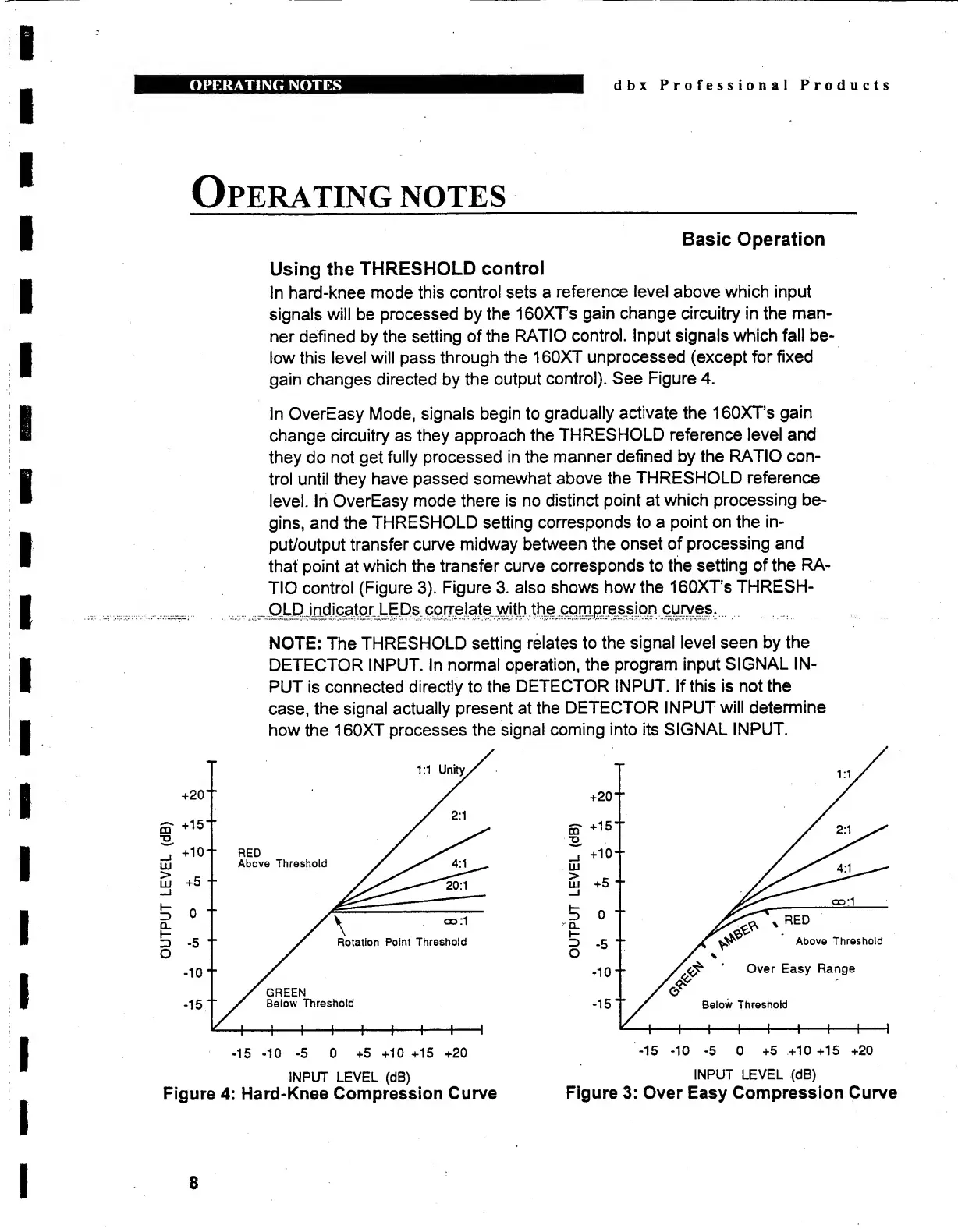
In
hard-knee
mode
this
control
sets
a
reference
level
above
which
input
signals
will
be
processed
by
the
160XT’s
gain
change
circuitry
in
the
man¬
ner
defined
by
the
setting
of
the
RATIO
control.
Input
signals
which
fall
be¬
low
this
level
will
pass
through
the
160XT
unprocessed
(except
for
fixed
gain
changes
directed
by
the
output
control).
See
Figure
4.
In
OverEasy
Mode,
signals
begin
to
gradually
activate
the
160XT’s
gain
change
circuitry
as
they
approach
the
THRESHOLD
reference
level
and
they
do
not
get
fully
processed
in
the
manner
defined
by
the
RATIO
con¬
trol
until
they
have
passed
somewhat
above
the
THRESHOLD
reference
level.
In
OverEasy
mode
there
is
no
distinct
point
at
which
processing
be¬
gins,
and
the
THRESHOLD
setting
corresponds
to
a
point
on
the
in¬
put/output
transfer
curve
midway
between
the
onset
of
processing
and
that
point
at
which
the
transfer
curve
corresponds
to
the
setting
of
the
RA¬
TIO
control
(Figure
3).
Figure
3.
also
shows
how
the
160XT’s
THRESH¬
OL
D
in
d
i
c
ator
LEDs
correlate
with
the
compression
curves.
NOTE:
The
THRESHOLD
setting
relates
to
the
signal
level
seen
by
the
DETECTOR
INPUT.
In
normal
operation,
the
program
input
SIGNAL
IN¬
PUT
is
connected
directly
to
the
DETECTOR
INPUT.
If
this
is
not
the
case,
the
signal
actually
present
at
the
DETECTOR
INPUT
will
determine
how
the
160XT
processes
the
signal
coming
into
its
SIGNAL
INPUT.
-15
-10
-5
0
+5
+10
+15
+20
-15
-10
-5
0
+5
+10
+15
+20
INPUT
LEVEL
(dB)
INPUT
LEVEL
(dB)
Figure
4:
Hard-Knee
Compression
Curve
Figure
3:
Over
Easy
Compression
Curve
8

Other manuals for dbx 160X

Related product manuals