EasyManua.ls Logo

dbx 4BX - Specifications

dbx 4BX
18 pages
Print Icon
To Next Page IconTo Next Page
To Previous Page IconTo Previous Page
Loading...
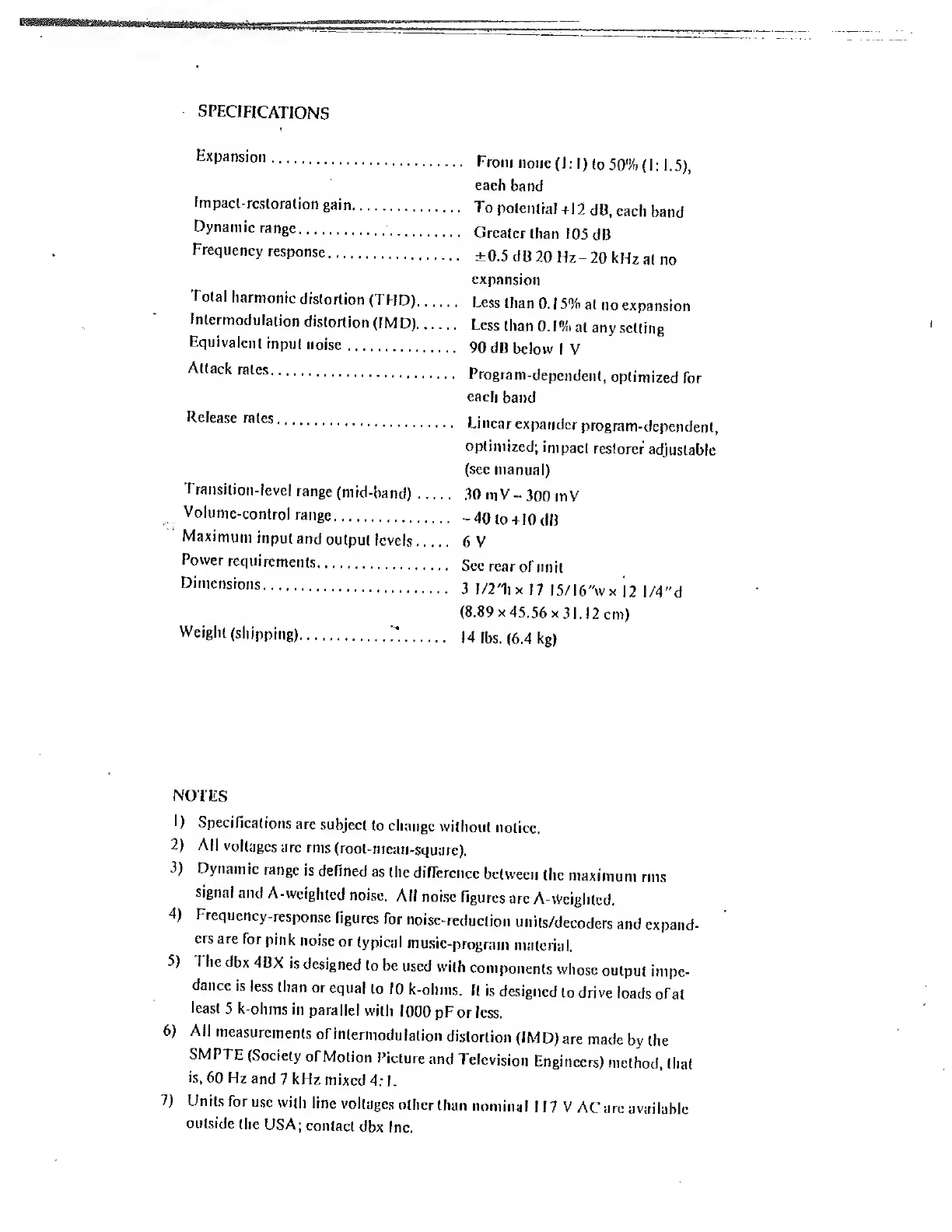
SPECIFICATIONS
Expanslon
From
none
(I:
I)
to
50%
(1
:
1.5),
each
band
Impact-restoration
gain
To
potential
+15
dB,
each
band
Dynamic
range
Greater
than
105
dB
Frequency
response
±0.5
dB
20
Hz
-
20
kHz
al no
expansion
Total
harmonic
distortion
(THD)
Less
than
O.I5%al
no
expansion
Inlermodulalion
distortion
(IMD)
Less
than
0. 1%
at
any
setting
Equivalent
input
noise
90
dB
below
I V
Attack
rales
Program-dependent,
optimized
for
each
band
Release
rales
Lincar
cxpan(
j cr
program-dependent,
optimized;
impact
restorer
adjustable
(see
manual)
Transition-level
range
(mid-band)
30
111V
-
300
m V
Volume-control
range
-40
to
+10
dB
Maximum
input
and
output
levels
6
V
Power
requirements
Sec
rear
of unit
Dimensions
3
]/2 "hx
17
I5/I6"wx
12
l/4"d
(8.89x45.56
x31.12
cm)
Weight
(shipping)
"
14
|
bs .
(6
4
kg)
NOTES
1)
Specifications
are
subject
to change
without
notice.
2)
All
voltages
arc
rms
(root-mcan-squarc).
3)
Dynamic
range
is
defined
as the
difference
between
the
maximum
rms
signal
and
A-weigh(cd
noise.
All
noise
figures
arc
A-Wcightcd.
4)
Frequency-response
figures
for
noise-reduction
units/decoders
and
expand-
ers are
Tor
pink
noise
or
typical
music-program
material.
5)
The
dbx
4BX
is
designed
to be
used
with
components
whose
output
impe-
dance
is
less
than
or
equal
to
1
0 k-ohms.
It is
designed
to drive
loads
or at
least
5
k-ohms in
parallel
with
1000
pF
or
less.
6)
All
measurements
of
intermodulation
distortion
(IMD)
are
made
by the
SMPTE
(Society
of
Motion
Picture
and
Television
Engineers)
method,
that
is,
60Hzand7kHz
mixed
4:
1.
7)
Units
for
use
with
line
voltages
other
than
nominal
1 17 V
AC are
available
outside
the
USA;
contact
dbx
Inc.

Related product manuals