6 CALIBRATION EC-5
6 Calibration
Decagon’s ECH2O Utility and DataTrac3 automatically apply fac-
tory calibrations to the sensor output data. However, this general
calibration may not be applicable for all soil types. For added accu-
racy we encourage our customers to perform soil-specific calibrations.
Which calibration equation you use depends on where you use it.
If you use it with sensors connected to a non-Decagon data logger
you will need to use the calibration appropriate to your excitation
voltage. If you use any Decagon software (DataTrac3, ECH2O Util-
ity, etc.) or the user calibration menu in the ProCheck, you must use
the RAW calibration. The difference between the two is the slope
constant. To increase the resolution of the sensor output, Decagon
uses all available increments of the 12-bit number (value of 4096)
where the measurement is stored. Thus, the output of the sensors
read by the ProCheck and Decagon loggers must be multiplied by
0.61 and the 2,500 mV slope to give the right value.
6.1 Sensor Calibration Values
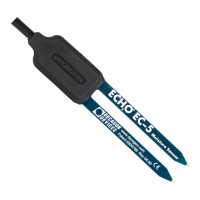
Following is a list of the both the millivolt and RAW calibration val-
ues for the EC-5, where is the VWC, mV is the millivolt output of
the sensor, and where x is the RAW sensor output.
The EC-5 is much less sensitive to variation in texture and elec-
trical conductivity because it runs at a much higher measurement
frequency. Therefore, its general calibration equation should apply
for all mineral soils up to 8 dS/m saturation extract. Its calibration
equations are shown below for mineral soil, potting soil, and rock-
wool growing media.
Dielectric Permittivity
Dielectric permittivity can be used to determine VWC using ex-
ternal published equations such as the Topp equation. Dielectric
14


 To Next Page