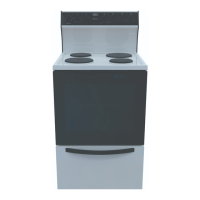
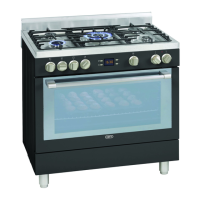
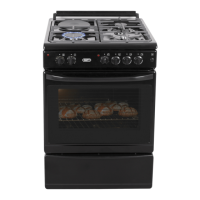
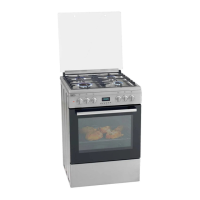
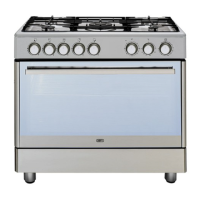
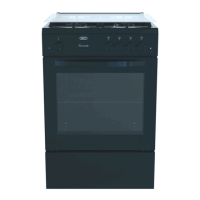
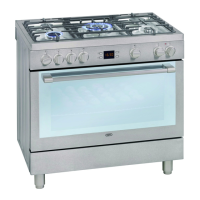
The Kitchenaire Multifunction Vitroceramic Stove DSS 617 is a versatile cooking appliance designed to provide a comprehensive range of cooking functions, from baking and roasting to grilling and hob-top cooking. Manufactured to stringent quality control procedures, this stove aims to offer years of trouble-free use, provided the user adheres to the instructions outlined in its manual.
Function Description
The core of the DSS 617 lies in its multifunction oven and vitroceramic smooth top hob. The oven offers several operating modes, each tailored for specific cooking needs:
- Off (0): This position switches off the oven.
- Operating with Fan (Defrost): In this mode, only the fan operates, without heating. It is ideal for slowly thawing frozen granular food at room temperature and for cooling down cooked food.
- Conventional Bake: Heat is evenly distributed from the top and bottom elements. This mode is recommended for baking on one level only, suitable for cakes, pastries, and casseroles.
- Fan Assisted Cooking: Warm air, heated by the top and bottom heaters, is evenly distributed throughout the oven rapidly by means of the fan. This function is suitable for cooking meals on different shelf levels, particularly for cooking with two shelves simultaneously.
- Thermofan Heating: Warm air, heated by the rear heater, is evenly distributed throughout the oven rapidly by the fan. This mode is suitable for cooking meals on different rack levels, often without the need for preheating. It is particularly effective for cooking with multiple trays.
- Static Bake & Steam Assisted Clean: This mode is recommended for dishes that require further cooking at the center or base, as heat is primarily given off from the bottom element. Only bottom heating is in operation, making it suitable for pizza and browning food. This function also incorporates a steam-assisted cleaning feature.
- Turbo Grill: This grilling mode is less intense than the Full Grill. It is designed for grilling small or medium-sized portions. Users should place food in the correct shelf position under the grill heater and set the desired temperature. Food should be turned after half of the grilling time for even cooking.
- Full Grill: This mode utilizes the large grill at the ceiling of the oven and is suitable for grilling large amounts of meat. Similar to Turbo Grill, food should be placed in the correct rack position under the grill heater, the temperature set to maximum, and food turned after half of the grilling time.
- 3D Function & Steam Assisted Cooking: This advanced mode combines top heating, bottom heating, and Thermofan heating, ensuring food is cooked evenly and quickly all around. It is designed for cooking with one shelf only and also incorporates the steam-assisted cleaning feature.
The vitroceramic smooth top hob features four variable plates, allowing for precise heat control for various cooking tasks. Each plate has a pilot light that indicates operation and a hot surface indicator light that remains on for 20 to 30 minutes after switch-off as a safety reminder.
Usage Features
The DSS 617 is designed for user-friendly operation with several features to enhance the cooking experience:
- Control Panel: The appliance is controlled via a 6-position selector switch for oven functions, an oven thermostat knob for temperature control, and individual plate control knobs for the vitroceramic hob.
- Oven Operation: To operate the electric oven, the user sets the temperature knob to the desired temperature and the function knob to the desired operating mode. The oven heats up to the adjusted temperature, and the temperature lamp stays on during heating. Once the selected temperature is reached, the light switches off, and it cycles on and off to maintain the temperature. After cooking, both knobs must be returned to the "0" position.
- Baking Guide: For optimal baking, it is recommended to use non-sticky coated metal plates, aluminum vessels, or heat-resistant silicone molds. Baking should ideally occur on the middle shelf position, with food placed in the center of the wire shelf towards the oven door. The oven door should not be opened during the first two-thirds of the baking time. The roast pan should not be used for baking.
- Roasting Tips: For whole chicken, turkey, or large meat pieces, dressings like lemon juice and black pepper can enhance cooking performance. Roasting meat with bones takes longer than boneless meat of the same size. A general guideline is 4-5 minutes of cooking time per centimeter of meat thickness, followed by a 10-minute rest in the oven after cooking to allow juices to distribute. Fish should be placed on the middle or lower shelf in a heat-resistant plate.
- Grilling Tips: Grilling quickly browns meat, fish, and poultry, creating a crust and preventing dryness. Flat pieces, skewers, sausages, and high-water-content vegetables like tomatoes and onions are particularly suited for grilling. Food should be distributed on the wire shelf or baking tray, ensuring it does not exceed the size of the grill element. The wire shelf can be used with the roast pan underneath as a drip tray. The grill element should be preheated for about 5 minutes.
- Time Setting: Upon initial energization, the user can set the time of day using the timer and +/- keys.
- Oven Accessories: The stove comes with a chromed oven shelf and a roast pan. Additional shelves, roast pans, and broilers can be purchased from Defy spares.
- Anti-tilt Mechanism: A crucial safety feature, the anti-tilt mechanism, consisting of a stability chain and hook, must be fitted to prevent the stove from tilting if downward pressure is applied to an open oven door.
Maintenance Features
Regular maintenance is essential for the longevity and optimal performance of the DSS 617.
- General Cleaning: Before cleaning any part of the appliance, the electrical power supply must be switched off. Glass panels, cabinet, door, control knobs, trims, and handles should be wiped with a hot soapy cloth and rinsed with a clean cloth. Liquid household cleaners are recommended, while abrasive powders, scouring pads, caustic cleaners, and steam cleaners should be avoided.
- Oven Cleaning: The oven should be allowed to cool down before cleaning. For easier access, the shelf, roast pan, and oven door can be removed. A damp, hot soapy cloth is suitable for cleaning. Burnt soils may require soaking with a liquid cleaner before scrubbing with a nylon brush or scouring sponge. Heavy soils on the oven bottom can be soaked overnight with household ammonia. Metal objects or steel wool should not be used.
- Steam Assisted Cleaning: This feature helps loosen food residue. It involves pouring 100 ml of water into the emboss on the oven floor, selecting the steam-assisted cleaning function, and running the oven for 5 minutes. After a 5-minute waiting period, the inner surfaces can be wiped with a damp sponge or cloth. For persistent dirt, warm water with washing liquid, a soft cloth, or sponge can be used. All food residue and oven accessories must be removed from the cavity before starting steam-assisted cleaning, and all water must be wiped away afterward. This cleaning should be performed on a cold oven.
- Removing the Oven Light: To replace a faulty 25-watt, 300°C rated light bulb, the power must be switched off at the wall isolator. The light cover is unscrewed anti-clockwise, the faulty bulb replaced, and the cover refitted.
- Removing the Oven Door: For improved access during cleaning, the oven door can be removed. This involves opening the door, pushing down clips at the hinge housing on both sides, moving the door to a halfway position, and then pulling it upwards to release it from the hinges. Reinstallation follows the reverse steps, ensuring the clips are closed at the hinge housing.
- Removing the Oven Door Glass: The inner glass can be removed for cleaning by pressing clips on both ends of the top décor, lifting the top décor, and then lifting the glass to a 45-degree position and pulling it out. Harsh abrasive cleaners, sharp metal scrapers, hard metal scrapers, scouring pads, or bleach should not be used on the inner glass as it may damage the easy-clean coating material.
- Vitroceramic Hob Care: The vitroceramic hob requires regular care. Spills should be wiped off as soon as possible with a damp cloth, ideally while the hob is still warm. Cleaning with a nylon pad and a suitable smooth top cleaning solution is recommended. Calcium stains can be removed with lime remover like vinegar or lemon juice. Stubborn spills may require a blade scraper. Metal scourers or coarse abrasive powders should be avoided to prevent scratches. Regular cleaning prevents dirt buildup and maintains the hob's appearance. The hob surround should be wiped with a damp hot soapy cloth and dried. Steam cleaners should not be used on the hob.
- Hob Recommendations: Use pots with a solid, level base and a base diameter slightly larger than the thermal area for even heat distribution and energy efficiency. Always cover pots with a lid to conserve energy and minimize spillage. Switching off the plate 5-10 minutes before the end of cooking can save energy due to residual heat. Rough-edged pots can scratch the hob surface. Sugar solution spills, like jam, must be removed immediately to prevent pitting and damage. Aluminum foil and poor-quality aluminum pots should not cover the vitroceramic surface as they can leave unsightly deposits.


 To Next Page
 General