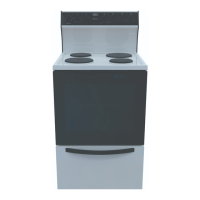
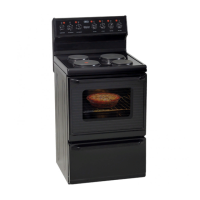
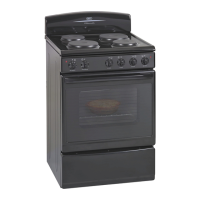
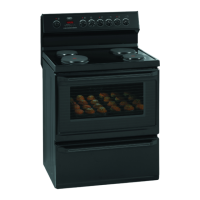
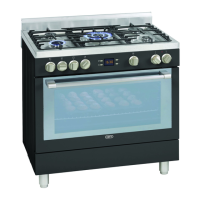
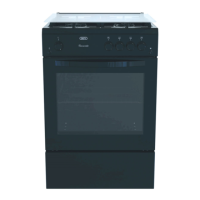
The Defy Kitcheanaire Multifunction Solid Plate Stove DSS 697 is a versatile cooking appliance designed for domestic use, offering a range of functions for baking, roasting, grilling, and hob cooking. It emphasizes safety, efficiency, and ease of maintenance, making it a reliable addition to any kitchen.
Function Description
The stove features a multifunction oven and solid plate hob. The oven provides various cooking modes to cater to different culinary needs. The "Off" mode switches the oven off, while the "Operating with fan (Defrost)" mode activates only the fan, suitable for thawing frozen granular food slowly at room temperature or cooling down cooked food. The "Conventional Bake" mode distributes heat evenly from the top and bottom elements, ideal for baking cakes, pastries, and casseroles on one level. For cooking on multiple shelf levels, the "Fan assisted cooking" mode uses warm air heated by the top and bottom heaters, distributed rapidly by the fan. The "Thermofan heating" mode, with warm air heated by the rear heater and distributed by the fan, is suitable for cooking meals on different rack levels without preheating in most cases, and is excellent for multi-tray cooking. The "Static Bake & Steam Assisted Clean" mode (described further in maintenance) is recommended for dishes requiring further cooking at the center or base, with heat primarily from the bottom element, making it suitable for pizza and browning food.
For grilling, the "Turbo grill" mode is designed for small or medium-sized portions, requiring placement under the grill heater and turning the food after half the grilling time. The "Full grill" mode utilizes the large grill at the ceiling of the oven for grilling larger amounts of meat, with the temperature set to maximum. Finally, the "3D Function & steam assisted cooking" mode combines top heating, bottom heating, and Thermofan heating for even and quick cooking all around, suitable for single-shelf cooking.
The hob consists of solid plates, each with variable heat controls. Users can select the desired heat level by turning the knob, with settings ranging from low (1) to high (6). An indicator light glows when a plate is switched on.
The appliance also includes a warming drawer, controlled by a rotary on/off switch. An indicator light signals when the drawer is in operation. This drawer is designed to keep food warm and can be removed for cleaning.
Usage Features
Operating the electric oven involves setting the temperature knob to the desired temperature and the function knob to the chosen operating mode. The oven heats up to the adjusted temperature, indicated by a temperature lamp that stays on during heating. Once the desired temperature is reached, the light switches off, and it cycles on and off to maintain the temperature during baking. After cooking, both knobs must be returned to the "0" position. The oven thermostat is marked to 70°C, which can be used as a warmer.
For baking, non-sticky coated metal plates, aluminum vessels, or heat-resistant silicone molds are recommended, placed in the middle of the shelf. The embossed shelf runners aid in positioning. It's crucial not to change shelf positions when the oven is hot and to keep the oven door closed. The roast pan should not be used for baking.
Roasting benefits from pre-treating meats with dressings to enhance performance. Roasting meat with bones takes longer than boneless meat. A general guideline is 4 to 5 minutes of cooking time per centimeter of meat thickness, with an additional 10 minutes in the oven after cooking to allow juices to distribute. Fish should be placed on the middle or lower shelf in a heat-resistant plate.
Grilling requires setting the selector switch and oven thermostat to their respective Grill positions. The grill element should be preheated for about 5 minutes. Food should be placed in the center of the shelf, which can be partially withdrawn for placement, and then slid back into position. Monitoring is essential to prevent burning, and the oven door must remain closed during grilling. After grilling, both knobs should be returned to "0".
For cooking vegetables, if a dish becomes too dry, it's advised to cook it in a lidded pan. For vegetables that don't cook properly, boiling them beforehand or using canned vegetables is suggested. Preheating is recommended at the start of cooking until the thermostat lamp switches off.
Baking cakes and pastries has specific tips: for dry cakes, increase temperature by 10°C and decrease cooking time; for wet cakes, use less liquid or lower temperature by 10°C; for dark tops, place on a lower rack, lower temperature, and increase cooking time; for sticky outsides but well-cooked insides, use less liquid, lower temperature, and increase cooking time. For pastries, to prevent dryness, increase temperature by 10°C and decrease cooking time, or dampen dough layers with a milk, oil, egg, and yogurt sauce. Ensure pastry thickness doesn't exceed tray depth. If the top browns but the bottom isn't cooked, distribute sauce evenly between dough layers and top, or place on a lower rack next time.
The solid plates require initial burn-in for about 4 minutes at the highest setting to cure the protective coating. Pots with solid, level bases and diameters slightly larger than the plate are recommended for efficiency and to prevent spillage. Covering pots with lids conserves energy. Cold pots should not be placed on very hot plates to avoid thermal shock.
Maintenance Features
General cleaning of the appliance requires switching off the electrical power supply. Glass panels, cabinet, door, control knobs, trims, and handles should be wiped with a hot soapy cloth. Liquid household cleaners are recommended, avoiding abrasive powders, scouring pads, and caustic cleaners. After cleaning, rinse and wipe with a clean cloth.
For oven cleaning, the electrical power supply must be switched off, and the oven allowed to cool. For improved access, the shelf, roast pan, and oven door can be removed. The oven can be cleaned with a damp, hot soapy cloth, avoiding steam cleaners. Burnt soils may require soaking with a liquid cleaner and scrubbing with a nylon brush or scouring sponge. Heavy soils on the oven bottom can be soaked overnight with household ammonia. Metal objects or steel wool should not be used for cleaning the oven.
The stove features a "Steam assisted cleaning" function. Before starting, all food residue and oven accessories must be removed. 100 ml of water is poured into the emboss on the oven floor, and the steam assisted cleaning function is selected for 5 minutes. After the cycle, wait 5 minutes before opening the door, then wipe inner surfaces with a damp sponge or cloth. Persistent dirt may require warm water with washing liquid. It's crucial to wipe away all water after cleaning to prevent damage and to perform this function on a cold oven. Using this feature as soon as possible after spills helps prevent them from drying and becoming harder to remove.
The oven light is controlled by the oven thermostat. To replace a faulty bulb, the power at the wall isolator must be switched off. The light cover is unscrewed anti-clockwise, the faulty bulb removed, and a new 25-watt bulb rated for 300°C fitted, then the cover refitted.
The oven door can be removed for thorough cleaning. First, open the front door, then push down the clips at the hinge housings on both sides. Move the front door halfway, then pull it upwards to release it from the hinges. Reinstallation is the reverse process, ensuring clips are closed at the hinge housing. The inner glass of the oven door can also be removed for cleaning by pressing clips on both ends of the top décor, lifting the top décor, and then lifting the glass to a 45-degree position and pulling it out. The inner glass is coated with an easy-clean material, so harsh abrasive cleaners, hard metal scrapers, scouring pads, or bleach should be avoided to prevent scratching. The oven door itself can be cleaned with warm water, washing liquid, and a soft cloth or sponge, then wiped dry.
For solid plates, to prevent blotchy discoloration and corrosion, moisture from spatters and spills should be cleaned immediately. Plates can be wiped with a damp cloth or nylon pad using a little liquid detergent, avoiding metal scourers or sharp objects. After cleaning, dry the plates by switching them on briefly. To prevent rust, especially in high humidity or coastal areas, periodically apply sewing machine oil or electrical hotplate polish.
The warming drawer can be removed for cleaning by pulling it out to the bump-stop, lifting the front slightly, and continuing to pull until it slides free. To refit, lift the rear of the drawer over the bump-stop and slide it back. Food in the warming drawer should always be covered to minimize drying.



 To Next Page
 General